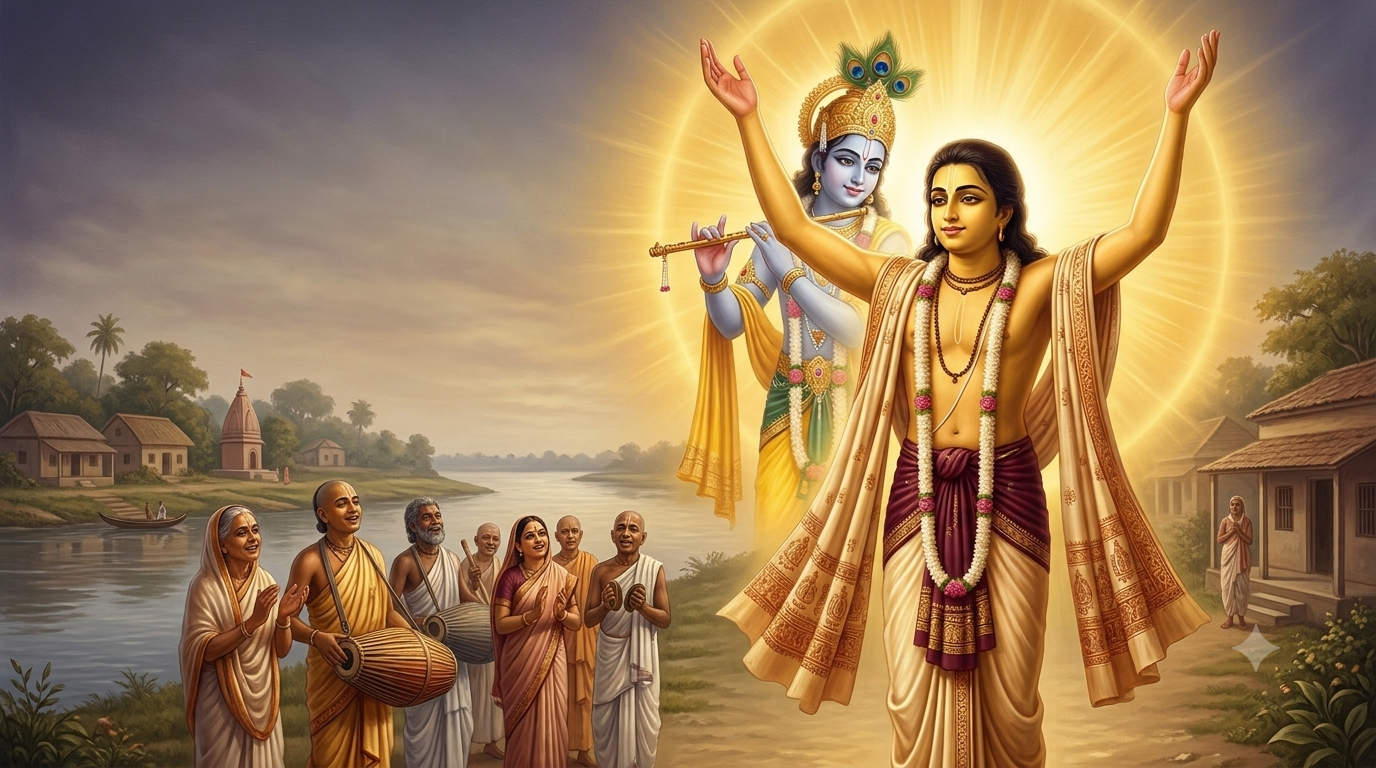
"Who was Chaitanya Mahaprabhu?"
I was once asked this by one of my colleagues, to which I replied, "He is non-different from Lord Sri Krishna Himself."
My colleague responded, "That is what you people say. But what is His real identity?"
It is a fair question. If someone claims that a person is the Supreme Personality of Godhead, should we accept the claim merely because someone says so? Certainly not. We should examine the evidence presented in the revealed scriptures.
The Vedic scriptures describe the identity, characteristics and mission of Sri Chaitanya Mahaprabhu. They explain His golden complexion, His appearance in the age of Kali, His associates and His principal activity: congregational chanting of the holy names of Krishna.
Let us examine some of the most significant scriptural references.
1. The Most Direct Evidence: Krishna Himself Appears in a Golden Form
One of the clearest descriptions of Sri Chaitanya Mahaprabhu appears in Srimad Bhagavatam, spoken by Karabhajana Muni while explaining the forms of the Supreme Lord in the different ages.
krsna-varnam tvisakrsnam
sangopangastra-parsadam
yajnaih sankirtana-prayair
yajanti hi su-medhasah
In the Age of Kali, intelligent persons perform congregational chanting to worship the incarnation of Godhead who constantly sings the names of Krishna. Although His complexion is not blackish, He is Krishna Himself. He is accompanied by His associates, servants, weapons and confidential companions.
Srimad Bhagavatam 11.5.32
Consider the characteristics described in this verse:
- Krishna-varnam: He constantly chants or describes Krishna, and the expression also identifies Him with Krishna.
- Tvisakrsnam: His complexion is not blackish. The verse describes an incarnation whose complexion differs from Krishna's familiar dark complexion.
- Sangopangastra-parsadam: He appears with His associates and companions.
- Sankirtana-prayair yajanti: He is worshipped through congregational chanting.
These characteristics correspond to Sri Chaitanya Mahaprabhu: His golden complexion, His absorption in Krishna's names, His associates and His propagation of sankirtana.
The identification is stated explicitly in Sri Chaitanya-charitamrita, where Srila Krishnadasa Kaviraja Gosvami explains this very verse:
In the Age of Kali, intelligent persons perform congregational chanting to worship the incarnation of Godhead who constantly sings the name of Krishna. Although His complexion is not blackish, He is Krishna Himself.
Sri Chaitanya-charitamrita, Adi-lila 3.52
The conclusion is clear: Sri Chaitanya Mahaprabhu is not merely a saint who taught people to worship Krishna. He is Krishna Himself, appearing in a golden form and demonstrating the path of devotion through His own example.
2. Garga Muni Describes Krishna's Appearance in Different Colours
During Krishna's naming ceremony, Garga Muni explained to Nanda Maharaja that Krishna had appeared in different colours in different ages.
asan varnas trayo hy asya
grhnato 'nuyugam tanuh
suklo raktas tatha pita
idanīm krsnatam gatah
Your son Krishna appears as an incarnation in every millennium. In the past, He assumed three different colours: white, red and yellow, and now He has appeared in a blackish colour.
Srimad Bhagavatam 10.8.13
Garga Muni's statement is significant because it describes the Supreme Lord appearing in different colours in different ages. The yellow or golden complexion is particularly relevant to understanding Sri Chaitanya Mahaprabhu.
Srila Krishnadasa Kaviraja Gosvami discusses this verse in Sri Chaitanya-charitamrita, Adi-lila, Chapter 3, explaining how the Lord's appearance in a golden complexion relates to His advent as Sri Chaitanya Mahaprabhu.
The same Supreme Personality of Godhead can manifest different transcendental forms and complexions. His identity is not limited to one visible appearance.
3. The Chaitanya Upanishad Describes the Golden Lord at Navadvipa
The Chaitanya Upanishad describes the appearance of the Supreme Lord in Navadvipa, on the bank of the Ganges. It identifies Govinda in a golden, two-armed form and describes His mission of spreading devotional service.
jahnavi-tire navadvipe golokakhye dhamni govindo dvibhujo gaurah sarvatma maha-puruso mahatma mahayogi tri-gunatitah sattva-rupo bhaktim loke kasyati
On the bank of the Jahnavi, in Navadvipa, which is known as Goloka, Govinda appears in a two-armed golden form. He is the Supersoul, the Supreme Personality, the great soul and the great mystic, transcendental to the three modes of material nature. He makes devotional service manifest in the world.
Chaitanya Upanishad, Text 5
Notice the identifying characteristics: Govinda, a two-armed golden form, Navadvipa on the bank of the Ganges, and the propagation of bhakti.
These characteristics correspond to Sri Chaitanya Mahaprabhu, who appeared in Navadvipa and dedicated His life to spreading Krishna consciousness through the chanting of the holy names.
The following verse further describes the golden form of the Lord:
eko devah sarva-rupi mahatma
gauro rakta-syamala-sveta-rupah
caitanyatma sa vai caitanya-saktir
bhaktakaro bhaktido bhakti-vedyah
The one Supreme Lord manifests in many forms. The great Lord appears in golden, red, dark and white forms. He is Chaitanya, the embodiment of consciousness and spiritual potency. He assumes the form of a devotee, bestows devotion and is understood through devotional service.
Chaitanya Upanishad, Text 6
This verse describes the Lord as appearing in the form of a devotee and bestowing bhakti. Sri Chaitanya Mahaprabhu did not merely teach devotional service from a distance. He personally demonstrated the life of a devotee, showing the world how to chant Krishna's names and develop love for Krishna.
4. The Chaitanya Upanishad Identifies Him with Krishna
The next verse directly addresses Chaitanya and identifies Him with Krishna and the Supersoul.
namo vedanta-vedyaya
krishnaya paramatmane
sarva-chaitanya-rupaya
chaitanyaya namo namah
I offer repeated obeisances to Chaitanya, who is understood through Vedanta, who is Krishna, the Supersoul, and whose form embodies all consciousness.
Chaitanya Upanishad, Text 7
The verse explicitly uses the name Krishna while offering obeisances to Chaitanya. It does not describe two unrelated personalities. It connects Chaitanya with Krishna and the Supersoul.
The same Upanishad describes the Supreme Person as the source of the universe and declares that knowing Him enables one to transcend death.
Thus, the Chaitanya Upanishad presents Sri Chaitanya as the Supreme Lord who appears in a golden form and makes devotional service available to the world.
5. Why Did Krishna Appear as Sri Chaitanya Mahaprabhu?
If Krishna is the Supreme Lord, why did He appear in the form of a devotee? Why did He chant Krishna's names, dance in ecstasy and teach others to engage in devotional service?
Sri Chaitanya-charitamrita explains that Krishna appeared as Sri Chaitanya Mahaprabhu to experience and distribute the highest expressions of devotional love and to establish the congregational chanting of the holy names.
His external mission was to spread nama-sankirtana throughout the world. His internal purpose included experiencing the love and devotional sentiments of His own devotees.
Srila Krishnadasa Kaviraja Gosvami explains the importance of His appearance in Sri Chaitanya-charitamrita, Adi-lila, Chapter 3. The chapter presents scriptural evidence for His identity as Krishna and explains why the Supreme Lord appeared in the form of a devotee.
Chaitanya Mahaprabhu's behaviour was therefore not evidence that He was merely an ordinary devotee. It was an essential feature of His divine mission: Krishna Himself demonstrated the path of pure devotion by practising it.
6. The Name of Krishna Is at the Centre of His Mission
The identity of Sri Chaitanya Mahaprabhu is inseparable from His principal activity: congregational chanting of the holy names of Krishna.
Srila Krishnadasa Kaviraja Gosvami states:
sankirtana-pravartaka sri-krishna-chaitanya
sankirtana-yajne tanre bhaje sei dhanya
Lord Sri Krishna Chaitanya is the initiator of sankirtana, the congregational chanting of the holy name of the Lord. One who worships Him through sankirtana is fortunate indeed.
Sri Chaitanya-charitamrita, Adi-lila 3.77
Chaitanya Mahaprabhu established sankirtana as the principal spiritual practice for the age of Kali. His teaching was not limited to a particular community, family or social position. He made the chanting of Krishna's holy names the centre of devotional life.
The Hare Krishna maha-mantra is:
Hare Krishna Hare Krishna
Krishna Krishna Hare Hare
Hare Rama Hare Rama
Rama Rama Hare Hare
The Hare Krishna Maha-mantra
By chanting the holy names with faith and attention, a person can begin the process of awakening love for Krishna. This is the practice Sri Chaitanya Mahaprabhu personally demonstrated and propagated.
7. The Scriptures Establish the Identity of Chaitanya Mahaprabhu
We have examined several important scriptural references:
- Srimad Bhagavatam 11.5.32 describes the golden-complexioned incarnation who chants Krishna's names and is worshipped through congregational chanting.
- Srimad Bhagavatam 10.8.13 records Garga Muni's statement that the Supreme Lord appears in different colours in different ages, including yellow.
- Chaitanya Upanishad, Texts 5-7 describes Govinda appearing in a golden, two-armed form at Navadvipa and identifies Chaitanya with Krishna.
- Sri Chaitanya-charitamrita, Adi-lila 3.52 directly explains the Bhagavatam verse as describing Krishna Himself appearing with a non-blackish complexion.
- Sri Chaitanya-charitamrita, Adi-lila 3.77 identifies Sri Krishna Chaitanya as the initiator of congregational chanting.
- Sri Chaitanya-charitamrita, Adi-lila 3.84 states that the Bhagavatam, Mahabharata, Puranas and other revealed scriptures provide evidence for Lord Chaitanya's identity as Krishna.
These references establish a consistent picture. The Lord appears in a golden form, is associated with Navadvipa, chants and teaches the holy names, and is identified with Krishna Himself.
Scriptural conclusions should be based on the actual texts and their context. It is better to present a smaller number of clear, verifiable references than to rely on a long list of quotations whose exact sources cannot be established.
Conclusion: Who Is Chaitanya Mahaprabhu?
Let us return to the question asked by my colleague: "Who was Chaitanya Mahaprabhu? What is His real identity?"
The answer is not based merely on what a particular group happens to believe. The answer is found in the scriptural evidence examined above.
Srimad Bhagavatam describes the golden-complexioned incarnation who chants Krishna's names. The Chaitanya Upanishad describes Govinda appearing in a golden form at Navadvipa and identifies Chaitanya with Krishna. Sri Chaitanya-charitamrita directly explains that the incarnation described in Srimad Bhagavatam 11.5.32 is Sri Krishna Himself, appearing in a golden form and accompanied by His associates.
Sri Chaitanya Mahaprabhu is Sri Krishna Himself, appearing in His golden form as His own devotee to establish and spread the chanting of the holy names.
He came not simply to tell the world about Krishna, but to demonstrate the highest process of devotion through His own life and to make that process accessible through nama-sankirtana.
Therefore, to understand Sri Chaitanya Mahaprabhu, we must take His scriptural identity seriously and understand the mission He personally established: chanting the holy names of Krishna and awakening pure love for Him.
Thank you for reading this article. If you found it helpful, please share it with your friends and loved ones. Your suggestions are welcome as we continue improving this service.
Hare Krishna!


