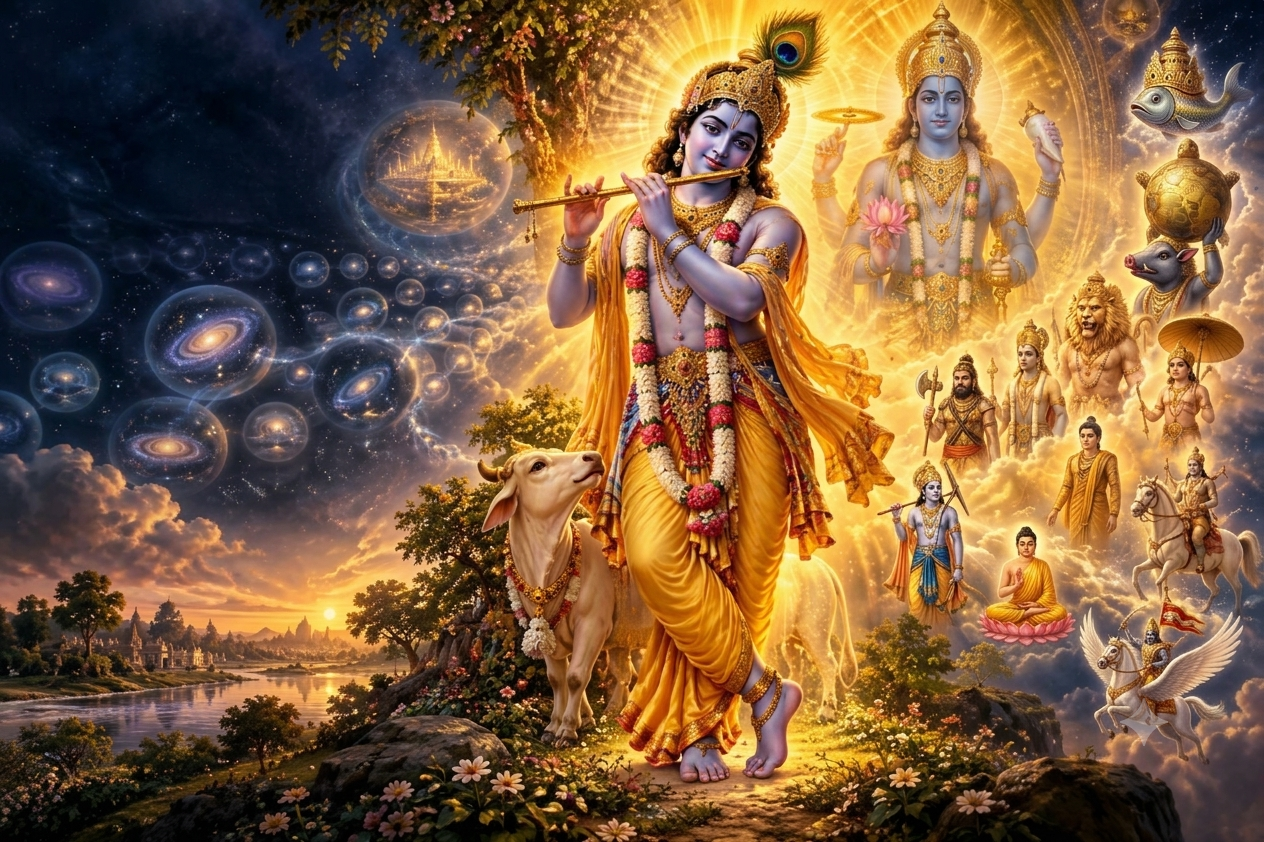
Is Lord Krishna an incarnation of Lord Vishnu, or is Krishna the Original Supreme Personality of Godhead from whom Vishnu and all other incarnations emanate? This question is answered directly in the Vedic scriptures. Rather than relying on sentiment, speculation or popular opinion, let us examine the scriptural evidence.
Many people find it difficult to accept that Krishna is the original source of Vishnu and all other divine incarnations. Yet the Srimad Bhagavatam, Brahma Samhita and other Vedic scriptures repeatedly describe Krishna as the Supreme Lord, the source of all incarnations and the cause of all causes.
Let us examine these statements from the scriptures themselves.
1. Krishna: The Original Supreme Personality of Godhead
The most direct statement appears in Srimad Bhagavatam, where Suta Gosvami concludes his description of the various incarnations of the Lord.
ete camsa-kalah pumsah
krsnas tu bhagavan svayam
indrari-vyakulam lokam
mrdayanti yuge yuge
All of the above-mentioned incarnations are either plenary portions or portions of the plenary portions of the Lord, but Lord Sri Krishna is the original Personality of Godhead. All of them appear on planets whenever there is a disturbance created by the atheists. The Lord incarnates to protect the theists.
Srimad Bhagavatam 1.3.28
The words krsnas tu bhagavan svayam are decisive. Krishna is Bhagavan Himself, the Original Supreme Personality of Godhead. The other incarnations are described as His plenary portions or portions of His plenary portions.
This is not merely a statement that Krishna is one among many incarnations. It establishes Krishna's original position as the source from whom the incarnations emanate.
2. Krishna: The Source of Vishnu
The Brahma Samhita, spoken by Lord Brahma, identifies Govinda, or Krishna, as the Supreme Lord and the cause of all causes.
isvarah paramah krsnah
sac-cid-ananda-vigrahah
anadir adir govindah
sarva-karana-karanam
Krishna, who is known as Govinda, is the Supreme Lord. He has an eternal, blissful, spiritual body. He is the origin of all, but He has no other origin, and He is the prime cause of all causes.
Brahma Samhita 5.1
The verse identifies Krishna as the Supreme Lord, the origin of all and the cause of all causes. Krishna is not dependent on another source for His existence.
The Brahma Samhita further explains the relationship between Krishna and Maha-Vishnu.
yasyaika-nisvasita-kalam athavalambya
jivanti loma-vilaja jagad-anda-nathah
visnur mahan sa iha yasya kala-viseso
govindam adi-purusam tam aham bhajami
The lords of the mundane worlds, the Brahmas and other demigods, appear from the pores of Maha-Vishnu and remain alive for the duration of His one exhalation. I adore the primeval Lord Govinda, of whom Maha-Vishnu is a portion of a plenary portion.
Brahma Samhita 5.48
This verse establishes the sequence clearly: the Brahmas and other lords of the material universes arise through Maha-Vishnu, and Maha-Vishnu Himself is described as an expansion of Govinda.
Therefore, when the question is whether Krishna is merely an incarnation of Vishnu, the Brahma Samhita provides direct evidence that Maha-Vishnu emanates from Govinda, Krishna.
3. Devaki Confirms That Maha-Vishnu Is Krishna's Expansion
In Srimad Bhagavatam, Devaki offers prayers to Krishna after recognizing His supreme position. She directly identifies Maha-Vishnu as an expansion of Krishna.
My dear Krishna, I know that Maha-Vishnu, who is lying in the causal ocean of the cosmic manifestation and who is the source of this whole creation, is simply an expansion of Your plenary portion. Creation, maintenance and annihilation of this cosmic manifestation are being effected only by Your plenary portion. I am therefore taking shelter of You without any reservation.
Srimad Bhagavatam 10.85.31
Devaki's prayer is significant because Maha-Vishnu is described as the source of the cosmic creation, yet He is identified as an expansion of Krishna's plenary portion.
Krishna is therefore not presented here as a subordinate incarnation of Maha-Vishnu. The relationship is the reverse: Maha-Vishnu emanates from Krishna through His plenary expansions.
4. Narayana Is Also Described as Krishna's Expansion
In the prayers of Lord Brahma, Srimad Bhagavatam describes Krishna as the source of Narayana.
O Lord of lords, O Lord Krishna, You are the seer of all creation. You are indeed everyone's dearest life. Are You not, therefore, my father, Narayana? The sacred name Narayana refers to one whose abode is in the water born from Nara. Indeed, that Narayana is also Your plenary portion. All Your plenary portions are transcendental and are not creations of material nature.
Srimad Bhagavatam 10.14.14
Lord Brahma addresses Krishna as Narayana, acknowledging that the name Narayana is also associated with Krishna's plenary expansion. The verse emphasizes that these divine forms are transcendental and never products of material nature.
The names and forms of the Lord are not ordinary material designations. The scriptures reveal the relationship between His original form and His plenary expansions.
5. Krishna Is the Source of Creation, Maintenance and Annihilation
Lord Brahma further explains that Krishna alone expands Himself as Brahma, Vishnu and Shiva for the functions of creation, maintenance and annihilation.
O Lord Krishna, persons who are unaware of Your inconceivable energy cannot understand that You alone expand Yourself as the creator Brahma, maintainer Vishnu and annihilator Shiva. Persons who are unaware of the truth consider Brahma the creator, Vishnu the maintainer and Shiva the annihilator. Actually, You alone are everything: creator, maintainer and annihilator.
Srimad Bhagavatam 10.14.19
This prayer distinguishes the functions performed by the divine expansions from the original source of those expansions. Brahma, Vishnu and Shiva have their respective cosmic functions, but Lord Brahma declares that Krishna is the ultimate source.
Understanding these relationships requires us to hear the statements of scripture carefully rather than assume that the different names and forms of the Lord are unrelated or that their original source must be the same as one of their expansions.
6. Krishna Is the Origin of the Purusha Incarnations
Srimad Bhagavatam also describes Krishna as the source of the Purusha incarnations responsible for the creation of the material universes.
Bhishmadeva, while offering his final prayers, directs his mind, feelings and desires toward Lord Sri Krishna.
Let me now invest my thinking, feeling and willing, which were so long engaged in different subjects and occupational duties, in the all-powerful Lord Sri Krishna. He is always self-satisfied, but sometimes, being the leader of the devotees, He enjoys transcendental pleasure by descending into the material world, although the material world is created from Him alone.
Srimad Bhagavatam 1.9.32
Bhishmadeva glorifies Krishna as the all-powerful Lord from whom the material world is created and who descends into this world to manifest His transcendental pastimes.
The verse reinforces the central conclusion: Krishna's appearance in this world is not an ordinary birth, nor does it make Him a subordinate being. His appearance is a transcendental act of the Supreme Lord.
7. Krishna Is the Source of All Incarnations
The scriptures repeatedly describe the Lord's many incarnations as manifestations of His transcendental potency. Srimad Bhagavatam records the following prayer offered by Narada Muni.
I offer my respectful obeisances to Lord Krishna, the all-knowing Original Personality of Godhead, who, in order to liberate the conditioned souls, accepts the auspicious forms of His many incarnations.
Srimad Bhagavatam 10.87.46
The verse identifies Krishna as the Original Personality of Godhead who accepts various incarnations for the deliverance of conditioned souls.
Another prayer, offered by Nalakuvara and Manigriva, emphasizes the transcendental nature of the Lord's incarnations.
Appearing in bodies like those of an ordinary fish, tortoise and hog, You exhibit activities impossible for such creatures to perform: extraordinary, incomparable, transcendental activities of unlimited power and strength. These bodies of Yours, therefore, are not made of material elements but are incarnations of Your Supreme Personality.
Srimad Bhagavatam 10.10.34
The Lord's incarnations may resemble the forms of living beings found in the material world, but their bodies and activities are transcendental. They are not subject to the limitations of ordinary material bodies.
Krishna's many forms and incarnations manifest His unlimited power. Their variety does not contradict His unity; rather, it reveals the unlimited nature of the Supreme Personality of Godhead.
8. The Candle Analogy: One Original Source, Many Expansions
Brahma Samhita uses the analogy of candles to explain how the Lord manifests in many forms without losing His original position.
The light of one candle being communicated to other candles, although it burns separately in them, is the same in its quality. I adore the primeval Lord Govinda, who exhibits Himself equally in the same manner in His various manifestations.
Brahma Samhita 5.46
When one candle lights another, the second candle possesses the same quality of light, yet the first candle remains the original source in that act of transmission.
Similarly, the Lord's plenary expansions are fully transcendental. Their existence does not diminish the original Personality of Godhead. The analogy helps us understand how Krishna can be the original source while His expansions remain fully divine.
9. Gargacharya Explains Krishna's Many Forms and Names
When Gargacharya performed the naming ceremony for Krishna, he explained to Nanda Maharaja that the child had appeared in different forms and was known by many names.
This son of yours has many names and appears in different forms according to His transcendental qualities and activities. These are known to me, but people in general do not understand them.
Srimad Bhagavatam 10.8.15
This statement points to Krishna's transcendental identity beyond the immediate appearance of a child in the household of Nanda Maharaja. His names and forms correspond to His unlimited qualities and activities.
The verse should be understood alongside the explicit declaration of Srimad Bhagavatam 1.3.28, which identifies Krishna as Bhagavan Himself, the Original Supreme Personality of Godhead.
10. Krishna Appears Without Taking an Ordinary Birth
Lord Brahma also addresses Krishna as the Original Personality of Godhead who appears among different classes of living beings to defeat the pride of demons and show mercy to devotees.
O Original Personality of Godhead, O creator of the entire cosmic manifestation, although You never take birth, You nevertheless appear among the demigods, sages, human beings, animals and aquatics, in order to crush the false pride of the demons and bestow Your mercy upon the saintly devotees.
Srimad Bhagavatam 10.14.20
Krishna's appearance is not an ordinary birth forced upon Him by material nature. He appears by His own transcendental potency, fulfilling His purposes and bestowing mercy upon His devotees.
11. Krishna Personally Manifests as the Various Avatars
Brahma Samhita further describes Govinda as the primeval Lord who manifests Himself as Krishna and as various incarnations, including Rama, Nrisimha and Vamana.
I worship Govinda, the primeval Lord, who manifested Himself personally as Krishna and the different avatars in the world in the forms of Rama, Nrisimha, Vamana and others as His subjective portions.
Brahma Samhita 5.39
The teaching is consistent throughout these scriptural statements. The Lord manifests in numerous transcendental forms and incarnations, yet Govinda, Krishna, remains the original source.
Conclusion: Is Krishna an Avatar of Vishnu?
Let us return to the question with which we began.
Is Krishna an avatar of Vishnu, or is Vishnu an expansion of Krishna?
The cited scriptures provide a direct answer. Srimad Bhagavatam 1.3.28 declares krsnas tu bhagavan svayam, identifying Krishna as the Original Personality of Godhead. Brahma Samhita 5.48 identifies Maha-Vishnu as a portion of a plenary portion of Govinda. In Srimad Bhagavatam 10.85.31, Devaki identifies Maha-Vishnu as an expansion of Krishna's plenary portion. Lord Brahma's prayers in Srimad Bhagavatam 10.14.14 and 10.14.19 further establish Krishna's supreme position.
These are not isolated statements. They form a consistent scriptural explanation of the relationship between Krishna, Vishnu and the other divine manifestations.
Krishna is Bhagavan Himself, the Original Supreme Personality of Godhead. Vishnu and the other incarnations emanate from Him through His transcendental expansions.
We should therefore approach this question through the authority of sastra, not sentiment, speculation or assumptions. The purpose of studying scripture is to understand what it actually teaches, even when its conclusions challenge our existing beliefs.
Thank you for reading this article. If you found it helpful, please share it with your friends and loved ones. Your suggestions are welcome as we continue improving this service.
Hare Krishna!


