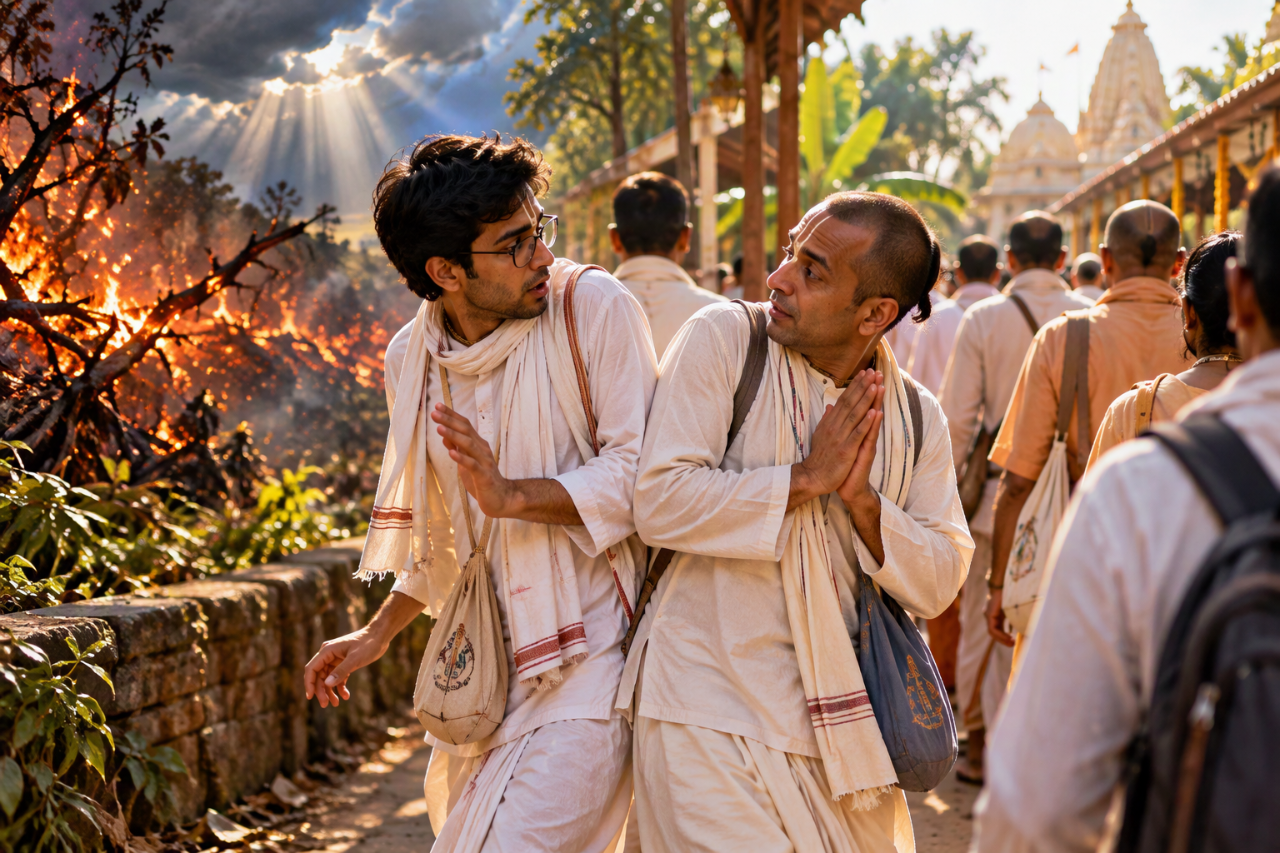
Why do we become so disturbed when someone hurts us unnecessarily? Is it possible to face difficult people and unpleasant situations without allowing them to disturb our inner peace? A reflection from an experience in Ayodhya and an analogy of forest fire helped me look at this question from a different perspective.
A Small Incident That Tested My Patience
During our visit to Ayodhya, I was standing in a queue for the darshan of Ram Lalla. The queue was moving very slowly, sometimes just one step every minute or two.
A young boy standing behind me repeatedly stepped on my feet. Initially, I ignored it. But as it happened again and again, I started getting disturbed.
I began wondering why he was behaving so carelessly. Was he doing it intentionally? Did he not realise that he was stepping on someone's feet? Why could he not maintain a little distance?
I was being careful not to step on the person standing in front of me. So I naturally expected the same consideration from the person behind me.
By the time I completed the darshan, the boy had stepped on my feet 17 times. I had actually counted!
Although the incident was relatively small, it had occupied my mind and disturbed me. I was not upset merely because someone had stepped on my feet. I was disturbed because I felt that someone was behaving carelessly towards me, without considering the discomfort he was causing.
When I Became the One Causing the Problem
After completing the darshan of Ram Lalla, I proceeded for the darshan of Ram Darbar. While climbing the stairs, I was walking behind Srinivas Prabhu.
As I climbed, I accidentally stepped on his feet. I immediately offered my obeisances and apologised. But a few steps later, I stepped on his feet again. Even after reaching the level ground, I managed to do it once more!
I was genuinely trying to be careful. I had absolutely no intention of causing him any discomfort. Yet, despite my intention, I ended up doing exactly what had irritated me so much earlier.
That incident made me reflect. When the boy had stepped on my feet repeatedly, I had become so disturbed, questioning his behaviour and wondering how someone could be so careless. But when I accidentally did the same thing to someone else, I realised that the other person might experience a similar disturbance, even though I had no intention of hurting him.
This brought back an analogy.
Why Does Conflict Arise in This World?
Let us see an analogy of forest fire.
A forest fire can sometimes begin when dry branches rub against one another due to the movement of wind. But the fire does not arise merely because two branches happen to touch. Several conditions contribute to it.
The scorching heat of the sun dries the branches and leaves. Dry leaves accumulate on the forest floor. Wind moves the branches and creates friction. When these different conditions come together, a small spark can develop into a devastating forest fire.
It would therefore be incomplete to blame only one branch for the entire fire. Several contributing factors have created the circumstances in which the fire could occur.
When someone behaves in a way that hurts us, we naturally focus on that person and the immediate incident. We ask ourselves why that person behaved like that and why we had to become the victim of such behaviour.
But perhaps there are deeper factors contributing to the situation.
We are all conditioned souls living in the material world. The influence of Kali, our false ego, selfish interests and the modes of material nature constantly affect our consciousness and behaviour. We are often driven by our own expectations, attachments, insecurities and conditioning.
Just as the branches in a forest may rub against each other because of several surrounding conditions, people in this material world frequently come into conflict because of multiple contributing factors.
This does not mean that everyone is innocent or that every harmful action is accidental. People must take responsibility for their actions. But it does help us understand that friction and conflict are not unusual occurrences in material existence.
Why Are We So Disturbed When Others Hurt Us?
One reason we become deeply disturbed is that we expect people to behave in a certain way.
We expect others to understand our feelings, respect our boundaries, appreciate our efforts and behave reasonably. When they fail to meet these expectations, we feel hurt and disappointed.
Sometimes the incident itself may be small, but our expectations make it much bigger within our minds. We repeatedly revisit what happened, question the other person's intentions and allow the incident to occupy our thoughts long after it has ended.
Of course, being hurt by someone's behaviour is a natural human response. We should not pretend that unpleasant experiences do not affect us. But the question is whether we need to allow every such experience to disturb us so deeply.
We live in a world where people are influenced by different material conditioning, interests and levels of consciousness. Friction is therefore bound to arise.
Perhaps we should not be so surprised when it happens.
Understanding this reality can help us develop a more balanced response. Instead of repeatedly asking why people are not behaving as we expect, we can remind ourselves that we are living in a material environment where such friction is natural.
This understanding does not make wrongdoing acceptable. It simply prevents us from adding unnecessary suffering to an already difficult situation.
Understanding Does Not Mean Accepting Unnecessary Disturbance
There is an important distinction that we must understand here.
Accepting that conflict is a natural feature of material existence does not mean that we should tolerate every form of irresponsible behaviour or allow someone to repeatedly disturb others.
If a person is creating unnecessary chaos, harming others, repeatedly crossing boundaries or damaging the atmosphere of a community, appropriate action must be taken.
We may need to communicate clearly, establish boundaries, seek intervention from responsible persons or take other necessary steps to resolve the situation.
In fact, avoiding necessary action in the name of tolerance can sometimes allow a problem to grow and affect many more people.
The point of this philosophical understanding is not to stop us from addressing problems. It is to help us address them without allowing anger, resentment and repeated mental agitation to consume us.
We can take firm action without becoming consumed by hatred. We can address an injustice without allowing it to destroy our inner peace. We can protect ourselves and others while continuing to work on our own consciousness.
The Forest Fire of Material Existence
This brings us to a deeper understanding of the analogy.
In the material world, the conditions that create friction are always present. The influence of Kali and the modes of material nature constantly affect our consciousness. Our false ego makes us identify with our material expectations and interests. Consequently, even small interactions can sometimes develop into major conflicts.
We may wish for everyone to behave properly, but we cannot control the consciousness or behaviour of everyone around us.
Just as a forest cannot always remain free from the conditions that cause fire, we cannot expect material existence to be completely free from conflict.
But the analogy also points towards a solution.
Dry wood catches fire more easily, whereas wood that retains moisture is less susceptible to ignition. Similarly, when our consciousness becomes dry due to material conditioning, even a small incident can create a major disturbance within us.
But when our hearts are nourished by spiritual knowledge and the mercy of Guru and Krishna, we gradually develop the strength to face difficult circumstances without being consumed by them.
We may not always be able to prevent others from creating friction, but we can work towards becoming less vulnerable to the disturbances caused by that friction.
The Mercy of the Spiritual Master
This understanding reminds me of the beautiful verse from Sri Gurvastakam, which describes the spiritual master's role in delivering the materially afflicted souls from the blazing fire of material existence.
saḿsāra-dāvānala-līḍha-loka- trāṇāya kāruṇya-ghanāghanatvam prāptasya kalyāṇa-guṇārṇavasya vande guroḥ śrī-caraṇāravindam
The spiritual master is receiving benediction from the ocean of mercy. Just as a cloud pours water on a forest fire to extinguish it, so the spiritual master delivers the materially afflicted world by extinguishing the blazing fire of material existence. I offer my respectful obeisances unto the lotus feet of such a spiritual master, who is an ocean of auspicious qualities.
Sri Gurvastakam, Verse 1
The material world is compared to a blazing forest fire, and the spiritual master is compared to a rain-bearing cloud that pours water to extinguish it.
Just as the cloud brings relief to a forest consumed by fire, the spiritual master brings the mercy of Krishna into the lives of conditioned souls and guides them towards spiritual life.
When we receive and sincerely follow the instructions of the spiritual master, our consciousness gradually becomes nourished by Krishna consciousness. We begin to see situations differently. Rather than allowing every unpleasant interaction to provoke us, we learn to respond with greater patience, understanding and spiritual maturity.
This does not mean that we become indifferent to what happens around us. Rather, we learn to distinguish between taking necessary external action and allowing an incident to create an unnecessary fire within our hearts.
Conclusion
I must honestly admit that I am not yet at this level of consciousness.
When someone hurts me unnecessarily, I too become disturbed. I feel disappointed, question the person's behaviour and sometimes find it difficult to move beyond the incident.
But the experience in Ayodhya, together with the analogy of forest fire, has given me a different perspective to reflect upon.
Perhaps instead of being repeatedly surprised and disturbed by the friction that naturally exists in this material world, I should learn to expect it, understand its deeper causes and respond more thoughtfully.
This does not mean that I will stop addressing problems or allow others to create unnecessary disturbances. Necessary action must be taken wherever required. But I would like to learn not to allow every such incident to become a fire within my own heart.
I am also like dry wood, vulnerable to the influence of material nature. I cannot claim to be above these disturbances. I need the mercy of my spiritual master just as much as anyone else.
I pray that I may become more receptive to that mercy, develop a deeper understanding of these teachings and gradually learn to face the unavoidable friction of material existence without being consumed by it.
May I learn to take the necessary steps to address external problems while maintaining peace and steadiness within my own heart.
Thank you for visiting.
If you have liked it, then please share it with your friends and loved ones. Please feel free to suggest how we can further improve our service.
For more Krishna Conscious Articles & Arts, please visit - Our Blog | Site Map
Hare Krishna!


