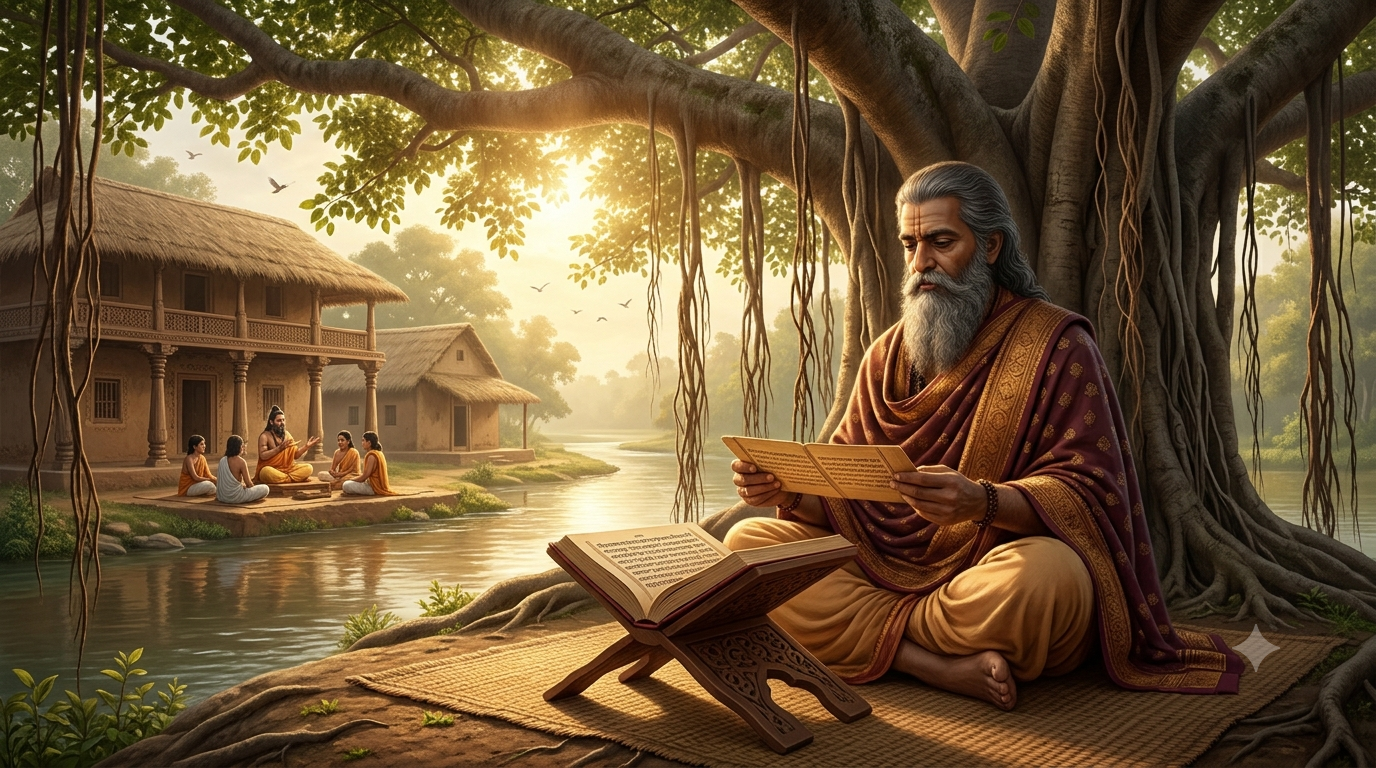
What is Veda or Vedic Knowledge? Who composed the Vedas? When were the Vedas composed? Are they authentic, or are they merely fairy-tale fiction created without any purpose? In today's modern scientific age, how relevant is Vedic Knowledge? Does it have any relevance for me if I am not particularly interested in spirituality? So many questions come to our minds when we hear about the Vedas.
This article is an attempt to explore these questions and understand the extraordinary breadth and depth of Vedic Knowledge.
Q1. Veda: What Does It Mean?
Veda or Ved (in Hindi) means knowledge.
Broadly speaking, knowledge can be understood in two categories: mundane knowledge and transcendental knowledge.
There are two kinds of knowledge: mundane knowledge and transcendental knowledge. Mundane knowledge means how to maintain this body, āhāra-nidrā-bhaya-maithunam, to meet the demands of this body. What are the demands of this body? We require to eat something. Eating, sleeping. We require rest after working hard. After eating sumptuously, we require sleeping. Eating, sleeping, and during sleeping we sometimes dream, fearing, or without dream, fearing. So we take protection. While sleeping, we close our doors. So eating, sleeping, fearing, and mating, sense gratification. So to arrange for these necessities of life of the body, the knowledge that we require, that is called mundane knowledge.
Srila Prabhupada's Lecture on Bhagavad Gita 4.1-6, Los Angeles, January 3, 1969
Our education system mainly teaches us how to use our skills to fulfil the basic bodily needs mentioned above. We study hard so that we can get a job. We want a job that pays us well. We want money to have a comfortable life, which generally means a beautiful home, a luxurious car, delicious cuisine, holidays and tours, getting married, and so on.
Everything ultimately revolves around eating, sleeping, protecting ourselves and enjoying our senses. Even animals seek these necessities of life, although according to their own standards.
While mundane education is required for survival and material progress, we must understand that bodily needs are common to both human beings and animals. A human being who remains occupied only with fulfilling these needs has not made proper use of the special opportunity offered by human life.
Human life is meant for a higher purpose. We need an education system that helps us understand our real identity, our relationship with the Supreme Lord and the purpose of our existence. Such knowledge elevates us beyond the modes of ignorance and passion towards the mode of goodness and, ultimately, transcendental realization.
Thus, basic knowledge teaches us that we must eat. Better knowledge tells us what to eat and what to avoid for maintaining a healthy body. Transcendental knowledge teaches us how to use even these ordinary activities in the service of a higher spiritual purpose.
Transcendental knowledge does not focus on endlessly expanding our material necessities. Instead, it teaches us to regulate them and use this human life to achieve the highest goal.
The most important part of knowledge is transcendental knowledge. 'What I am? Wherefore I have come? What is my constitutional position? Am I this body or I am beyond this body?' These are transcendental knowledge.
Srila Prabhupada's Lecture on Bhagavad Gita 4.1-6, Los Angeles, January 3, 1969
Q2. Veda: What Is It All About?
Vedic Knowledge primarily deals with transcendental knowledge, but its scope is not limited to spiritual subjects alone. It also addresses numerous aspects of material life.
The vast spectrum of Vedic Knowledge includes guidance on maintaining a healthy body and mind, family life, medicine, governance, social organisation, the development of the child in the womb, astronomy, mathematics, music, architecture and many other subjects. Above all, it explains the ultimate purpose of human life: understanding our relationship with the Supreme Lord and returning back to Godhead.
Let us explore a few examples of this remarkable body of knowledge.
Science and Cosmology in the Vedas
Vedic literature presents a remarkably elaborate understanding of time, the universe and cosmic cycles. For example, Srimad Bhagavatam 3.11.1-12 describes units of time beginning with extremely minute divisions associated with atoms and extending to the vast duration of universal creation.
The Vedic and Puranic cosmological descriptions present a universe with multiple planetary systems, immense distances and vast cycles of creation and destruction. These descriptions reveal a conception of the cosmos that extends far beyond the limited experience of ordinary human life.
Texts such as the Surya Siddhanta contain detailed mathematical astronomy, including calculations relating to planetary movements, eclipses and celestial cycles. These works demonstrate the sophistication of traditional Indian astronomical thought.
The Vedic understanding of the universe is not restricted to the planets visible to the naked eye. The Puranas describe numerous planetary systems and higher and lower regions of existence, with the universe extending far beyond what ordinary human senses can perceive.
Another fascinating example is the traditional account of the varieties of living entities. The Padma Purana describes 8.4 million species of life, including 400,000 human forms. This classification considers the varieties of embodied life and their different levels of consciousness.
The Vedic vision of the universe is vast. It encompasses time, matter, living beings, planetary systems and the Supreme Lord, who is the source and controller of all creation.
Medicine and Ayurveda in the Vedas
Ayurveda is one of the great knowledge traditions of ancient India. It presents a comprehensive approach to health, addressing the body, mind, diet, lifestyle and the maintenance of balance in human life.
Classical Ayurvedic literature, including the Charaka Samhita and Sushruta Samhita, discusses the diagnosis of diseases, medicinal preparations, surgery, anatomy, preventive healthcare and various methods of treatment.
Traditional Ayurvedic physicians also developed methods of diagnosis that included examining the pulse, among other clinical observations.
Ayurveda does not view health merely as the absence of disease. It considers the proper functioning of the body, the balance of its constituent elements, the condition of the mind, digestion, lifestyle and the overall well-being of an individual.
Ayurveda continues to be practised in India and many other parts of the world. Its extensive body of traditional knowledge, accumulated through generations of observation and practice, remains an important part of India's intellectual heritage.
Ayurveda demonstrates that the Vedic civilisation gave serious attention not only to the spiritual well-being of human beings but also to their physical health and quality of life.
Music in the Vedic Tradition
Music has a profound place in Indian spiritual and cultural life. The Samaveda, in particular, is closely associated with the musical rendering of Vedic hymns.
The Indian musical tradition subsequently developed an elaborate system of ragas and talas. Different ragas became associated with particular moods, seasons and times of the day. Music was understood not merely as entertainment but also as a means of influencing the mind and cultivating particular states of consciousness.
The richness of Indian classical music, its intricate structures and its deep connection with spiritual and cultural traditions demonstrate the remarkable refinement of this knowledge system.
Politics and Governance in the Vedic Tradition
Vedic literature gives considerable importance to righteous leadership and responsible governance. A king was not expected to rule merely for personal enjoyment or power. He was entrusted with the responsibility of protecting citizens, maintaining justice, ensuring social order and creating conditions in which people could progress materially and spiritually.
The ideal of Varnasrama-dharma describes a comprehensive social and spiritual organisation in which people are engaged according to their qualities and natural inclinations, while progressing through the different stages of spiritual development.
Under this system, a saintly king protects the population, qualified brahmanas guide society through spiritual knowledge, and different sections of society contribute through their respective duties.
When Varnasrama-dharma is properly followed, society functions harmoniously. People are engaged according to their natural qualities and abilities, responsibilities are clearly defined, and material prosperity is directed towards spiritual advancement.
The ultimate purpose of Varnasrama is not merely economic prosperity or social stability. It is to organise human society in such a way that people can gradually advance towards spiritual perfection.
Vedic and Puranic literature also describes extensive geographical knowledge, kingdoms, journeys, trade and exchanges between different regions. These accounts reflect the wide geographical and cultural horizons of ancient Indian civilisation.
Architecture in the Vedic Tradition
Traditional Indian architecture was guided by established principles and scriptural traditions, including the Shilpa Shastras and Vastu Shastra. These texts discuss the construction of temples, images, buildings and other structures, with attention to proportions, measurements, materials and aesthetic principles.
Even today, magnificent examples of traditional Indian architecture can be observed at places such as Kanchipuram and Jagannath Puri.
The temples of India demonstrate extraordinary skill in stone carving, structural design, sculpture and ornamentation. Many of these structures have survived for centuries and continue to inspire admiration for the knowledge and craftsmanship of their builders.
Ancient Indian temples were not merely places of worship. They were centres of art, culture, education, music, architecture and community life. Their construction involved highly skilled artisans, sculptors, architects and craftsmen who worked according to established traditions.
Unfortunately, a considerable part of India's architectural and cultural wealth was destroyed or plundered during successive invasions. Numerous temples were attacked, their deities desecrated, their wealth looted and their structures demolished by Muslim invaders and rulers. During British rule, many valuable Indian artefacts, sculptures, manuscripts and other cultural treasures were also taken away.
Despite these devastating losses, the surviving temples, sculptures and traditional structures continue to bear testimony to the extraordinary artistic and technical abilities of ancient Indian civilisation.
The descriptions of magnificent palaces, elaborate interiors, precious stones, water arrangements and architectural wonders found in the Puranas also reveal the grandeur associated with the royal and divine settings of Vedic literature.
Historical accounts by travellers, including Jean-Baptiste Tavernier, provide additional descriptions of India's extraordinary wealth and its precious stones, including the famous Hope and Koh-i-Noor diamonds.
The architectural heritage of India is a living reminder of a civilisation that combined technical knowledge, artistic excellence and spiritual purpose.
Mathematics in the Vedic and Ancient Indian Tradition
Ancient India made remarkable contributions to the development of mathematics. The Shulba Sutras, which form part of the wider Vedic literature, contain geometrical principles used in the construction of sacrificial altars. These texts demonstrate knowledge of geometrical constructions, including principles related to what is now known as the Pythagorean theorem.
Indian mathematicians also made pioneering contributions to the development of the decimal place-value system and the use of zero. These developments transformed mathematical calculations and eventually influenced mathematical practice across the world.
The Indian mathematical tradition also made significant advances in arithmetic, algebra, geometry, trigonometry and astronomy.
Aryabhata, in his work Aryabhatiya, composed in 499 CE, provided an approximation of pi as 3.1416. Later Indian mathematicians, including Brahmagupta and Bhaskara, made further contributions to arithmetic, algebra, astronomy and mathematical methods.
The development of mathematics in India was not confined to a single text or period. It was a continuous intellectual tradition in which knowledge was preserved, expanded and refined by successive generations of scholars.
The contributions of ancient Indian mathematicians form an important foundation in the history of world mathematics.
Warfare and the Principles of Dharma in the Vedas
Vedic and related scriptural literature discusses warfare not merely as an exercise of military strength but also as an activity governed by principles of dharma.
The Mahabharata, particularly its account of the Kurukshetra war, describes principles of righteous warfare, commonly understood as Dharmayuddha. These principles included the expectation that warriors should fight fairly and avoid attacking opponents who were unarmed, unconscious, surrendering or otherwise unable to defend themselves.
Other principles included avoiding attacks on those who were not participating in combat and generally conducting battles during the prescribed hours of the day.
These principles reveal that the Indian scriptural tradition recognised ethical responsibilities even during warfare. The rules were not merely concerned with victory; they also placed restrictions on how that victory could be pursued.
The Mahabharata describes how the great warriors were expected to observe these principles. It also narrates the serious consequences when the principles of dharma were violated. The killing of Abhimanyu and the events involving Dronacharya and Ashvatthama illustrate the gravity of such violations.
The Mahabharata also describes extraordinary weapons, including celestial weapons invoked through mantras, such as the Brahmastra. These accounts form part of the epic's descriptions of divine and supernatural warfare. They reveal the extraordinary power attributed to mantra and celestial weapons within the Vedic tradition.
The Dhanurveda, traditionally associated with the knowledge of warfare and military training, is another important part of the broader Indian knowledge tradition.
What stands out is that the Indian scriptural tradition did not glorify unrestricted violence. It sought to place even the conduct of warfare within a framework of dharma, discipline and responsibility.
Art and Culture in the Vedic Tradition
The Indian knowledge tradition encompasses a vast range of artistic expressions, including drama, theatre, poetry, sculpture, dance and music.
The Natya Shastra, traditionally attributed to Bharata Muni, is an extensive work on drama, performance, music and aesthetics. Indian classical dance forms, including Bharatanatyam, preserve elaborate systems of movement, expression, rhythm and storytelling.
The sculptures and carvings found in temples across India further demonstrate the refinement of artistic knowledge. These works often communicate philosophical teachings, religious narratives and spiritual symbolism through visual expression.
The vast body of Indian scriptures, epics, Puranas and other traditional texts also reflects an extraordinary literary heritage.
It is said that only a fraction of the vast Vedic literary heritage has survived in its original form. The preservation of this knowledge through generations of teachers, scholars, acharyas and traditional institutions is itself a remarkable achievement.
Plenty of temples, scriptures and libraries were systematically destroyed during the invasions of India. Yet, despite these losses, the surviving literature and monuments continue to reveal the extraordinary depth of Indian civilisation.
Besides these subjects, Vedic literature also discusses economics, psychology, metaphysics, philosophy, social organisation and numerous other areas of knowledge.
Vedic civilisation was not limited to one branch of learning. It developed an extensive and interconnected body of knowledge with the ultimate purpose of understanding the Supreme Lord and the position of the living entity.
Q3. Who Is the Author of the Vedas? Who Composed Them? What Is Their Origin?
By all the Vedas am I to be known; indeed I am the compiler of Vedanta, and I am the knower of the Vedas.
Bhagavad Gita 15.15
So we see that Krishna is the original source and ultimate authority of Vedic Knowledge. Vedic knowledge is eternal and is not the creation of an ordinary human author.
According to the Srimad Bhagavatam, the Supreme Lord imparted transcendental knowledge to Lord Brahma, the first created living entity of this universe. Brahma transmitted this knowledge to Narada, who subsequently instructed Srila Vyasadeva.
Srila Vyasadeva, the literary incarnation of Krishna, compiled and organised the Vedic knowledge for the benefit of humanity. Thus, while Krishna is the ultimate source and Lord of the Vedas, Vyasadeva is recognised as the compiler who organised the Vedic literature.
This process of transmitting knowledge through successive teachers is known as Guru-Shishya-Parampara, literally a chain of teachers and students, one coming after the other.
The humans of previous ages, Satya, Treta and Dvapara, possessed extraordinary capacities of memory. They could retain extensive bodies of knowledge throughout their lives simply by hearing. Hence, knowledge was traditionally passed from one person to another through oral transmission. This is called Sruti, which in Sanskrit means "that which is heard".
Srila Vyasadeva understood the declining capacities of human beings in the age of Kali. The Srimad Bhagavatam describes this condition:
Sukadeva Gosvami said: Then, O King, religion, truthfulness, cleanliness, tolerance, mercy, duration of life, physical strength and memory will all diminish day by day because of the powerful influence of the Age of Kali.
Srimad Bhagavatam 12.2.1
Therefore, for the benefit of the people of Kali-yuga, Vyasadeva systematically organised the Vedic knowledge into four divisions: the Rigveda, Yajurveda, Samaveda and Atharvaveda. He also composed or compiled other important works, including the Mahabharata and the Puranas, so that the essential spiritual teachings would remain accessible to humanity.
The Vedic understanding is that knowledge does not originate from the limited intelligence of human beings. It descends from the Supreme Lord and is preserved through an authorised chain of spiritual teachers.
Q4. How Old Are the Vedas?
Many historians and scholars attempt to assign dates to the Vedic texts based on linguistic, textual and historical studies. However, according to the Vedic scriptures, Vedic knowledge is eternal. It is not something that originated at a particular point in human history.
In Srimad Bhagavad Gita, Krishna gives an indication of the antiquity of this knowledge when He says:
I instructed this imperishable science of yoga to the sun-god, Vivasvan, and Vivasvan instructed it to Manu, the father of mankind, and Manu, in turn, instructed it to Iksvaku.
Bhagavad Gita 4.1
His Divine Grace A.C. Bhaktivedanta Swami Prabhupada explains:
At the present moment we have just passed through five thousand years of the Kali-yuga, which lasts 432,000 years. Before this, there was Dvapara-yuga (800,000 years), and before that, there was Treta-yuga (1,200,000 years). Thus, some 2,005,000 years ago, Manu spoke the Bhagavad-gita to his disciple and son Maharaja Iksvaku, the king of this planet earth. The age of the current Manu is calculated to last some 305,300,000 years, of which 120,400,000 have passed. Accepting that before the birth of Manu the Gita was spoken by the Lord to His disciple the sun-god Vivasvan, a rough estimate is that the Gita was spoken at least 120,400,000 years ago; and in human society, it has been extant for two million years.
Srimad Bhagavad Gita 4.1 Purport
Thus, according to the Vedic understanding, the knowledge of Bhagavad Gita and the Vedic scriptures is far older than the historical periods generally considered in modern academic discussions.
The Vedic scriptures describe knowledge that is eternal and repeatedly transmitted through the cycles of creation. The Lord Himself is its original source, and the disciplic succession preserves it for the benefit of humanity.
Q5. What Scriptural Texts Does Vedic Knowledge Comprise Of?
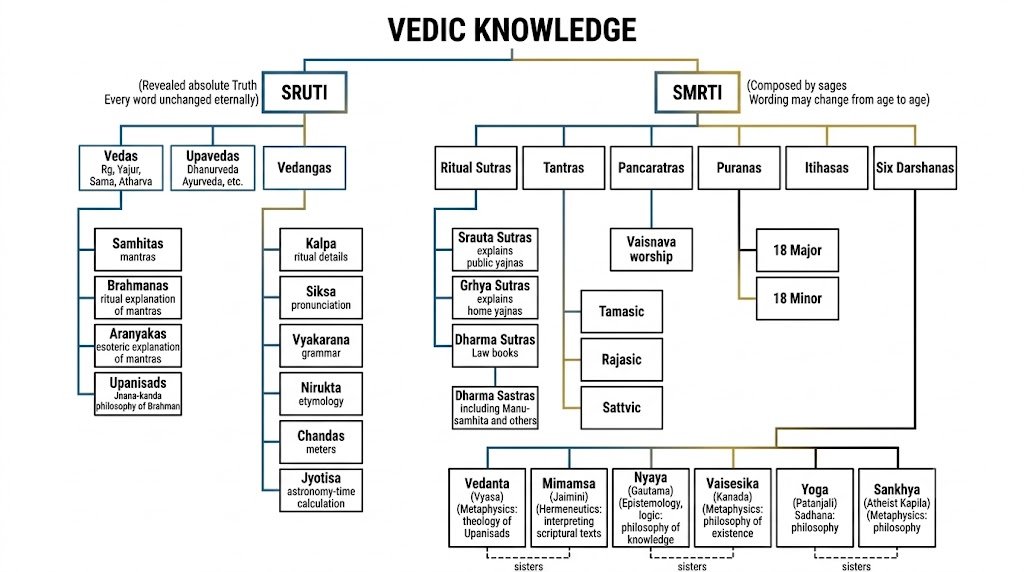
Image caption: Incredible Veda, PadaSeva.in: The vast branches of Vedic Knowledge.
Contrary to the common understanding that Vedic Knowledge consists only of the four Vedas, the complete body of Vedic literature is much more extensive. It comprises numerous scriptures, each serving a particular purpose and addressing different aspects of knowledge.
The four Vedas form the foundation. The Upanishads, Vedanta-sutra, Itihasas and Puranas further elaborate on Vedic teachings. The Mahabharata, which includes the Bhagavad Gita, presents profound spiritual and moral teachings through historical narratives.
There are also numerous supplementary texts dealing with subjects such as grammar, astronomy, mathematics, medicine, architecture, music and other branches of knowledge.
Vedic Knowledge is therefore not confined to a single book or a narrow collection of teachings. It is an extensive knowledge tradition with spiritual realisation at its centre.
Q6. How Are the Vedas a Manual of Life?
In our day-to-day life, we have experience of buying so many appliances, gadgets etc. One thing is in common with all these appliances: a document called the User Manual or User Guide. Though at times, we tend to ignore it, the User Manual has its own importance. A User Manual, prepared by the manufacturers, provides important information on how to use a product to end-users. With proper use of a device, there is much less risk of bringing the device out of order unintentionally and it also reduces the risk of running into accidents.
If these small, insignificant man-made devices come with a manual or a guide, how come the magnificent devices, like our body, the micro-world (the molecular, atomic and subatomic structures), and the macro-world (like the superbly harmonious planetary system, both in and beyond our Solar System), come without any user manual?
Just like manufacturing companies provide these manuals or guides, the Manufacturer of the gigantic and microscopic systems, which we tend to take for granted, also provides a User Manual. These manuals guide us in every aspect of life: social, political, religious, economic, military, mechanical, chemical, physical, metaphysical, medical and other subjects, and above all, provide specific directions for spiritual realization.
These manuals are known as Scriptures. Just like our day-to-day life, we tend to ignore these manuals and, at times, if not often, risk putting ourselves into unpleasant situations or accidents.
The Vedic scriptures are not merely books of religious rituals. They provide guidance on how to live, how to organise society, how to understand the material world, how to fulfil our responsibilities and, most importantly, how to understand our eternal identity and relationship with the Supreme Lord.
Just as a user manual helps us understand the proper use of a device, the Vedic scriptures guide human beings in the proper use of this precious human life.
Conclusion
The purpose of this article was to highlight that Vedic Knowledge is not fairy-tale, imaginary, or mythological. It is an authentic and profound body of knowledge presented for mankind to lead their lives in a God-conscious way.
The Vedas do not merely address the temporary needs of the body or the practical challenges of material existence. They also reveal the eternal nature of the soul, the Supreme Personality of Godhead and the ultimate purpose of human life.
From medicine and mathematics to astronomy, architecture, governance, music and the arts, the wider Vedic tradition presents an extraordinary range of knowledge. Yet all these subjects ultimately find their highest purpose in spiritual realisation.
Human life is not meant merely for acquiring information, accumulating wealth or satisfying the senses. It is a precious opportunity to understand our eternal identity and revive our relationship with the Supreme Lord.
The Vedic scriptures provide this direction. The real benefit comes when we do not merely admire their vastness, but sincerely study their teachings and apply them in our lives.
Thank you for visiting.
If you have liked it, then please share it with your friends and loved ones. Please feel free to suggest how we can further improve our service.
For more Krishna Conscious Articles & Arts, please visit - Our Blog | Site Map
Hare Krishna!


This article serves as a poignant reminder that Vedic Knowledge is not merely a collection of fanciful tales or mythical stories, but rather a profound and authentic body of wisdom that offers invaluable guidance for navigating life with a sense of divine consciousness. By shedding light on the real essence of Vedic Knowledge, it emphasizes its relevance and significance in today’s world, urging readers to delve deeper into its teachings and apply them in their daily lives for spiritual growth and enlightenment.