The contents of this article have been compiled from books, scriptures and lectures by acharyas.
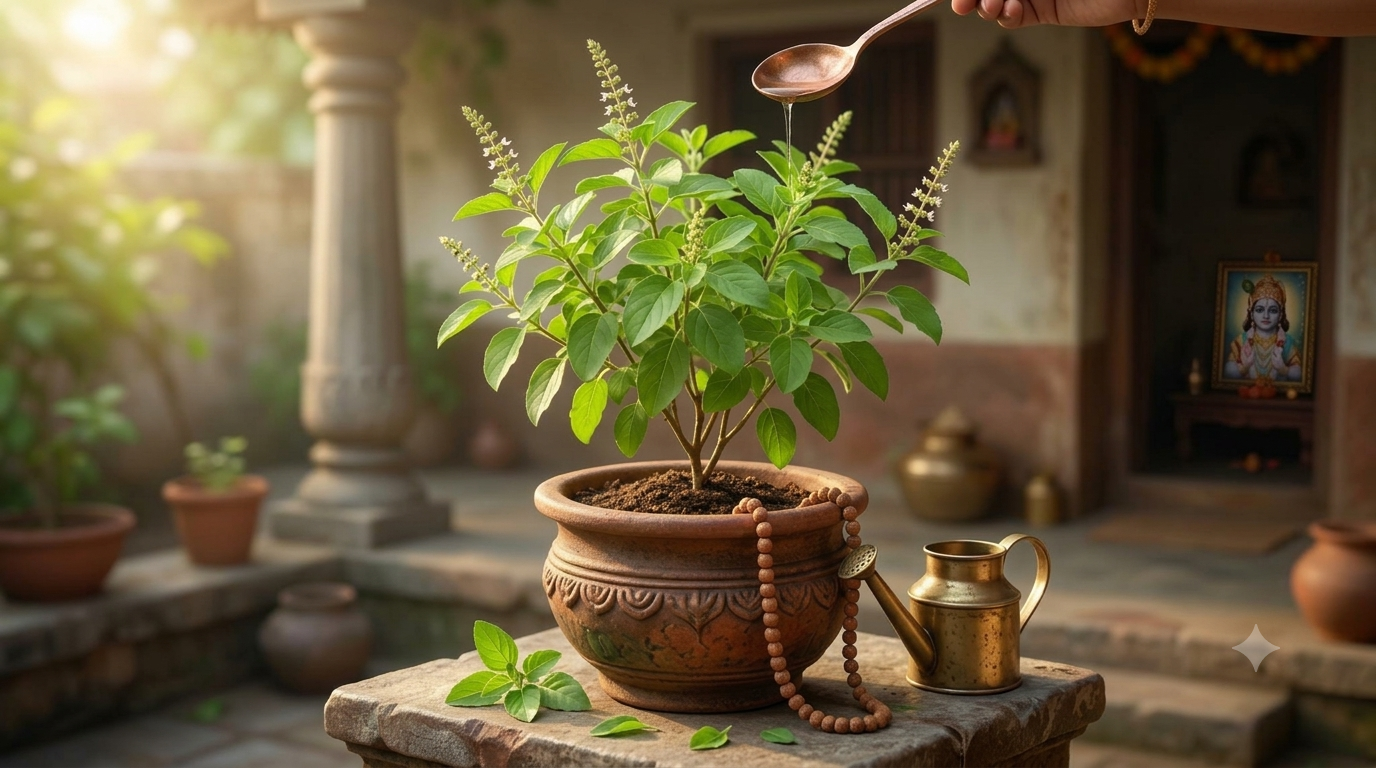
Tulasi, the sacred holy basil, is very dear to Lord Krishna and holds a special place in Hindu tradition. In ancient times, Tulasi plants were commonly found in the courtyards of Hindu homes. Even today, many households maintain a Tulasi plant, offer obeisances to her and water her every morning. Devotees of Lord Vishnu and Sri Krishna hold Tulasi in the highest regard. Let us explore why she is so special and considered so auspicious.
Who Is Tulasi?
Tulasi is Vrinda Sakhi, a gopi from the spiritual abode of Lord Sri Krishna, Goloka Vrindavan. She appears in this world as Tulasi and exists in various spiritual realms, from Bhuloka, the earthly plane, to Vaikuntha, the abode of Lord Vishnu.
The name Tulasi means one who is unequalled, or one for whom there is no equal. She is known by many other names that describe her transcendental qualities, including Vishva Pavani, Vishva Pujita, Krishna Jivani and Nandini. Reverentially addressed as Tulasi Maharani, she is none other than Vrinda Devi.
Srimati Radharani, the Queen of Vrindavan, known as Vrindavaneshwari, empowers Vrinda Devi to maintain and oversee the divine realm of Vrindavan. Vrinda Devi expertly manages the affairs of the Vrindavan forest as her seva to the Divine Couple, arranging everything to give Them pleasure.
Although Lord Krishna spent His childhood in Vrindavan and performed sweet, enchanting pastimes with Srimati Radharani in its forest groves, this sacred abode is known not by the names of Radha or Krishna, but as Sri Vrindavan Dham, in connection with Vrinda Devi.
Vrinda Devi is the Yogamaya potency, or shakti, who coordinates the loving pastimes of Radha and Krishna in Vrindavan. In Vrindavan, Yogamaya appears as Purnamasi, the mother of Sandipani Muni, Krishna's guru, and the grandmother of Madhumangal, Krishna's cowherd friend.
Purnamasi arranges Radha-Krishna's pastimes in the moods of neutrality, servitude, friendship and parental affection (shanta, dasya, sakhya and vatsalya bhava). However, being elderly, she does not personally coordinate the conjugal pastimes in madhurya bhava. For this purpose, she expands into a younger form as Vrinda Devi, who orchestrates the captivating loving pastimes of Radha and Krishna.
Vrinda Devi prepares elaborate arrangements for these pastimes. She creates the perfect settings with wonderful seasonal changes, waterfalls, fresh flowers and enchanting fragrances. She also coordinates the movements of birds, bees, peacocks, deer and other creatures. She manages communications and directions with extraordinary skill, facilitating transcendental pastimes for the pleasure of the Divine Couple.
She possesses the extraordinary potency known as aghatana-ghatana-patiyasi shakti, the ability to make the impossible possible.
Scriptures Glorify Tulasi
The Tulasi plant is deeply respected and held in high esteem by devotees of Lord Krishna and Lord Vishnu. Since Tulasi is a great devotee of Krishna, she bestows her mercy upon those who seek her shelter and serve her with devotion. By her mercy, we can aspire to attain the service of Radha and Krishna.
Vaishnava scriptures glorify her through various prayers, including the Tulasi Pranam Mantra, Tulasi Arati, Tulasi Pradakshina Mantra and Vrinda Devi Ashtakam.
- Through these prayers, we seek her shelter and pray for residence in Vrindavan, in the forest groves where we may behold the beautiful pastimes of Radha and Krishna.
mora ei abhilasha vilasa kunje dio vasa,
nayana heribo sada yugala-rupa-rasi
My desire is to reside in the pleasure groves and always behold the beautiful forms of the Divine Couple.
Tulasi Arati, Verse 3
- We pray for her mercy so that we may assist the sakhis in their service to Radha and Krishna.
ei nivedana dhoro sakhi anugata koro,
seva adhikara diye koro nije dasi
We pray to be accepted as followers of the sakhis and to be granted the qualification to serve as their maidservants.
Tulasi Arati, Verse 4
- By circumambulating Tulasi, sins accumulated over many lifetimes are destroyed.
yani kani cha papani
brahma-hatyadikani cha
tani tani pranashyanti
pradakshinaha pade pade
All kinds of sins, including even the gravest offences, are destroyed with every step taken while circumambulating Tulasi.
Tulasi Pradakshina Mantra
Our Acharyas Recommend Worship of Tulasi
Our scriptures describe several instances in which worship of Tulasi is recommended as a means of purification and spiritual advancement.
Advaita Acharya
Advaita Acharya, an incarnation of Sadashiva and Mahavishnu, was deeply troubled by the fallen, atheistic mentality of people in Kali-yuga. Out of great compassion, he invoked the appearance of Lord Krishna. He worshipped the Shaligram Shila with Tulasi leaves and Ganga water. His sincere prayers contributed to the descent of Lord Chaitanya Mahaprabhu.
To propagate the worship of Sri Krishna, Advaita Acharya spoke the following verse:
tulasī-dala-mātreṇa jalasya culukena vā
vikrīṇīte svam ātmānaṁ bhaktebhyo bhakta-vatsalaḥ
Translation by Srila Prabhupada: "Sri Krishna, who is very affectionate toward His devotees, sells Himself to a devotee who offers Him merely a tulasi leaf and a palmful of water."
Gautamiya Tantra, quoted in Sri Chaitanya-charitamrita, Adi-lila 3.104
Mrigari, the Hunter
Mrigari was a cruel hunter who enjoyed killing animals and leaving them half-dead. One day, he encountered the celestial sage Narada Muni, who sought to reform him and transform his heart. Narada Muni instructed him to chant the holy name of Hari and worship Tulasi. By following these instructions, Mrigari gradually underwent a profound transformation.
Madhai, the Former Dacoit
In Navadvipa, Madhai was a dacoit who had committed many sinful acts and had even struck and injured Lord Nityananda. Later, after receiving Lord Nityananda's mercy, Madhai surrendered and asked how he could purify himself. Lord Nityananda advised him to chant the holy name constantly and worship Tulasi.
Namacharya Haridasa Thakura
Namacharya Haridasa Thakura also recommended Tulasi worship. When a prostitute named Lakshahira approached him with the intention of distracting him and damaging his reputation, he remained unaffected by her advances. Instead, she herself became transformed and developed devotion.
Later, she repented and asked Haridasa Thakura how she could overcome her sinful tendencies. He instructed her to chant the holy name and take shelter of Tulasi.
nirantara nāma lao, kara tulasī sevana
acirāt pābe tabe kṛṣṇera caraṇa
Translation by Srila Prabhupada: "Chant the Hare Krishna mantra continuously and render service to the tulasi plant by watering her and offering prayers to her. In this way you will very soon get the opportunity to be sheltered at the lotus feet of Krishna."
Sri Chaitanya-charitamrita, Antya-lila 3.137
Srila Raghunatha Dasa Goswami
When Chaitanya Mahaprabhu gave Srila Raghunatha Dasa Goswami the Govardhana Shila, He instructed him to worship the shila with eight Tulasi manjaris, two placed on each side.
These examples illustrate how worshipping Tulasi and taking shelter of her can bring spiritual auspiciousness.
Importance of Tulasi
Tulasi is very dear to Lord Krishna and is therefore deeply cherished by His devotees. For Vaishnavas, she is practically indispensable. Whether in applying tilaka, offering bhoga or performing Deity worship, Tulasi has an essential place in devotional practice.
Tilaka
Tilaka is an auspicious mark made with gopi-chandana on a devotee's forehead. It reminds the devotee of being an eternal servant of Lord Vishnu. It consists of two vertical lines and a leaf-like mark at the base. The two lines represent Krishna's lotus feet, while the leaf represents Tulasi. Applying tilaka is considered auspicious and is understood to provide spiritual protection.
Japa Mala
Vaishnavas chant the Hare Krishna maha-mantra on japa malas traditionally made from Tulasi wood and consisting of 108 beads. Chanting on Tulasi beads is pleasing to Krishna and is considered conducive to purifying the practitioner's mind and attracting His mercy.
Devotees also chant their prescribed rounds before Tulasi Maharani, seeking her blessings and assistance in remaining attentive and focused during japa.
Vaishnava kanthi malas are also made from Tulasi wood. Wearing one reminds the devotee of surrender to Krishna and is traditionally associated with spiritual protection.
Bhoga Offering
When food is offered to the Lord, Tulasi leaves are traditionally placed on the preparations offered to Him. Devotees offer Tulasi with devotion, recognizing her special place in Krishna's worship and His affection for her.
Worshipping the Lord
During Deity worship, Tulasi leaves are offered at the lotus feet of the Lord. In Vaishnava practice, Tulasi is offered to Vishnu-tattva Deities, not indiscriminately to all forms of the Divine.
On Ekadashi, also known as Madhava-tithi, devotees may offer Tulasi manjaris to Krishna, which are especially dear to Him. Tulasi leaves can also be used to prepare garlands. Out of respect for Tulasi Devi, devotees traditionally avoid piercing her leaves with a needle and instead make garlands by knotting the leaves onto a string.
According to traditional Vaishnava observances, devotees avoid plucking Tulasi leaves on the day after Ekadashi, as she is understood to have observed the fast and is therefore treated with special care.
It is said that even if the Lord is decorated beautifully, worship remains incomplete without Tulasi. Such is her significance in devotional service.
Glories of Tulasi Maharani
Our scriptures, including the Bhakti-rasamrita-sindhu, describe various glories of Tulasi Maharani. When we take her darshan, offer obeisances and water her with devotion, she bestows her mercy upon us.
- Taking her darshan: It is said that sins accumulated over many lifetimes are destroyed by receiving her darshan.
- Touching Tulasi beads: Contact with Tulasi beads is traditionally associated with the purification of the body and mind.
- Offering obeisances: Offering obeisances to Tulasi is described as auspicious and beneficial.
- Planting Tulasi: Planting and caring for Tulasi can help connect our hearts with Krishna.
- Offering Tulasi to Krishna: Offering her at Krishna's lotus feet is associated with the attainment of Krishna-prema, pure love for Krishna.
Krishna Tulabhara Pastime
Queen Satyabhama was one of Krishna's queens in Dvaraka. She possessed immense wealth and great beauty but had also developed pride. The sage Narada Muni noticed her pride and decided to teach her a lesson.
He approached her and suggested that she give Krishna in charity to him, since he was a brahmana sage, and then buy Krishna back by performing the traditional tulabhara ritual. In this ritual, a person's physical weight is balanced against valuables. Narada Muni claimed that if Satyabhama performed this ritual, Krishna would become exclusively devoted to her.
Desiring Krishna's undivided attention, Queen Satyabhama readily agreed. A large weighing balance was arranged, and Krishna sat on one side. Satyabhama instructed her servants to pile gold, diamonds and precious jewellery onto the other side.
To her astonishment, the balance did not move. Narada Muni warned her that if she failed to balance Krishna's weight with gold and jewels, she would lose Him to Narada Muni forever.
Panic-stricken, Satyabhama begged the other queens to contribute their gems and jewellery. Yet the balance remained unchanged. In desperation, she approached Queen Rukmini, who was renowned for her complete surrender to Krishna.
Queen Rukmini approached the balance in a mood of pure devotion. She first removed the heaps of gold and jewellery. Then, with a heart full of devotion, she placed a single Tulasi leaf on the empty pan. Immediately, the balance tipped, demonstrating the extraordinary spiritual significance of that humble offering.
This humbled Satyabhama. She realized that Krishna cannot be purchased through material wealth but is won through devotion and love. In this way, Narada Muni helped her overcome her pride.
The lesson of this pastime echoes Krishna's own words in the Bhagavad-gita:
patraṁ puṣpaṁ phalaṁ toyaṁ
yo me bhaktyā prayacchati
tad ahaṁ bhakty-upahṛtam
aśnāmi prayatātmanaḥ
Translation by Srila Prabhupada: "If one offers Me with love and devotion a leaf, a flower, a fruit or water, I will accept it."
Bhagavad-gita 9.26
Prahlada Maharaja also explains that material qualifications alone cannot satisfy the Supreme Lord:
manye dhanābhijana-rūpa-tapaḥ-śrutaujas-
tejaḥ-prabhāva-bala-pauruṣa-buddhi-yogāḥ
nārādhanāya hi bhavanti parasya puṁso
bhaktyā tutoṣa bhagavān gaja-yūtha-pāya
Translation by Srila Prabhupada: "Prahlada Maharaja continued: One may possess wealth, an aristocratic family, beauty, austerity, education, sensory expertise, luster, influence, physical strength, diligence, intelligence and mystic yogic power, but I think that even by all these qualifications one cannot satisfy the Supreme Personality of Godhead. However, one can satisfy the Lord simply by devotional service. Gajendra did this, and thus the Lord was satisfied with him."
Srimad Bhagavatam 7.9.9
Tulasi Devi is a pure devotee of Sri Krishna and is extremely dear to Him. Her leaves hold a special place in the worship and offerings made to the Lord. When we seek shelter of Tulasi Maharani, it is by her mercy that we may become qualified to engage in the service of Srimati Radharani and Lord Krishna.
For devotees of Krishna, Tulasi is truly indispensable.
Thank you for visiting!
If you liked this article, please share it with your friends and loved ones. We welcome your suggestions on how we can improve our service.
For more Krishna-conscious articles and art, please visit our Blog or explore our Site Map.
Hare Krishna!


