The Supreme Personality of Godhead is the Lord of bewilderment. He can bewilder the jiva through His transcendental activities. We cannot comprehend His potencies and all-pervasiveness through mental speculation.
We all know about the Earth, Moon, Sun, other planets, stars, asteroids and spaceships. We know Delhi, Kolkata, New York, Bangladesh, Switzerland and many other places. Each of us is engaged in a particular profession and holds certain titles. We wake up, work, sleep and wake up again. This cycle continues endlessly.
Consequently, our world remains limited to these familiar things. Our knowledge is also limited because the people around us often possess similar knowledge. In this way, our intelligence remains covered by avidya, or ignorance, and we fail to see beyond what we already know.
So, can we know about the Lord? Yes. How? It all starts with a little faith and taking shelter of pure devotees and the shastras.
But why are we going to talk about Brahma? He is already a devotee! True. That is precisely why we are going to explore the Lord's greatness through the eyes of Brahma, the first living entity in our universe.
Do we really need this? Yes, indeed. Do you not want to understand your constitutional position and your relationship with Him? Let us begin!
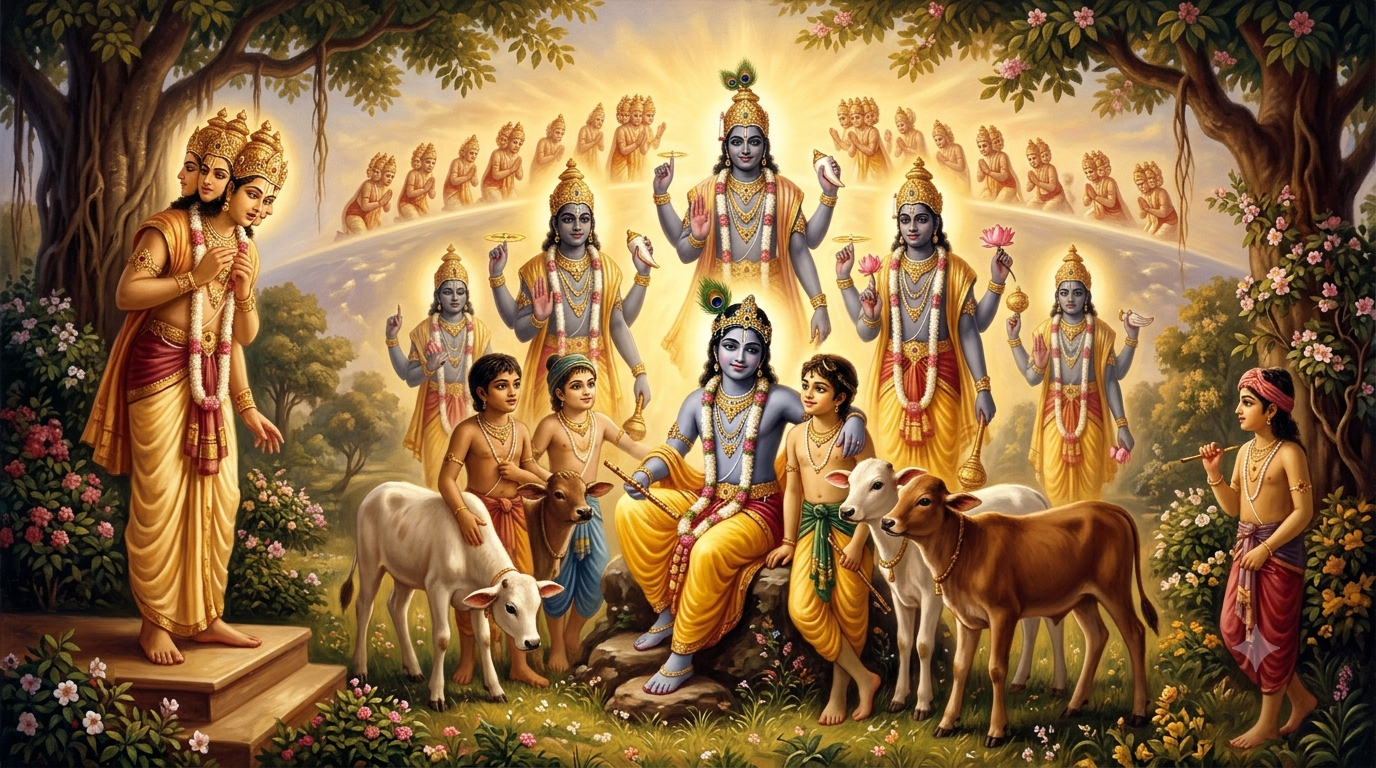
There are certain pastimes in which the Lord bewilders Brahma by revealing His greatness. In this article, we will explore one of them. The 13th chapter of the Tenth Canto of the Srimad Bhagavatam, titled "The Stealing of the Boys and Calves by Brahma," describes the Brahma Vimohana Lila. This chapter recounts how Lord Brahma attempted to take away the calves and cowherd boys, how he himself became bewildered, and how his illusion was ultimately dispelled.
To examine the potency of Krishna, Lord Brahma took away all the calves and cowherd boys and kept them in a secluded place.
When Krishna could not find the calves and boys, He understood that Brahma had performed this trick.
Brahma wanted to bewilder the One who bewilders the entire universe. However, the all-pervading Lord caused Brahma to become bewildered by his own mystic power.
What Did Brahma See?
When a full year had passed, Brahma returned and saw that Krishna was still engaged as usual with His friends, the calves and the cows.
Then Krishna manifested all the calves and cowherd boys as four-armed forms of Narayana. These Vishnu forms bore divine smiles, radiating such brightness and bliss that they dispelled ignorance from the heart. Countless living entities, both animate and inanimate, along with innumerable Brahmas, assumed their respective forms and worshipped the Lord. He was surrounded by all kinds of material and mystic opulence.
What Is the Lesson for Us?
Sometimes, we lose faith and try to reject the Lord's arrangements. We then attempt to act whimsically. Without realizing it, however, we become implicated in Krishna's maya. Instead, we should learn to accept His arrangements. This acceptance can help us find genuine happiness.
When someone acquires a little scientific knowledge, that person may begin to defy the authority of the Lord. Yet even Brahma, the most knowledgeable and learned personality in the universe, became bewildered and astonished by Krishna's potency. What, then, can we say about those philosophers and scientists whose knowledge is far more limited?
So, should we believe in scientists? Yes, but we should recognize the limitations of human knowledge arising from the four defects commonly described in the Vedic tradition as ITCC:
- Imperfect senses
- The propensity for cheating
- Certainty of committing mistakes
- Certainty of being illusioned
How can we know whether someone is free from these four defects? This is a subject that deserves a detailed discussion. For now, let us keep it simple. Scientists are human beings like the rest of us. Ask yourself a few questions:
- Do your senses, including your eyes, ears, tongue, nose and skin, always provide accurate knowledge about objects?
- Have you never told a lie?
- Have you never made a single mistake?
- Have you never been under an illusion?
The answers to these questions will not differ significantly between you and scientists.
Yes, we all have these defects. Consequently, the knowledge we develop or propose through our limited human faculties is also subject to limitations.
Now, whom should we trust? Who is free from all these defects? The answer is shastra. Why?
The answer is simple: shastra is apaurusheya, meaning that it is not authored by an ordinary human being like you and me. It is described as anadi, or beginningless, and ananta, or unlimited, and is understood in the Vedic tradition to be non-different from the Lord in its transcendental authority.
Someone might say, "I have read all the shastras. They are outdated and impractical."
Let us consider an example. What happens when you keep blowing air into a small balloon? Eventually, it bursts. Similarly, the human brain has limited capacity. Its ability to comprehend the vastness of reality is insignificant when compared with the knowledge and power of Brahma.
Only pure devotion to the Lord's lotus feet can help us understand Him. Why? Consider another example: a beloved person is truly known through the love and intimacy of the one who loves them.
Similarly, the Lord's pure devotees are His closest associates because of their unconditional love for Him. When we read the Srimad Bhagavatam, we learn how the Lord reciprocated with and revealed Himself to pure devotees such as Prahlada Maharaja, Queen Kunti, Dhruva Maharaja, Mother Yashoda, Nanda Maharaja, the gopis, Bhishma Deva and Arjuna. Their relationships with the Lord gave rise to wonderful pastimes.
How can we develop love for Him? As mentioned at the beginning:
It all starts with a little faith and taking shelter of pure devotees and the shastras.
Thank you for visiting!
If you liked this article, please share it with your friends and loved ones. We welcome your suggestions on how we can improve our service.
For more Krishna-conscious articles and art, please visit our Blog or explore our Site Map.
Hare Krishna!
How Brahma Discovered Astonishing Secrets of the Multiverse
Category :
Vedic Knowledge & Modern Science
Tags :
Bhakti Yoga Brahma Brahma Vimohana Lila Four Defects of Human Beings Goloka Vrindavana Krishna Krishna Consciousness Krishna's Pastimes Limits of Human Knowledge Lord Brahma Lord Narayana maya Modern Science vs Vedic Knowledge Multiverse Pure Devotion Shastra Spiritual Wisdom Srila Prabhupada Srimad Bhagavatam Supreme Personality of Godhead Tenth Canto Transcendental Knowledge Vedic Cosmology Vedic Knowledge Vedic Scriptures


