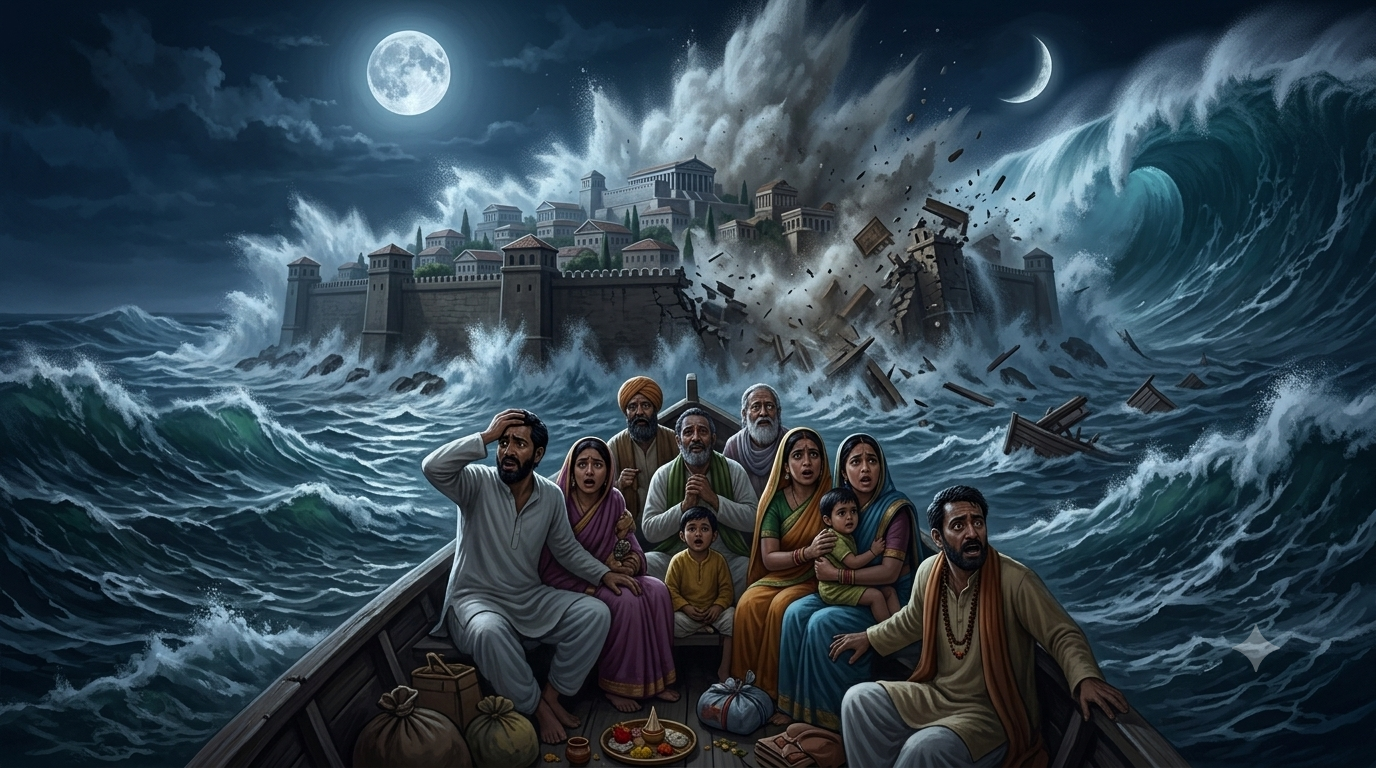
Hidden from the pages of modern history is the story of a mysterious island in the far eastern ocean. Small enough to appear on a map, the island was one day swallowed by the sea. It sank into the ocean depths, as though it had never existed.
Yet the most remarkable part of this story was not the disappearance of the island. It was the fate of its inhabitants, and the choices they made when they were warned of the approaching catastrophe.
This is the story of the Lost Island.
The Sage's Warning
Legend tells us that the island was inhabited by a highly advanced human civilisation. Its northern horizon was covered by a dense forest, where sages lived in seclusion. These sages devoted themselves to self-realisation and the pursuit of spiritual wisdom. They rarely, if ever, entered the busy city.
One early morning, while the city was still waking up, five men saw a mysterious figure approaching from the northern horizon. They had never seen anyone emerge from that direction before.
It was a sage with a lean body, a long beard, and matted hair. His grave voice broke the morning silence.
Hear me carefully. The land on which you live will soon be claimed by the kingdom of water. Leave before the waves engulf you.
Travel towards the eastern edge of the forest, where it meets the shore. When the sun begins to disappear into the ocean, set sail. Keep the shining eye of the sky, which never moves, to your east, and you will reach a much larger island.
It is a land of promise, covered with flowers and fruits. Those who reach it will no longer be troubled by the waves that destroy this little land. They will not return here.
Having delivered his message, the sage turned and disappeared into the forest.
The five men stood motionless, staring after him in astonishment. They could scarcely believe what they had heard.
Five Men, Five Responses
The First: The One Who Refused to Believe
After a moment of silence, the first man laughed.
What nonsense! The land will sink? The ocean will swallow us? And how does this man know that another island even exists?
We all have to die one day. Why should we listen to a beggar who cannot even feed his own body? He must have lost his senses through malnutrition.
Having dismissed the warning, he returned to his work.
For him, what he could immediately see and experience was more trustworthy than the testimony of someone claiming to possess deeper knowledge. He had no intention of changing his life on the strength of a warning he did not understand.
The Second: The One Who Redefined the Warning
The second man watched the first walk away and began to speak.
We are all going to die one day. We were born on this island, just as hair grows from the body. The island itself emerged from the water, so perhaps we are all ultimately water contained in different vessels.
You are me, and I am you. We are all the same. One day, we will return to the kingdom of water. Until then, we should help one another and make this island a better place to live.
I will ask people to donate their gold. With that gold, I will build a school, then a hospital, and then more institutions to help the needy. I will feed the hungry and serve society.
Why should anyone need to dig a well when we are already water ourselves? We sweat, we cry, and we pass water from our bodies. Let us serve the pots of water standing before us!
With this declaration, he departed to organise his plans for the island.
His intentions appeared compassionate. He wanted to help people, reduce suffering, and improve society. Yet he had overlooked the most important part of the sage's warning: the island was going to sink.
His plans might improve the inhabitants' circumstances temporarily, but they would not address the danger that threatened every one of them.
The Third: The One Who Thought Only of Himself
The third man pinched his arm and examined his limbs.
Am I water? Then why do I have arms and legs? Why would water enter different vessels only to merge back into itself?
This makes no sense. The sage is a man of wisdom, and his message was clear. I do not need to interpret it. I am leaving for the eastern shore.
The other two men asked him a question.
But what about all the people who live here? What about the animals that cannot escape on their own? Should we not help them too?
The third man replied:
The power that resides in the clouds showers mercy upon those who are chosen. We are the chosen ones. Let us save ourselves. If that power wishes to save everyone else, it will do so.
With that, he hurried towards the eastern horizon.
He had accepted the warning and understood the urgency of his own escape. But his concern ended with himself. He had little interest in helping anyone else reach safety.
The Fourth: The One Who Became a Guide
The fourth man disagreed with the third.
You are right that the sage has revealed something extraordinary. The power of the clouds has allowed us to hear this warning, but why should we keep it to ourselves?
We must tell everyone. We must help them understand the danger and guide them towards safety before it is too late.
He immediately ran through the streets, knocking on doors and calling out to the inhabitants.
He was so absorbed in warning others that he temporarily forgot about his own safety. His concern was no longer limited to himself. He wanted everyone to have the opportunity to escape.
The Fifth: The One Who Accepted His Responsibility
The fifth man watched the fourth disappear into the city.
He too accepted the sage's warning. However, he first thought of his family and cattle. He needed to gather them and make sure they could travel safely.
He resolved to begin the journey towards the eastern shore and, along the way, assist the fourth man in helping others escape.
His responsibilities were different from those of the fourth man, but his destination was the same. He wanted to reach safety without abandoning those entrusted to his care.
The City Refuses to Listen
The fourth man ran from house to house, warning everyone he met.
As the sun climbed higher, the island began to tremble. The earth rumbled repeatedly. Birds filled the sky with their cries, while monkeys hooted from the trees.
To his horror, the fourth man discovered that most of the inhabitants had gathered around the second man.
Some were planning to build enormous walls around the island to prevent the ocean from entering the city. Others were planning schools, hospitals, and charitable institutions. Still others relied on their wizards, who could supposedly make things appear and disappear through spells.
The fourth man pleaded with them.
Please listen! The land itself has been warned. These arrangements cannot save us from the fate that is approaching. Do not mistake temporary improvements for permanent safety. You must leave before it is too late.
But the people became angry.
Serving humanity is our responsibility. We are not cowards like you. We cannot abandon our duties and run away. We must make this island a better place for everyone!
The fourth man was deeply saddened. He understood the importance of helping others, but he could not force anyone to accept the warning.
With a silent prayer for those who refused to listen, he continued towards the eastern coast with the small number of people who had chosen to follow him. They brought their cattle and other animals along with them.
The Baggage That Prevented Escape
Along the way, the travellers encountered a man carrying an enormous pile of baggage on his back.
Every time he tried to move forward, the weight pulled him down. He struggled, stumbled, and fell. The others advised him to abandon the load so that he could continue the journey.
But he became furious at the suggestion. He could not bear the thought of leaving his possessions behind.
Unable to convince him, the travellers continued their journey.
Further ahead, they found another man who wanted to leave but was waiting for his wife and five-year-old son to wake up.
There is still some time. Let them wake up, and then we will all get ready and leave together. We need not rush just yet.
He remained where he was, convinced that there would be sufficient time later.
Meanwhile, the others continued towards the shore. Some ran, some walked, some rode horses, and others used vehicles that could fly. Each traveller tried to make progress in a different way.
But as the journey continued, their numbers began to dwindle. Some became tired and stopped. Some lost their determination. Others became distracted or simply failed to appreciate the urgency of their situation.
The fourth man noticed that people were falling behind. Forgetting his own fatigue, he turned back to encourage them.
Keep moving! If you cannot run, walk. If you are tired, slow down, but do not give up and do not waste precious time. We must reach the shore before it is too late!
He continued encouraging the travellers, helping them regain their determination and reminding them of their destination.
The Journey Across the Ocean
Finally, the group reached the eastern coast.
To their astonishment, they found the island surrounded by enormous walls that seemed to reach the sky. The inhabitants had worked tirelessly to construct them, hoping to keep the ocean at bay.
The travellers waited at the port until the sun began to disappear into the ocean. Then they boarded a ship and set sail, keeping the shining eye of the sky to their east, just as the sage had instructed.
The journey was difficult, but they continued. At last, they reached the larger island the sage had described.
It was a land of beauty and abundance, filled with flowers and fruits. The travellers had reached the destination that had seemed so improbable when they first heard the warning.
Behind them, the moon rose over their former home.
The ocean began to rise, its waves growing higher and higher. At last, the enormous walls began to break apart with a thunderous crash. The island shook, tilted, and disappeared beneath the water.
The walls could not save it. Neither the schools nor the hospitals could prevent its destruction. The island, with all its buildings and achievements, sank into the ocean.
We are never told what became of those who remained behind.
And so ended the story of the Lost Island and its inhabitants.
The Spiritual Meaning of the Lost Island
The story is an allegory. Its characters and events invite us to examine our own lives, our priorities, and the choices we make when spiritual wisdom calls us to change.
Let us understand what the different elements represent.
1. The Island: The Temporary Material World
The island represents the material world in which we presently live.
We build homes, pursue careers, accumulate possessions, establish institutions, and seek security. These activities may have practical value, but none can make our temporary material existence permanent.
The Bhagavad-gita describes the material world as a place of impermanence and suffering:
duḥkhālayam aśāśvatam
The material world is a place of misery, where life is temporary.
Bhagavad-gita 8.15
The problem is not that we must never perform our duties or help society. The problem arises when we mistake temporary arrangements for the ultimate solution to the soul's suffering.
Just as the inhabitants of the island needed to understand their situation, we need to recognise the temporary nature of material life and seek the eternal spiritual destination.
2. The Sage: The Vedic Scriptures and Bona Fide Acharyas
The sage represents the Vedic scriptures and the guidance of bona fide spiritual teachers who explain the nature of material existence and the soul's eternal relationship with Krishna.
We cannot always discover spiritual reality through our limited senses and reasoning alone. We need to hear from a trustworthy source.
The sage did not merely announce that the island was in danger. He also provided directions to safety. Similarly, the scriptures do not simply describe the limitations of material existence. They teach us how to return to our original spiritual position through devotional service.
Srila Prabhupada brought this message to the world through the teachings of the Bhagavad-gita, Srimad-Bhagavatam, and the wider Vedic literature. His mission was not simply to criticise material life, but to give people a practical path of Krishna consciousness.
3. The Promised Island: The Eternal Spiritual World
The larger island represents the eternal spiritual destination, the kingdom of God. In the Gaudiya Vaishnava understanding, Goloka Vrindavana is the supreme spiritual abode of Sri Krishna.
The Bhagavad-gita describes that destination in these words:
yad gatvā na nivartante
Having reached that destination, one never returns to this material world.
Bhagavad-gita 15.6
The destination is not merely a place where material suffering is temporarily reduced. It is the eternal spiritual world, where the soul can revive its loving relationship with the Supreme Lord.
The sage's promise reminds us that spiritual life has a destination. We are not practising bhakti merely to become more comfortable in the material world. We are cultivating our eternal relationship with Krishna.
4. The First Man: Denial of Spiritual Reality
The first man represents those who dismiss spiritual teachings because they cannot immediately verify them through their material senses.
His reasoning was simple: everyone must die, so why change anything? He assumed that because death is inevitable, there is no need to understand what lies beyond it.
This attitude can prevent a person from even beginning a spiritual journey. If we reject the testimony of scripture before seriously examining it, we may continue living according to our assumptions without considering the purpose of human life.
Spiritual inquiry begins when we become willing to ask whether our present understanding of life is complete.
5. The Second Man: Mistaking Temporary Welfare for the Highest Welfare
The second man represents a spiritual misunderstanding in which the distinctions between the individual soul, the Supreme Lord, and the material world are confused or denied.
He interpreted the sage's warning according to his own theory and then directed everyone's attention towards improving the island. His plans were ambitious, and some of the activities he proposed could certainly benefit people in practical ways. Yet he failed to address the central warning: the island itself would disappear.
The lesson is not that education, healthcare, charity, or social responsibility are worthless. A devotee can engage in such activities as part of responsible service. The deeper point is that temporary material relief cannot, by itself, solve the soul's fundamental problem.
From the Vaishnava perspective, the highest welfare includes helping the soul revive its forgotten relationship with Krishna. Material assistance may address immediate suffering, but spiritual knowledge reveals the soul's eternal identity and destination.
We must therefore be careful not to distort the teachings of scripture to support our preferred conclusions. Good intentions alone do not guarantee spiritual understanding. We need guidance from the genuine teachings of the acharyas.
6. The Third Man: Seeking Personal Liberation Alone
The third man represents the spiritual seeker who understands that the material world is temporary and is determined to escape it, but whose concern remains centred on personal liberation.
He accepted the sage's warning and began moving towards safety. However, he showed little concern for those who could not make the journey on their own.
The story contrasts this self-centred approach with the compassionate mood of a Vaishnava.
A devotee certainly needs to practise seriously and take personal responsibility for spiritual advancement. But genuine devotion also awakens compassion for others. The desire to serve Krishna naturally encourages the desire to help others come into contact with Krishna's teachings and devotional service.
Spiritual progress is not measured only by how quickly we advance. We must also ask whether our hearts are becoming more compassionate.
7. The Fourth Man: The Compassionate Preacher
The fourth man represents the renounced preacher who dedicates himself to sharing spiritual knowledge with others.
He does not keep the sage's message to himself. He travels through the city, warns its inhabitants, and tries to help them understand the urgency of the situation.
Even when people reject him, he does not simply abandon them. When he notices that travellers are becoming tired and falling behind, he returns to encourage them.
This illustrates an important quality of a genuine spiritual guide: he does not merely point towards the destination and disappear. He patiently helps sincere seekers understand the path, overcome obstacles, and continue their journey.
Vaishnava compassion is not passive goodwill. It expresses itself through practical service, the distribution of spiritual knowledge, and the sincere desire that others also benefit from Krishna consciousness.
The fourth man reminds us of the preaching mission of Srila Prabhupada and his followers, who endeavour to share the teachings of Krishna with people throughout the world.
8. The Fifth Man: The Responsible Householder
The fifth man represents the devotee who lives as a householder and has responsibilities towards family members and dependants.
He understands the urgency of the journey, but he also recognises that he has been entrusted with the care of others. He plans to gather his family and cattle before leaving, and he intends to assist the fourth man in helping others reach safety.
This illustrates that household life and devotional service are not contradictory. A householder can practise Krishna consciousness sincerely while fulfilling legitimate family responsibilities.
The important question is whether those responsibilities become an excuse for postponing spiritual life or an opportunity to serve Krishna and help others progress.
A responsible devotee does not simply abandon dependants in the name of renunciation. Nor does the devotee indefinitely postpone spiritual practice while waiting for every material circumstance to become perfect.
Instead, the householder makes a sincere effort to bring family life into harmony with devotional service and to help dependants develop their own spiritual understanding.
The fourth and fifth men have different responsibilities, but both are concerned about others. One serves through dedicated preaching; the other integrates spiritual purpose with household responsibilities. Both illustrate the importance of compassion and commitment.
9. The Man Carrying the Enormous Baggage: The Burden of Anarthas
The man struggling under an enormous pile of baggage represents those who have begun spiritual life but continue to carry burdens that prevent them from advancing.
In devotional life, these unwanted habits and attachments are often described as anarthas. They may include material desires, pride, greed, envy, the desire for recognition, and the tendency to criticise others.
Among the most serious obstacles are offences against devotees, commonly known as Vaishnava aparadha. Such offences can damage our devotional attitude and obstruct spiritual progress.
The man in the story was advised to put down his load, but he refused. Similarly, we may hear spiritual instructions repeatedly while remaining unwilling to give up the attitudes and habits that hold us back.
We may chant, read scripture, attend classes, and perform service, yet still need to examine our motives and conduct honestly.
The lesson is not that anyone who struggles with anarthas is doomed to remain in material existence. Rather, it is that sincere progress requires humility, self-examination, repentance where necessary, and a willingness to accept corrective guidance.
We should not merely increase our external activity. We should also allow devotional practice to transform our hearts.
10. The Man Waiting for His Family: The Excuse of a Perfect Time
The man who waited for his sleeping wife and son represents those who continually postpone spiritual life while waiting for a supposedly better time.
There will always be responsibilities to fulfil, financial concerns to address, career goals to pursue, and family circumstances to consider. These are real matters, but if we wait until every difficulty disappears, we may never begin.
At the same time, the story should not be interpreted as an instruction to neglect one's spouse or children. A devotee should act responsibly and help family members grow in spiritual understanding rather than using them as an excuse for indefinite delay.
Instead of waiting for an ideal situation, we can begin with practical steps: regular chanting, daily reading, hearing from devotees, and gradually arranging our lives around Krishna consciousness.
We can also help our families participate in this journey according to their circumstances and capacity.
The essential question is not whether our lives are perfectly arranged. It is whether we are making sincere progress with the opportunities we have today.
11. The Inhabitants: Our Choices Determine Our Direction
The inhabitants represent all of us. Like them, we encounter different ideas about the purpose of life and different proposals for achieving happiness.
We may dismiss spiritual knowledge altogether. We may become absorbed in temporary improvements. We may seek personal advancement without concern for others. Or we may accept the guidance of scripture and follow the path of devotional service while helping others along the way.
Our choices shape our direction.
In the Gaudiya Vaishnava tradition, the association and guidance of bona fide devotees are essential because they help us understand scripture correctly and practise bhakti in a meaningful way.
Accepting a spiritual path is the beginning, not the end. We must continue walking towards the destination with sincerity, determination, and dependence on Krishna's mercy.
How Can We Increase Our Spiritual Speed?
One of the most interesting details in the story is that the travellers moved at different speeds. Some ran, some walked, and others used vehicles to cover the distance more quickly.
This offers a useful way to reflect on our devotional practice.
- Chanting the holy names: Regular chanting of the Hare Krishna maha-mantra is a central practice of bhakti. It helps us remember Krishna and establish a steady foundation for spiritual life.
- Hearing and reading: Studying the Bhagavad-gita, Srimad-Bhagavatam, and the books of Srila Prabhupada deepens our understanding and helps us apply spiritual knowledge.
- Accepting prasadam: Honouring food offered to Krishna is a practical expression of devotional life and helps us cultivate a relationship with Him through our daily activities.
- Engaging in service: Service performed in a spirit of devotion helps us practise humility, cooperation, and dedication to Krishna's pleasure.
- Seeking devotee association: Sincere association gives us encouragement, guidance, and opportunities to correct our course when we become distracted.
- Removing obstacles: We should honestly examine our attachments, habits, pride, and offences, seeking guidance and making sincere efforts to improve.
These practices are not mechanical shortcuts to spiritual success. Nor should we imagine that one activity automatically guarantees a particular level of advancement. Their value lies in cultivating sincere devotional service under proper guidance.
Progress is not simply a matter of speed. It is a matter of direction, sincerity, and perseverance.
The Greatest Welfare Is to Help Others Remember Krishna
The story of the Lost Island ultimately asks us to reconsider our understanding of compassion.
Is compassion limited to making temporary life more comfortable? Or can it also mean helping someone discover the eternal purpose of life?
Vaishnava compassion includes concern for the immediate needs of others, but it does not stop there. It seeks to share spiritual knowledge and help living beings revive their relationship with Krishna.
This spirit is reflected in the mission of Sri Chaitanya Mahaprabhu, who taught the importance of chanting the holy names of Krishna and encouraged people to share this opportunity with others.
We should therefore examine ourselves honestly:
- Am I taking spiritual knowledge seriously, or am I dismissing it because material life seems comfortable?
- Am I improving my circumstances while neglecting the deeper purpose of human life?
- Am I concerned only with my own spiritual progress, or do I sincerely wish to help others?
- Am I carrying unnecessary burdens that obstruct my devotional practice?
- Am I waiting for a perfect time to begin, even though I can take a sincere step today?
- Am I helping my family and associates understand the value of Krishna consciousness?
These questions are not meant to create fear or despair. They are meant to awaken spiritual urgency and inspire practical change.
Our Journey Home
The inhabitants of the Lost Island were given a warning and a direction. What they did with that knowledge depended on their willingness to listen, act, and persevere.
We too have received the teachings of the Vedic scriptures and the guidance of the Vaishnava acharyas. The path of bhakti has been made accessible through chanting, hearing, remembering Krishna, serving devotees, honouring prasadam, and sharing spiritual knowledge.
We need not wait for a catastrophe to recognise the temporary nature of material life. We can begin our journey now, with whatever sincerity and determination we can muster.
And we need not travel alone. We can encourage one another, help one another overcome obstacles, and share the mercy of Krishna consciousness with those we meet.
A sincere prayer: By the mercy of Sri Guru and Gauranga, and by the sweet will of Sri Krishna, may we develop the sincerity to follow the path of bhakti, the determination to continue our journey, and the compassion to help others discover their eternal home.
May we all return to the shelter of Sri Krishna, in the eternal spiritual world.
Hare Krishna!
A Note About the Story
This is a work of fiction. The island, characters, places, events, and incidents are products of the author's imagination or are used in a fictional manner. Any resemblance to actual persons, living or dead, or actual events is purely coincidental.
Thank you for reading this article. If you found it meaningful, please share it with your friends and loved ones. Your suggestions are welcome and will help us improve this service.
Hare Krishna!


