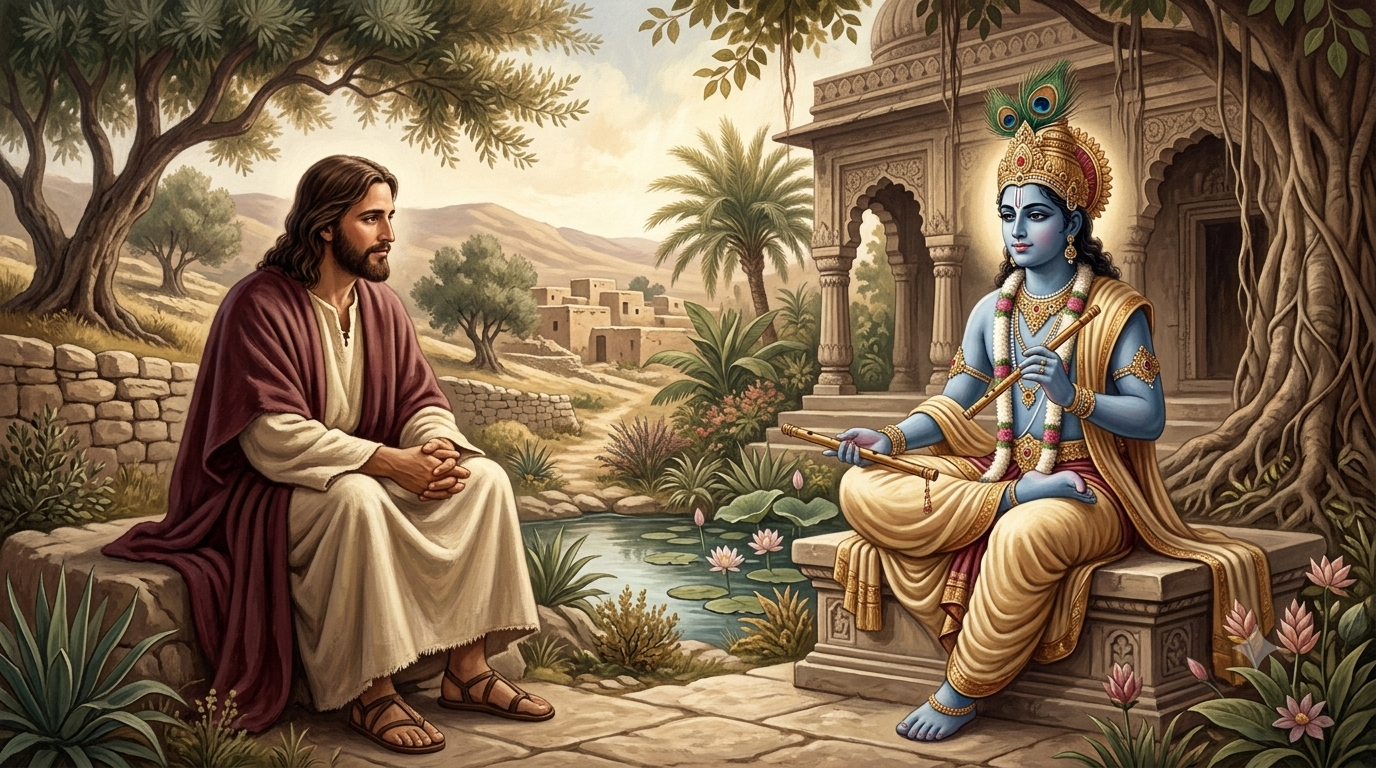
The similarities between the Bhagavad-gita and the Bible reveal a profound spiritual message: there is one Supreme God, the Father and source of all creation. Although different religious traditions use different names and expressions, their scriptures contain important teachings about the Supreme Lord, His presence, divine guidance and the need for loving devotion.
God is neither Indian nor American nor otherwise, neither Christian nor Hindu nor Muslim. God is God.
- Srila Prabhupada
Unfortunately, religious differences are sometimes used to create divisions, hatred and hostility. People may become so attached to the external identity of their religion that they overlook the deeper spiritual principles shared by different traditions. Such divisions can even lead some young people to turn away from religion altogether.
Yet, genuine spiritual understanding should bring us closer to God and encourage us to recognise our relationship with Him. When we study sacred scriptures under the guidance of an authentic spiritual master and a genuine disciplic succession, we can understand their teachings more deeply.
This article explores nine similarities between the Bhagavad-gita and the Bible. The purpose is not to claim that every theological statement in the two scriptures is identical. Rather, it is to highlight important common teachings about the Supreme God, His relationship with living beings and the principles of spiritual life.
From the Vedic understanding, Lord Krishna is the Supreme Personality of Godhead and the original source of everything. The following comparisons help us appreciate how the Bible also speaks about the one Supreme Father and His relationship with creation.
1. God Is Present in Everyone's Heart
Bhagavad-gita: Krishna as the Supersoul
I am the Supersoul, O Arjuna, seated in the hearts of all living entities.
Bhagavad-gita 10.20 - Read on Vedabase
I am in everyone's heart as the Supersoul.
Bhagavad-gita 7.21 - Read on Vedabase
I, dwelling in their hearts.
Bhagavad-gita 10.11 - Read on Vedabase
The Supreme Lord is situated in everyone's heart.
Bhagavad-gita 18.61 - Read on Vedabase
Bible: God Dwells Among His Creation
One God and Father of all, who [is] above all, and through all, and in you all.
Ephesians 4:6 - Read in the Bible
Know ye not that ye are the temple of God, and that the Spirit of God dwelleth in you?
1 Corinthians 3:16 - Read in the Bible
The Bhagavad-gita explains that the Supreme Lord is present within the heart of every living being as the Supersoul, or Paramatma. He is not distant from His creation. He accompanies every living being and remains the witness within the heart.
Similarly, the Bible speaks of one God and Father who is above all, through all and in all. It also describes the body as the temple of God, with the Spirit of God dwelling within.
Although the two traditions explain this divine presence through their own theological language, both direct our attention towards God's presence and relationship with living beings.
2. God Is the Source of Knowledge and Wisdom
Bhagavad-gita: Krishna Gives Knowledge
I am seated in everyone's heart, and from Me come remembrance, knowledge and forgetfulness. By all the Vedas, I am to be known. Indeed, I am the compiler of Vedanta, and I am the knower of the Vedas.
Bhagavad-gita 15.15 - Read on Vedabase
Bible: The Father Works Through Jesus
The words I say to you are not just my own. Rather, it is the Father, living in me, who is doing his work.
John 14:10 - Read in the Bible
Lord Krishna explains that remembrance, knowledge and forgetfulness come from Him. He is the ultimate source of knowledge, and the purpose of Vedic literature is to know Him.
Similarly, Jesus explains that the words and works he shares are connected to the Father dwelling within him. He does not present himself as acting independently of the Father.
Both passages direct our attention towards the Supreme as the source behind divine knowledge and spiritual understanding.
3. God Is the Supreme Father of All Living Beings
Bhagavad-gita: Krishna Is the Seed-Giving Father
It should be understood that all species of life, O son of Kunte, are made possible by birth in this material nature, and that I am the seed-giving father.
Bhagavad-gita 14.4 - Read on Vedabase
I am the father of this universe, the mother, the support and the grandsire. I am the object of knowledge, the purifier and the syllable om. I am also the Rg, the Sama and the Yajur Vedas.
Bhagavad-gita 9.17 - Read on Vedabase
Bible: We All Have One Father
Have we not all one father? hath not one God created us? why do we deal treacherously every man against his brother, by profaning the covenant of our fathers?
Malachi 2:10 - Read in the Bible
I am the Son of God
John 10:36 - Read in the Bible
The Bhagavad-gita makes a universal declaration. Krishna is the seed-giving father of all species of life. He is not merely the father of one nation, community or religious group. Every living being, whether human, animal, bird or aquatic, is connected to Him.
The Bible also makes a powerful statement in Malachi: we all have one Father, and one God has created us. This is a direct reminder that humanity shares a common divine origin.
Jesus also identifies himself as the Son of God. This further highlights the relationship between the Father and His Son in biblical teachings.
From the Vedic perspective, Krishna is the original Supreme Father, and all living beings are His eternal parts and parcels. Recognising this common relationship can help us rise above narrow religious identities and develop respect for all living beings.
4. God Has a Transcendental Personal Form
Bhagavad-gita: Krishna's Transcendental Form
Fools deride Me when I descend in the human form. They do not know My transcendental nature as the Supreme Lord of all that be.
Bhagavad-gita 9.11 - Read on Vedabase
Bible: Humanity Made in God's Image
God said, Let us make man in our image, in our likeness.
Genesis 1:26 - Read in the Bible
The Bhagavad-gita clearly teaches that Krishna possesses a transcendental personal form. When He appears in this world, He does not acquire a material body. His form is eternal and spiritual. In Vedic philosophy, the Supreme Lord is not an impersonal or formless force. He possesses an beautiful, eternal spiritual form, and His personal nature is not limited by material form. His all-pervading presence and His personal form are not contradictory.
Genesis speaks of human beings being created in the image and likeness of God. This provides an interesting point of comparison. However, God's form should not be treated as human body.
5. Spiritual Guidance Is Essential to Approach God
Bhagavad-gita: Approach a Genuine Spiritual Master
Just try to learn the truth by approaching a spiritual master. Inquire from him submissively and render service unto him. The self-realized souls can impart knowledge unto you because they have seen the truth.
Bhagavad-gita 4.34 - Read on Vedabase
Bible: Jesus Points the Way to the Father
Jesus said to him, “I am the way, and the truth, and the life. No one comes to the Father except through me”
John 14:6 - Read in the Bible
The Bhagavad-gita instructs a sincere seeker to approach a genuine spiritual master, inquire submissively and render service. Spiritual knowledge is not simply a matter of speculation. It is received through a genuine disciplic succession from those who have realised the truth.
Similarly, Jesus declares that he is the way, the truth and the life, and that no one comes to the Father except through him.
The two passages express the importance of spiritual guidance in approaching the Supreme. Their theological explanations reject the idea that one can understand the highest spiritual truth merely through independent speculation.
6. We Should Love God With Unfailing Devotion
Bhagavad-gita: Offer Everything to Krishna
O son of Kunti, all that you do, all that you eat, all that you offer and give away, as well as all austerities that you may perform, should be done as an offering unto Me. In this way you will be freed from all reactions to good and evil deeds, and by this principle of renunciation you will be liberated and come to Me.
Bhagavad-gita 9.27-28 - Read verse 9.27 and verse 9.28
Engage your mind always in thinking of Me, offer obeisances and worship Me. Being completely absorbed in Me, surely you will come to Me
Bhagavad-gita 9.34 - Read on Vedabase
Bible: Love the Lord With Your Whole Being
You shall love the Lord your God with all your heart and with all your soul and with all your might.
Deuteronomy 6:5 - Read in the Bible
Krishna asks Arjuna to dedicate all his activities, offerings, food and austerities to Him. He also instructs him to always think of Him, worship Him and become absorbed in Him.
Similarly, the Bible commands people to love the Lord with all their heart, soul and might.
Both teachings place wholehearted love and devotion to God at the centre of spiritual life. Genuine devotion is not limited to occasional prayer or ritual. It should influence our thoughts, actions, choices and daily conduct.
7. Our Qualities and Actions Determine Our Spiritual Destination
Bhagavad-gita: Divine and Demoniac Qualities
Pride, arrogance, conceit, anger, harshness and ignorance-these qualities belong to those of demoniac nature, O son of Prtha.
Bhagavad-gita 16.4 - Read on Vedabase
Bewildered by false ego, strength, pride, lust and anger, the demons become envious of the Supreme Personality of Godhead, who is situated in their own bodies and in the bodies of others, and blaspheme against the real religion.
Bhagavad-gita 16.18 - Read on Vedabase
One who is not envious but is a kind friend to all living entities, who does not think himself a proprietor and is free from false ego, who is equal in both happiness and distress, who is tolerant, always satisfied, self-controlled, and engaged in devotional service with determination, his mind and intelligence fixed on Me-such a devotee of Mine is very dear to Me.
Bhagavad-gita 12.13-14 - Read verse 12.13 and verse 12.14
Bible: Those Who Practise Sinful Activities
Envyings, murders, drunkenness, revellings,and such like: of the which I tell you before, as I have also told you in time past, that they which do such things shall not inherit the kingdom of God.
Galatians 5:21 - Read in the Bible
nor thieves, nor the greedy, nor drunkards, nor revilers [whose words are used as weapons to abuse, insult, humiliate, intimidate, or slander], nor swindlers will inherit or have any share in the kingdom of God.
1 Corinthians 6:10 - Read in the Bible
The Bhagavad-gita describes divine and demoniac qualities. Pride, arrogance, anger, envy and ignorance lead a person away from spiritual life. In contrast, kindness, humility, tolerance, self-control and devotion make a person dear to Krishna.
The Bible also warns that those who persist in sinful conduct, such as envy, drunkenness, greed and other destructive activities, will not inherit the Kingdom of God.
Both scriptures make it clear that spiritual life is not merely about belonging to a religious community. Our character, conduct and relationship with God matter deeply. A person who claims to love God must also strive to develop godly qualities.
8. The Supreme Abode of God Is Beyond Material Illumination
Bhagavad-gita: Krishna's Supreme Abode
That supreme abode of Mine is not illumined by the sun or moon, nor by fire or electricity. Those who reach it never return to this material world
Bhagavad-gita 15.6 - Read on Vedabase
Bible: The Lord Is the Eternal Light
And there shall be no night there; and they need no candle, neither light of the sun; for the Lord God giveth them light; and they shall reign for ever and ever.
Revelation 22:5 - Read in the Bible
The Bhagavad-gita describes Krishna's supreme abode as a spiritual realm that does not depend on the sun, moon, fire or electricity for illumination. Those who attain it never return to the material world.
Similarly, the Bible describes a realm where there is no night and no need for the light of the sun, because the Lord Himself gives light.
Both passages point towards an eternal spiritual destination that is beyond the limitations of the material world.
9. God Is the Beginning and the End of Everything
Bhagavad-gita: Krishna Is the Beginning, Middle and End
Of all creations I am the beginning and the end and also the middle.
Bhagavad-gita 10.32 - Read on Vedabase
Of letters I am the letter A, and among compound words I am the dual compound.
Bhagavad-gita 10.33 - Read on Vedabase
Bible: The Alpha and Omega
I am alpha and Omega, the beginning and the end, the first and the last.
Revelation 22:13 - Read in the Bible
Krishna declares that He is the beginning, middle and end of all creations. Nothing exists independently of Him. Everything ultimately rests upon the Supreme Lord.
The Bible describes the Lord as the Alpha and Omega, the beginning and the end, the first and the last. Both declarations point towards the Supreme as the ultimate source and final destination of everything.
Conclusion: One Supreme Father, Many Names
The similarities between the Bhagavad-gita and the Bible offer us an important opportunity to recognise the spiritual truths that unite humanity. Both scriptures speak about the Supreme, His relationship with living beings, the importance of divine guidance, loving devotion and the eternal spiritual destination.
From the Vedic understanding, that Supreme Personality of Godhead is Lord Sri Krishna. The Bhagavad-gita identifies Him as the source of everything and the father of all living beings.
People may address the Supreme Lord by different names. In English, He is called God. In Arabic, He is called Allah. In the Vedic tradition, He is known by names such as Krishna, which means the all-attractive one. These names express different attributes and understandings of the Supreme.
Recognising the one Supreme Father should inspire us to look beyond superficial religious identities. It should encourage humility, compassion, respect and a sincere desire to know God.
There is a beautiful analogy by which HH Radhanath Swami Maharaj explains that a dog recognises its master regardless of how the master is dressed. The point is that we should not become so attached to the external appearance of religion that we fail to recognise the Supreme Lord being spoken of through another tradition.
A dog will recognize his master in whatever way he dresses. The master may dress in robes, suit and tie, or stand naked, but the dog will always recognize his master. If we cannot recognize God, our beloved master, when he comes in a different dress from another religion, then we are less than that dog.
HH Radhanath Swami Maharaj
Let us therefore make a sincere effort to understand the Supreme Lord, deepen our love for Him and recognise our shared relationship with Him. Rather than allowing religious identities to divide us, let our spiritual understanding bring us closer to the one Supreme Father.
Conclusion
The Bhagavad-gita declares Krishna to be the Supreme Father and source of all existence. The Bible too speaks of one God and Father of all. These shared teachings give us a meaningful foundation for spiritual understanding, mutual respect and unity in our search for the Supreme.
Thank you for visiting.
If you have liked it, then please share it with your friends and loved ones. Please feel free to suggest how we can further improve our service.
For more Krishna Conscious Articles & Arts, please visit - Our Blog | Site Map
Hare Krishna!


Comments are closed!