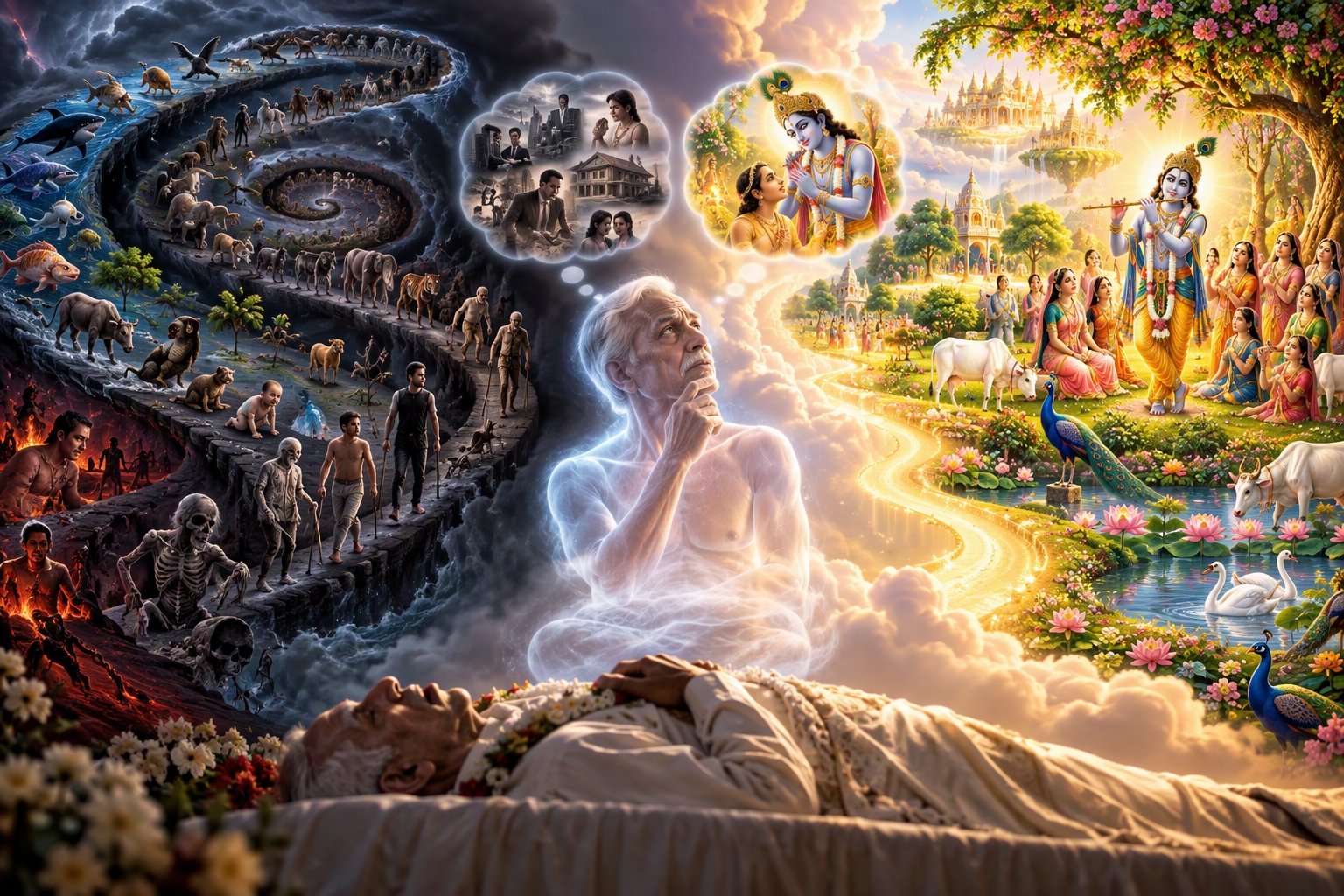
What if the most important examination of our life is one for which we have not yet started preparing? Just as students identify their ultimate academic goal and organise their efforts accordingly, we too must recognise the final examination of human life and prepare for our eternal destination.
When we entered the 9th Standard, there was suddenly a noticeable change in the atmosphere of our classroom. The class was virtually divided into two groups.
While most students were focused on immediate class examinations or simply enjoying their school life, a section of students made remarkable changes in their attitude. They started carrying huge books meant for IIT entrance preparation. Their priorities changed, their daily routines became more disciplined, and their efforts were directed towards a single goal: cracking the FINAL EXAMINATION - the IIT Entrance Examination.
Nearly two decades later, many of those students have established themselves in successful professional careers.
What made the difference? They had identified their goal earlier and pursued it with single-pointed determination. This is precisely what Lord Krishna advises in the Bhagavad Gita:
vyavasāyātmikā buddhir
ekeha kuru-nandana
bahu-śākhā hy anantāś ca
buddhayo ’vyavasāyinām
Those who are on this path are resolute in purpose, and their aim is one. O beloved child of the Kurus, the intelligence of those who are irresolute is many-branched.
Bhagavad Gita 2.41
If we analyse the students in our classroom, the fundamental difference was their understanding of the Final Examination.
Some considered passing the immediate class tests their priority. Others focused on passing the 9th Standard, while some looked forward to the 10th or 12th Standard Board examinations. However, a particular group understood that their ultimate academic objective was to qualify for admission into prestigious institutions through entrance examinations.
By preparing for that larger goal, they also developed a strong conceptual foundation that helped them perform well in their regular school examinations.
Similarly, many students score exceptionally well in their Board examinations but fail to secure the required marks in competitive entrance examinations. Consequently, they may not get admission into the institutions of their choice.
Therefore, entrance examinations can be equally, and sometimes even more, important than exit examinations.
The lesson is simple. When we understand which examination ultimately determines our destination, we can organise our priorities accordingly. Without understanding the ultimate goal, we may spend our entire lives preparing for examinations that offer only temporary results.
The "Exit" Examination of Life
This brings us to a fundamental question: What is the final examination of human life?
The answer is Death.
Death is the inevitable conclusion of our present material existence. Regardless of our wealth, achievements, social position or personal ambitions, everyone must eventually leave the body.
Yet, most of us behave like an ostrich, imagining that by burying our heads in the sand, we can escape the approaching danger.
We remain engrossed in the various examinations and assignments of material life: acquiring wealth, building careers, maintaining families, pursuing recognition and fulfilling countless desires. These activities occupy most of our attention, leaving little time to consider the ultimate destination towards which our lives are heading.
However, those who understand the gravity of this situation recognise that human life offers a precious opportunity. Instead of remaining absorbed in temporary achievements, they begin preparing for the final examination of life, with the ultimate objective of returning home, back to Godhead.
We may be prepared for death or completely unprepared, but death will arrive regardless.
The Vedic scriptures explain that this is not our first experience of death. The living being has accepted countless material bodies, passing through different species of life over innumerable lifetimes.
vāsāṁsi jīrṇāni yathā vihāya
navāni gṛhṇāti naro ’parāṇi
tathā śarīrāṇi vihāya jīrṇāny
anyāni saṁyāti navāni dehī
As a person puts on new garments, giving up old ones, the soul similarly accepts new material bodies, giving up the old and useless ones.
Bhagavad Gita 2.22
Just as changing clothes does not change the identity of the person wearing them, changing bodies does not change the identity of the living being. We are not these temporary bodies; we are eternal spiritual souls.
Due to our material conditioning, however, we remain absorbed in the pursuit of temporary happiness. We invest enormous energy in accumulating possessions, relationships and achievements, often forgetting that death can take away everything connected with our present material identity.
Srimad Bhagavatam describes the suffering associated with the final stages of material existence. Lord Kapila explains to His mother, Devahuti, how a person becomes afflicted by disease, weakness and the inability to perform even ordinary activities as death approaches.
He describes how the dying person becomes helpless, surrounded by lamenting relatives, unable to communicate even when he wishes to speak.
... Afflicted with many illnesses, such as dyspepsia and loss of appetite, he eats only very small morsels of food, and he becomes an invalid who cannot work any more.
In that diseased condition, one’s eyes bulge due to the pressure of air from within, and his glands become congested with mucus. He has difficulty breathing, and upon exhaling and inhaling he produces a sound like ghura-ghura, a rattling within the throat.
In this way he comes under the clutches of death and lies down, surrounded by lamenting friends and relatives, and although he wants to speak with them, he no longer can because he is under the control of time.
Thus the man, who engaged with uncontrolled senses in maintaining a family, dies in great grief, seeing his relatives crying. He dies most pathetically, in great pain and without consciousness.
Srimad Bhagavatam 3.30.15-18
These descriptions remind us of an uncomfortable truth: material existence, despite its temporary pleasures, is subject to old age, disease and death.
We cannot permanently escape death by improving our material circumstances. However, according to Krishna, we can become free from the cycle of repeated birth and death.
The real objective is not merely to postpone death, but to become free from rebirth.
The Eternal World
Is there a destination beyond this temporary material existence? Lord Krishna answers this question directly:
ā-brahma-bhuvanāl lokāḥ
punar āvartino ’rjuna
mām upetya tu kaunteya
punar janma na vidyate
From the highest planet in the material world down to the lowest, all are places of misery wherein repeated birth and death take place. But one who attains to My abode, O son of Kuntī, never takes birth again.
Bhagavad Gita 8.16
Krishna explains that even the highest planets within the material universe cannot offer permanent freedom from birth and death. Every destination within the material world is temporary.
However, His own abode is beyond the material creation. It belongs to the eternal spiritual sky, where there is no repeated birth, old age, disease or death.
Krishna's supreme abode is known as Goloka Vrindavana, the eternal spiritual abode of the Supreme Personality of Godhead.
Krishna is revealing the ultimate destination of the living being: returning to Him and engaging eternally in loving devotional service.
The appearance of Lord Krishna in this material world and the teachings of the Vedic scriptures reveal this path of returning home, back to Godhead.
When we understand this, our definition of success changes completely.
Is the real success of human life merely becoming famous, enjoying different cuisines in expensive restaurants, living in luxurious apartments, accumulating enormous wealth, raising children or eventually playing with grandchildren?
These experiences may occupy different stages of our lives, but none of them can provide permanent happiness or freedom from repeated birth and death.
The real success of human life is to revive our eternal relationship with Krishna and return to His spiritual abode.
The "Entrance" Examination
If death is the exit examination of our present material life, what determines our next destination?
Lord Krishna explains this through a very important verse:
yaṁ yaṁ vāpi smaran bhāvaṁ - tyajaty ante kalevaram
taṁ tam evaiti kaunteya - sadā tad-bhāva-bhāvitaḥ
Whatever state of being one remembers when he quits his body, O son of Kuntī, that state he will attain without fail.
Bhagavad Gita 8.6
Our consciousness at the time of death plays a decisive role in determining our next destination.
Just as our performance in an exit examination determines the opportunities available to us in the next stage of education, the consciousness we cultivate throughout our present life influences the destination we attain after leaving this body.
We cannot expect to remain absorbed in material desires throughout our lives and suddenly remember Krishna at the moment of death without having cultivated that consciousness.
What we repeatedly think about, desire and practise during our lifetime shapes our consciousness. Therefore, preparation for the final moment must begin now.
Krishna further explains that different forms of worship lead to different destinations:
yānti deva-vratā devān
pitṝn yānti pitṛ-vratāḥ
bhūtāni yānti bhūtejyā
yānti mad-yājino ’pi mām
Those who worship the demigods will take birth among the demigods; those who worship the ancestors go to the ancestors; those who worship ghosts and spirits will take birth among such beings; and those who worship Me will live with Me.
Bhagavad Gita 9.25
This verse establishes an important principle: different objects of worship lead to different destinations. Worship of the demigods leads to their respective planets, worship of the ancestors leads to the ancestral planets, while those who worship Krishna attain Him.
This is an important distinction when considering the popular idea that all spiritual paths ultimately lead to the same destination.
Although different spiritual paths may share certain practices or aspirations, the Vedic scriptures clearly distinguish their philosophical foundations and ultimate destinations. They should not automatically be considered identical.
In our article All Roads Do Not Lead to Rome, we have examined this subject in greater detail.
Bhagavad Gita 9.25 makes Krishna's position clear. Those who worship Him attain Him. If our ultimate objective is to reach Goloka Vrindavana, we must take shelter of the devotional process that leads to Krishna.
We cannot simply choose any destination and expect to reach Goloka Vrindavana. We must understand the goal and follow the process that leads to it.
The Solution: Preparing to Remember Krishna
Having understood the ultimate destination and the importance of our consciousness at the time of death, the next question is: How do we prepare ourselves?
Krishna provides a direct and practical instruction:
man-manā bhava mad-bhakto
mad-yājī māṁ namaskuru
mām evaiṣyasi yuktvaivam
ātmānaṁ mat-parāyaṇaḥ
Engage your mind always in thinking of Me, become My devotee, offer obeisances to Me and worship Me. Being completely absorbed in Me, surely you will come to Me.
Bhagavad Gita 9.34
Krishna gives us four clear instructions:
1. Man-mana bhava: Always think of Krishna
We should gradually train our minds to become absorbed in Krishna, His names, His form, His qualities, His pastimes and His instructions.
2. Mad-bhakto: Become His devotee
We should revive our eternal relationship with Krishna and cultivate genuine devotion towards Him through the process of bhakti-yoga.
3. Mad-yaji: Worship Krishna
We should engage in His worship and offer our activities, resources and efforts in His service.
4. Mam namaskuru: Offer obeisances to Him
We should develop humility and acknowledge Krishna as the Supreme Personality of Godhead, surrendering ourselves to His instructions.
These instructions are not merely theoretical principles. They provide a practical framework for transforming our consciousness and preparing ourselves for the final moment of life.
Through regular chanting of the Hare Krishna Maha-mantra, hearing Srimad Bhagavatam and Bhagavad Gita, associating with devotees and engaging in devotional service, we gradually develop the consciousness necessary to remember Krishna at the time of death.
Conclusion
Let us summarise the essential lessons from our discussion.
1. Our Exit Examination is Death.
Death is inevitable. It marks the end of our present material body. However, the consciousness we have cultivated determines our next destination. Material desires keep us connected with the material world, while Krishna consciousness enables us to return to Him.
2. Our Ultimate Destination is Goloka Vrindavana.
Krishna's eternal abode is beyond the material creation, where there is no repeated birth and death. Attaining Krishna and engaging in His eternal loving service is the ultimate success of human life.
3. Our Preparation Must Begin Now.
We cannot expect to remember Krishna at the time of death without cultivating Krishna consciousness throughout our lives. Our daily thoughts, activities and priorities should be directed towards developing our relationship with Him.
Srila Prabhupada explains the practical significance of this in his purport to Bhagavad Gita 8.6:
If in one’s present life one lives in the mode of goodness and always thinks of Kṛṣṇa, it is possible for one to remember Kṛṣṇa at the end of one’s life. That will help one be transferred to the transcendental nature of Kṛṣṇa. If one is transcendentally absorbed in Kṛṣṇa’s service, then his next body will be transcendental (spiritual), not material. Therefore the chanting of Hare Kṛṣṇa, Hare Kṛṣṇa, Kṛṣṇa Kṛṣṇa, Hare Hare/ Hare Rāma, Hare Rāma, Rāma Rāma, Hare Hare is the best process for successfully changing one’s state of being at the end of one’s life.
Bhagavad Gita 8.6 - purport
Based on these teachings, we can adopt three practical commitments in our daily lives:
1. Cultivate the mode of goodness (sattva-guna).
Regulate our lives through proper habits, discipline, cleanliness, truthful conduct and responsible actions. At the same time, understand that our ultimate objective is to transcend the material modes through devotional service.
2. Remain absorbed in Krishna through devotional service.
Engage our time, talents and resources in serving Krishna. Regularly hear and study Bhagavad Gita and Srimad Bhagavatam, associate with devotees and participate in devotional activities.
3. Chant the Hare Krishna Maha-mantra regularly.
Make chanting a central part of our daily routine. In the ISKCON tradition, initiated devotees are instructed to chant a minimum of sixteen rounds of the Hare Krishna Maha-mantra every day.
We have spent countless lifetimes pursuing temporary goals and preparing for examinations that offer only temporary results.
Human life gives us the opportunity to understand our real identity, revive our eternal relationship with Krishna and prepare for our ultimate destination.
Let us not postpone this preparation. We may not know when the final examination will arrive, but we can certainly begin preparing for it today.
Let us become focused on returning to Krishna in this very lifetime. The more sincerely we engage in devotional service and cultivate Krishna consciousness, the better prepared we become to remember Him at the most important moment of our lives.
Ultimately, the real success of life is not merely to pass through the examinations of this temporary world, but to return to our eternal home and serve Krishna forever.
Thank you for visiting.
If you have liked it, then please share it with your friends and loved ones. Please feel free to suggest how we can further improve our service.
For more Krishna Conscious Articles & Arts, please visit - Our Blog | Site Map
Hare Krishna!


The focus begins with self inflicting devotion them moment we get sukriti …there is no turning back … the process comes naturally ….the moment we see ,learn and hear pure and intense devotional service of our guru and vaishnava devotees …if still we are not inclined and show our back then this life is simply wasted .thank u jaidip prabhu and rusha mataji for such wonderful article.. post..the infographics are equally more relevant too.
Paiya manush jonmo…je na shone gauragun….
Heno jonmo tar byartho hoilo……
hariboll!!
The article is simple to understand, has a practical approach and is very applicable to us all.
Haribol to Rusha mataji and Jaideep prabhu
এক কথায় “অনবদ্য”। এত সহজ ভাবে বোঝানোর মাধ্যমে জয়দীপ প্রভু এবং রুশা মাতাজি সকলের কাছে সেই পরমপুরুষ ৺শ্রীকৃষ্ণের বাণী আমাদের গৌড়িয়াগণের কাছে পৌঁছে দিয়ে তাঁরা আমাদের সকলের ভক্তির মার্গ প্রশস্ত করছেন এবং যুগাচার্য শ্রীল প্রভুপাদের লক্ষ্যের সৈনিক হিসেবে নিজেদের বহুমূল্য সময় ও শ্রম দিচ্ছেন। বেশী কথা বলবো না, শ্রী নরোত্তম দাস বিরচিত কয়টি শ্লোক দিয়ে শেষ করি যেটি আমার এই আলোচনার সার মনে হলো।
“হরিনাম বিনে রে গোবিন্দ নাম বিনে।
বিফলে মনুষ্য জন্ম যায় দিনে দিনে।।
দিন গেল মিছে কাজে রাত্রি গেল নিদ্রে।
না ভজিনু রাধাকৃষ্ণ চরণারবিন্দে।।
কৃষ্ণ ভজিবার তরে সংসারে আইনু।
মিছে মায়ায় বদ্ধ হয়ে বৃক্ষ সম হইনু।।
ফলরূপে পুত্র-কন্যা ডাল ভাঙি পড়ে।
কালরূপে সংসারেতে পক্ষ বাসা করে।।”
হরে কৃষ্ণ
Excellent article prji and mataji…a biggggg HARI BOL for both of you…two of you are really an asset in Srila Prabhupada’s movement….pls keep writing this kind of fantastic article to enrich our beloved Srila Prabhupada’s mission….
Yas
Dibyendu and Munmun
“Thank you, Dibyendu & Munmum, for sharing a valuable article on preparing for the final exam. I will share your writing with my students of law cet classes in Pune,
law cet classes in pune “