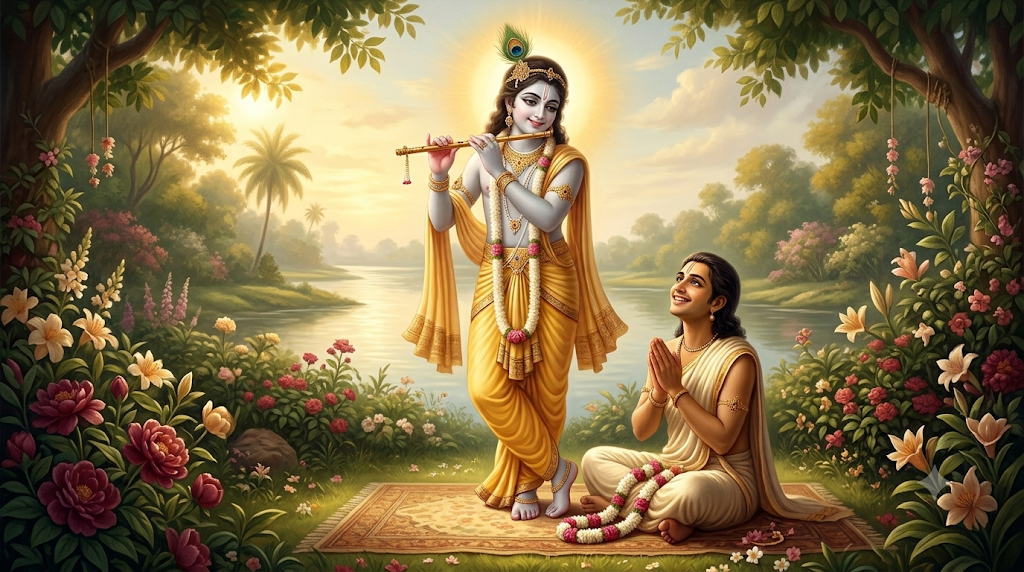
We all serve someone or something. Whether we are employees, business owners, parents, leaders or even kings, service is an inseparable part of our existence. But have we ever considered why we are always engaged in serving? Is service merely a responsibility imposed upon us, or is it actually our eternal nature?
Let us explore the meaning of duty, service and servitude, and understand why the Vedic scriptures describe the living entity as an eternal servant of Lord Krishna.
Duty, Service and the Identity of a Servant
One frequently used word in our daily lives is duty. What exactly is duty?
Dictionaries generally define duty as a moral or legal obligation, or a responsibility. Duty is closely associated with service. In ordinary conversation, we frequently use the word "service" to describe employment. Ask a software engineer, an army officer or a labourer about their profession, and they may describe themselves as being in service.
Now comes a word that some people may find uncomfortable: servant.
A servant is generally understood as a person who performs duties for another. Consider this simple example. If you employ someone and assign that person certain responsibilities, that person is serving you. Even if the person chooses not to perform the assigned duties, the responsibility does not automatically disappear. The person remains employed, although the service is not being performed properly.
This illustrates an important point: having a responsibility and actually fulfilling that responsibility are two different things.
Now, if we ask someone, "Are you a servant?", the response may be:
- "No, I have a job."
- "No, I run my own business."
- "How dare you ask me that? Do you know who I am?"
Yet, if we look carefully at our lives, we will find that service is present everywhere.
We have responsibilities towards our parents, family members, children, society and country. A person may be a government servant, civil servant, judge, teacher, software engineer, farmer, businessperson or household worker. Each performs some form of service.
Even in family life, husband and wife serve one another through love, care and responsibility. Parents serve their children by nurturing and protecting them, while children, as they grow, have responsibilities towards their parents.
And here is a lighter example. If you happen to see a wealthy person walking his dog every morning, you might ask yourself, "Who is serving whom here?" The owner may have to organise his morning routine around the dog's needs!
Of course, caring for a pet is an expression of affection and responsibility, not literal servitude. The example simply reminds us how service is woven into our everyday lives.
So, service is not something foreign to our nature. But the Vedic scriptures take this understanding much deeper. They explain that service is not merely a temporary social or professional role. It is the eternal constitutional position of the living entity.
Lord Caitanya Mahaprabhu explains this fundamental truth:
Jīvera 'svarupa' haya-kṛṣṇera 'nitya-dāsa'
The real identity of the living entity is that he is eternally a servitor of the Supreme Lord.
Chaitanya Charitamrita, Madhya 20.108
This is a profound statement. Our eternal identity is not that we are the master, enjoyer or controller. We are servants of Lord Krishna.
This does not mean that the living entity is equal to an ordinary material servant or that Krishna requires our service to fulfil some deficiency. Krishna is the Supreme Personality of Godhead, completely self-sufficient and the ultimate enjoyer. Our service is an expression of our natural loving relationship with Him.
Service in the Material World and the Spiritual World
Although service is our natural inclination, there is a fundamental difference between service in the material world and service in the spiritual world.
In material consciousness, service is frequently influenced by personal expectations. An employee works in exchange for a salary. An employer expects work in return for payment. A businessperson serves customers while expecting profit. Even within personal relationships, people may sometimes measure affection and commitment in terms of what they receive in return.
When service is based primarily on personal gain, it can easily turn into exploitation. A person may be valued only as long as he or she remains useful. When the expected benefit disappears, the relationship may also weaken.
The Srimad Bhagavatam describes some of the symptoms of Kali Yuga in this regard:
[In Kali Yuga] Servants will abandon a master who has lost his wealth, even if that master is a saintly person of exemplary character. Masters will abandon an incapacitated servant, even if that servant has been in the family for generations. Cows will be abandoned or killed when they stop giving milk.
Srimad Bhagavatam 12.3.36
[In Kali Yuga] Men will no longer protect their elderly parents, their children or their respectable wives. Thoroughly degraded, they will care only to satisfy their own bellies and genitals.
Srimad Bhagavatam 12.3.42
These descriptions are not merely observations about other people. They invite us to examine our own behaviour.
Do we value people only for what they can do for us? Do we continue to care for someone when that person can no longer offer us any material benefit? Do we fulfil our responsibilities with affection, or only when there is something to gain?
It is easy to criticise selfishness in society. It is much more difficult to recognise it within ourselves.
Krishna: The Supreme Lord Who Serves His Devotees
Let us consider a remarkable feature of the spiritual world.
In the material world, people generally aspire to occupy positions of authority. They want to be respected, obeyed and served. But the Supreme Personality of Godhead, Lord Krishna, displays an extraordinary quality in His dealings with His devotees.
Although He is the Supreme Lord, He takes pleasure in serving those who love Him.
Consider the pastime of Sudama Vipra. Sudama was a poor brahmana and a dear childhood friend of Krishna. When he visited Krishna in Dvaraka, the Supreme Lord personally welcomed him, seated him with great affection and washed his feet.
This pastime is described in the Srimad Bhagavatam (10.80.20-22). Krishna, the Supreme Personality of Godhead and the Lord of all creation, personally washed the feet of His devotee and friend, and even placed the water on His own head.
Think about the significance of this pastime. The Supreme Lord, whom great yogis strive to realise through years of austerity and meditation, personally serves His devotee out of love.
Krishna also displays this loving disposition in His relationship with Nanda Maharaja. He carries the shoes of His father, Nanda Maharaja, on His head. Similarly, He becomes the charioteer of Arjuna, serving him on the battlefield of Kurukshetra.
These are not ordinary acts of service. They reveal the extraordinary nature of the spiritual world, where loving relationships are not governed by pride, status or the desire to dominate others.
In the spiritual world, Krishna is the Supreme Lord, yet He willingly accepts different loving roles in relation to His devotees. His devotees, in turn, take pleasure in serving Him.
We may find it difficult to understand how the Supreme Lord, who is completely self-sufficient, can derive pleasure from serving His devotees. But this is the nature of transcendental loving relationships. Krishna is not compelled to serve, nor does He serve because He lacks anything. He does so out of His unlimited affection for His devotees.
The spiritual world is therefore not a place where everyone competes to become the master. It is a world where everyone finds happiness in loving service.


This is the spiritual world!
The Difference Between Exploitation and Pure Service
The Material world is the world of Exploitation. The spiritual world is a world of pure service.
HH Bhakti Charu Swami Maharaj
This statement captures the fundamental distinction between material and spiritual consciousness.
In material consciousness, even when we serve others, our minds may remain focused on our own satisfaction. We may want appreciation, recognition, power, wealth or reciprocation. In spiritual consciousness, service is rendered for the pleasure of Krishna, without the desire to exploit Him or use Him for our personal enjoyment.
This does not mean that every material relationship is devoid of affection or that every person in the material world acts selfishly. Rather, even genuine material affection remains vulnerable to the limitations of bodily identification, temporary relationships and material expectations. Pure devotional service is different because its centre is Krishna, the eternal Supreme Lord.
Now let us look at ourselves.
We may be comfortable serving someone who is wealthy, influential or powerful. But can we show the same respect and affection to someone who works in our home? Can we treat a domestic worker with dignity, gratitude and genuine concern? Can we put aside false prestige and serve another person when there is no material benefit for us?
Krishna's behaviour towards Sudama gives us a wonderful example of humility and loving service. If the Supreme Lord Himself personally washed the feet of His devotee, why should we hesitate to serve others with respect?
We should not imitate Krishna's position or assume that we can reproduce His transcendental activities. But we can learn from His example and cultivate humility, compassion and a genuine willingness to serve.
How Can We Begin Serving in Spiritual Life?
If our eternal identity is that of Krishna's servant, how do we practically revive that identity?
The Vedic scriptures explain that devotional service begins through the association of devotees, hearing about Krishna and chanting His holy names.
Srila Prabhupada explains the importance of chanting in his purport to Srimad Bhagavatam 6.2.11:
To chant the holy name and dance in ecstasy is so easy and sublime that one can achieve all the benefits of spiritual life simply by following this process. .... The Sankirtana movement we have started offers the best process for becoming purified of all sinful reactions and coming immediately to the platform of spiritual life.
Srimad Bhagavatam 6.2.11, purport
Chanting the holy name is not merely a religious ritual. It is a direct engagement of the soul in devotional service to Krishna. By chanting Hare Krishna, we gradually purify our consciousness and awaken our dormant love for the Lord.
Srila Prabhupada also explains the importance of association with devotees:
Simply by associating with a pure devotee, one becomes wonderfully advanced in Krishna Consciousness. Sadhu-sanga, or association with a devotee, means always engaging in Krishna Consciousness by chanting the Hare Krishna mantra but he whose heart is contaminated sees things differently. Therefore by sat-sanga, or association with devotees, one becomes perfectly pure in heart.
Srila Prabhupada
Association with devotees helps us understand the proper purpose of life and gives us the encouragement to practise devotional service. Through hearing, chanting and serving in their association, we gradually develop the right understanding and attitude.
Srila Prabhupada further explains:
In the devotional service of the Lord, the only qualification required is surrender. Surrendering oneself is in one’s hand. If one likes, he can surrender immediately, without delay and that begins his spiritual life.
Srila Prabhupada
This is an encouraging instruction. We do not have to wait until we become materially qualified, wealthy, influential or highly learned before beginning spiritual life. We can begin by sincerely surrendering to Krishna and following the process of devotional service under proper guidance.
Srila Prabhupada also emphasises:
One must seek the association of persons who are Krishna Conscious and who engage in devotional service. Without such association one cannot make advancement..
Srila Prabhupada
These instructions point towards a practical path: take shelter of devotees, hear and chant about Krishna, and engage our time, abilities and resources in His service.
Conclusion: Reviving Our Eternal Identity
We have seen that service is an inseparable part of our existence. In the material world, we serve our families, employers, customers, society and many others. But the Vedic scriptures reveal that our service does not begin with our material identity. It is rooted in the eternal nature of the soul.
As Lord Caitanya Mahaprabhu teaches, the living entity is the eternal servant of Krishna. Our real happiness is therefore found not in trying to become the master and enjoyer, but in reviving our loving relationship with the Supreme Lord.
The material world is characterised by the tendency to exploit and enjoy. The spiritual world is characterised by pure loving service. Krishna Himself demonstrates this through His extraordinary dealings with His devotees.
So, how can we begin experiencing the happiness of spiritual service in our present lives?
- Accept our eternal identity: Understand that we are servants of Krishna, not independent enjoyers.
- Chant the holy names: Regularly chant the Hare Krishna maha-mantra with attention and sincerity.
- Associate with devotees: Seek the company of those who are sincerely engaged in Krishna consciousness.
- Engage in devotional service: Use our time, talents and resources in ways that please Krishna.
- Cultivate humility: Learn to serve without demanding recognition, prestige or personal reward.
The Hare Krishna maha-mantra is:
Hare Krishna Hare Krishna
Krishna Krishna Hare Hare
Hare Rama Hare Rama
Rama Rama Hare Hare
Let us sincerely endeavour to revive our eternal relationship with Krishna. When service is rendered with love and devotion, it is no longer a burden or an obligation. It becomes the natural expression of the soul's eternal identity and the source of genuine spiritual happiness.
Thank you for visiting.
If you have liked it, then please share it with your friends and loved ones. Please feel free to suggest how we can further improve our service.
For more Krishna Conscious Articles & Arts, please visit - Our Blog | Site Map
Hare Krishna!


