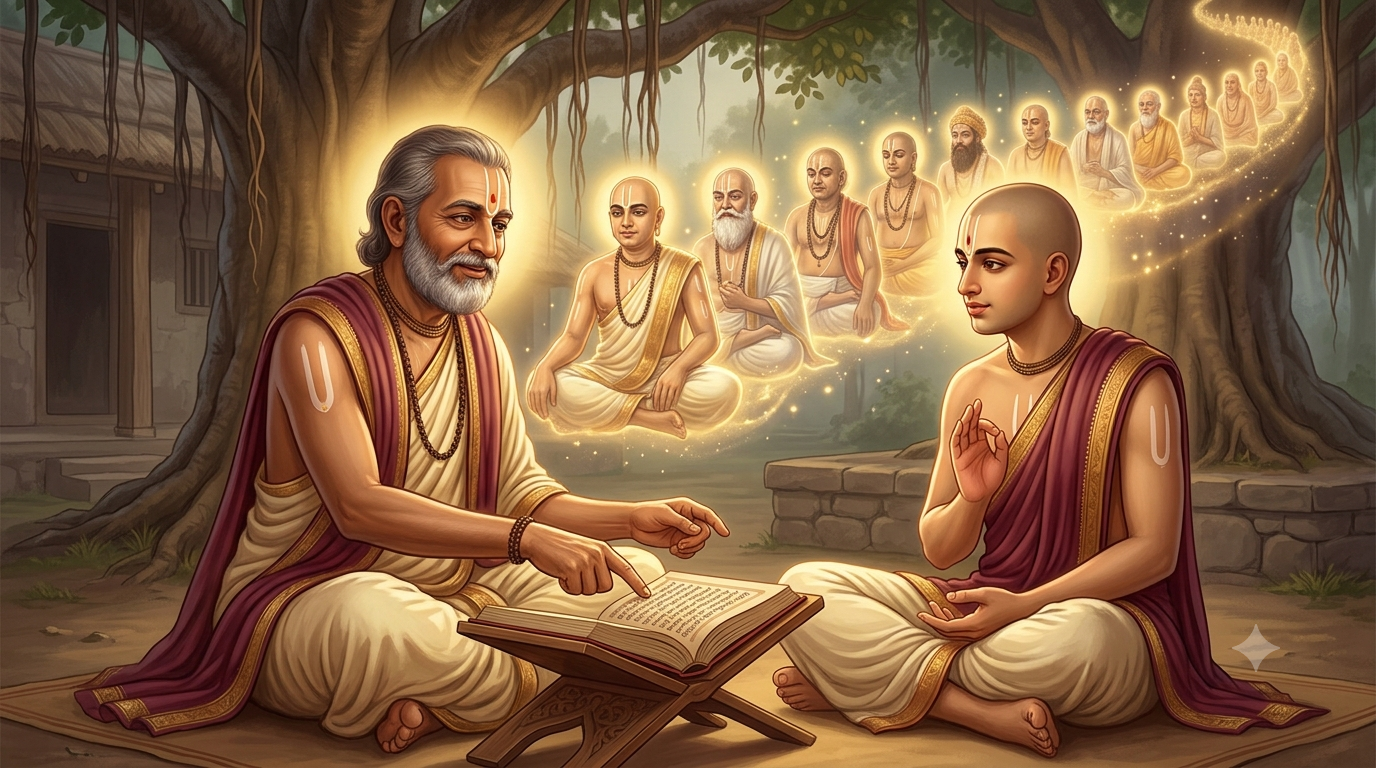
How can we distinguish authentic spiritual knowledge from personal opinion? The Vedic tradition teaches that transcendental knowledge is received through disciplic succession, known as sampradaya or guru-parampara. Discover why this succession matters, how to evaluate spiritual teachings, and what the four recognized Vaishnava sampradayas teach us about receiving knowledge of God.
1. What Is Sampradaya?
The Sanskrit word sampradaya refers to an established tradition through which spiritual teachings are transmitted. It is closely connected with the concept of parampara, or disciplic succession, in which a spiritual teacher receives knowledge from an authorized predecessor and passes it on to the next generation.
We may also call this the guru-shishya parampara: the succession of spiritual masters and disciples.
In the Bhagavad-gita, Lord Krishna explains that transcendental knowledge was received through such a succession:
evam parampara-praptam
imam rajarshayo viduh
sa kaleneha mahata
yogo nashtah parantapa
"This supreme science was thus received through the chain of disciplic succession, and the saintly kings understood it in that way. But in course of time the succession was broken, and therefore the science as it is appears to be lost."
Bhagavad-gita 4.2
Krishna does not present spiritual knowledge as something that should be repeatedly reinvented according to individual preference. He emphasizes its transmission through disciplic succession.
2. Understanding Sampradaya Through an Example
Imagine a battery, an electric wire, and a bulb. The bulb cannot glow merely because it is near the battery. A wire must connect the two, allowing electricity to flow.
Similarly, a spiritual teacher may speak about God, but speaking about God and faithfully transmitting knowledge received through an authentic spiritual tradition are not necessarily the same thing.
The analogy helps us understand two essential principles:
- Connection: Spiritual knowledge should be received through an authentic succession of teachers and disciples.
- Faithful transmission: The teachings must remain faithful to their original source rather than being altered to accommodate the personal opinions of individual teachers.

|
| Just as a wire connects a bulb to a battery, disciplic succession transmits spiritual knowledge from its source to the sincere seeker. |
3. Why Must Spiritual Knowledge Be Transmitted As It Is?
Consider a message passed from one person to another. If each person changes the message according to personal understanding, the final version may be very different from the original.
This is the familiar idea behind the telephone game. A message that begins accurately can become distorted when people add assumptions, omit important details, or replace the original meaning with their own interpretations.

|
| The telephone game illustrates the danger of changing a message as it passes from one person to another. |
Authentic disciplic succession is intended to preserve the essential teachings of the original source. This does not mean that every teacher must use identical words or examples. A teacher may explain a teaching in language suited to a particular audience, but the explanation should preserve the original meaning.
The distinction is between explaining a teaching and changing its substance.
For example, Bhagavad-gita 4.2 describes the transmission of spiritual knowledge through disciplic succession. In Bhagavad-gita 4.34, Krishna also instructs the seeker to approach a spiritual master, inquire submissively, and render service. Together, these verses establish the importance of both receiving knowledge through a qualified teacher and approaching that teacher with the proper attitude.
4. Why Is Sampradaya Important?
Spiritual knowledge concerns the nature of the self, the Supreme Lord, the purpose of human life, and our relationship with the Absolute Truth. These are not subjects that can be conclusively settled merely by personal preference or speculation.
We recognize the need for qualified instruction in many fields. A person who wants to become a doctor studies under qualified teachers, follows a structured curriculum, and learns established principles before practising independently.
Similarly, a sincere seeker of spiritual knowledge benefits from a genuine spiritual tradition that preserves its teachings, provides qualified guidance, and teaches the student how to understand scripture.
This does not mean that a teacher is authentic simply because the teacher belongs to a large institution, has many followers, speaks persuasively, or possesses academic qualifications. These things alone do not establish spiritual realization or fidelity to scripture.
We must examine the teachings themselves and the teacher's relationship with the authentic spiritual tradition they claim to represent.
5. Can We Understand Scripture Through Logic Alone?
Reason and careful examination are valuable. However, our present understanding is limited, and our conclusions can change as we gain knowledge.
Consider a student who has learned only whole numbers. If asked to identify a number between 1 and 2, the student may initially believe that no such number exists. After learning about fractions and decimals, the student discovers that the original understanding was incomplete.
The limitation was not that reasoning had no value. The limitation was that the student's reasoning was operating within an incomplete framework of knowledge.
Similarly, spiritual subjects should be studied systematically, with guidance from qualified teachers and reference to the relevant scriptures. We should neither accept every claim without examination nor dismiss a teaching simply because it does not fit our current understanding.
The Katha Upanishad describes the limitations of mere intellectual ability in the pursuit of spiritual realization:
nayamatma pravachanena labhyo
na medhaya na bahuna shrutena
"This Self cannot be attained by mere discourse, nor by intellectual power, nor by much hearing."
Katha Upanishad 1.2.23, opening lines
The verse continues by explaining that the Self reveals its nature to the one to whom it becomes accessible. The teaching cautions us against assuming that eloquence, intelligence, or extensive study alone guarantees spiritual realization.
Bhagavad-gita 4.34 gives a practical direction: approach a self-realized spiritual master, inquire sincerely, and render service. A genuine spiritual teacher helps the student understand spiritual knowledge rather than encouraging blind acceptance or independent speculation.
6. Why Should We Examine a Spiritual Teacher's Teachings?
Suppose a person receives medicine mixed into a piece of bread. If the person eats only the bread and rejects the medicine, the intended treatment is lost.
In a similar way, a spiritual speaker may quote scripture while leaving out its central teaching or presenting it in a way that changes its meaning. The presence of scriptural quotations does not automatically establish that the speaker's conclusions are faithful to the text.
For a seeker studying the Bhagavad-gita, an important question is whether the teacher addresses what Krishna actually says in the text, explains the verses in their context, and supports the interpretation with relevant scriptural teachings.
For example, Krishna states:
mattah parataram nanyat
kinchid asti dhananjaya
mayi sarvam idam protam
sutre mani-gana iva
"O conqueror of wealth, there is no truth superior to Me. Everything rests upon Me, as pearls are strung on a thread."
Bhagavad-gita 7.7
A responsible explanation should address this statement directly and consider its meaning alongside the wider teachings of the Bhagavad-gita. An interpretation should not simply replace the text's explicit statement with an unsupported personal theory.
Likewise, knowledge of Sanskrit is useful but does not, by itself, establish that someone understands the spiritual conclusions of a scripture. Language skills, academic study, personal experience, and spiritual realization are related but distinct qualifications.
We should therefore examine a teacher's conclusions, the evidence offered for them, and their consistency with the relevant scriptural tradition.
7. The Guru, Sadhu, and Sastra Test
In the Vaishnava tradition, the teachings of a spiritual guide should be examined in harmony with three important sources: guru, sadhu, and sastra.
- Guru: Examine what the spiritual teacher teaches and how the teacher applies those teachings in life.
- Sadhu: Compare the explanation with the teachings of saintly persons and recognized acharyas in the spiritual tradition.
- Sastra: Check whether the explanation is supported by scripture and consistent with its intended meaning.
These are not three competing authorities. They should support and illuminate one another. A spiritual claim deserves careful scrutiny when it contradicts the scripture it claims to explain or conflicts with the established teachings of the tradition without a sound explanation.
Popularity, charisma, eloquence, institutional size, and claims of special revelation should not replace this examination.
8. What Are the Four Recognized Vaishnava Sampradayas?
Vaishnava literature traditionally identifies four principal disciplic successions: the Sri, Brahma, Rudra, and Kumara sampradayas. A well-known verse quoted by Vaishnava acharyas states:
sampradaya-vihina ye
mantras te nishphala matah
"Mantras that are not received through an authorized disciplic succession are considered ineffective."
A verse traditionally attributed to the Padma Purana and quoted in Vaishnava literature
The verse is commonly cited in discussions of the importance of receiving spiritual mantras through an authorized Vaishnava succession. The longer passage identifies four recognized Vaishnava traditions and associates them with their principal acharyas.
The four are traditionally identified as follows:
- Sri Sampradaya: Associated with Sri Lakshmi and represented by Sri Ramanujacharya.
- Brahma Sampradaya: Associated with Lord Brahma and represented by Sri Madhvacharya.
- Rudra Sampradaya: Associated with Lord Shiva and represented by Sri Vishnuswami.
- Kumara Sampradaya: Associated with the four Kumaras and represented by Sri Nimbarkacharya.
These four successions are recognized within the traditional Vaishnava framework discussed in this article. The statement should be understood in that context rather than as a claim that no other religious or spiritual traditions exist.
For a practitioner, the important principle is that initiation and spiritual instruction should be received through an authentic tradition, with its teachings preserved and explained by qualified representatives.
9. How Does ISKCON Connect to Guru Parampara?
The International Society for Krishna Consciousness (ISKCON), also known as the Hare Krishna movement, follows the Brahma-Madhva-Gaudiya Vaishnava tradition.
Srila A. C. Bhaktivedanta Swami Prabhupada, the founder-acharya of ISKCON, presented Krishna consciousness through the teachings of the previous acharyas and the scriptures. His books, lectures, and instructions emphasize receiving spiritual knowledge through disciplic succession rather than manufacturing a new interpretation according to personal preference.
The succession presented in the introduction to Bhagavad-gita As It Is traces the line through Krishna, Brahma, Narada, Vyasa, Madhva, and subsequent acharyas, eventually reaching Sri Chaitanya Mahaprabhu and the Gaudiya Vaishnava acharyas, including Srila Bhaktisiddhanta Sarasvati Thakura and Srila Prabhupada.
This succession provides the historical and theological framework through which ISKCON presents its teachings. To understand those teachings properly, students should study Srila Prabhupada's books alongside the Bhagavad-gita, Srimad-Bhagavatam, and the works of the previous acharyas.
The aim is not simply to identify a name in a list. It is to learn the teachings that the succession has preserved and to apply them sincerely in one's spiritual life.
10. What If We Discover a Problem with Our Spiritual Guide?
Choosing a spiritual guide is a serious responsibility. A seeker may sometimes discover that a teacher's teachings are inconsistent with scripture or with the principles the teacher originally claimed to represent.
Such a situation should not be handled impulsively or through hostility. The seeker should carefully examine the evidence, consult knowledgeable and trustworthy Vaishnavas, and distinguish between a teacher's limited knowledge, a correctable mistake, and a fundamental departure from the teachings of the tradition.
The story of Bali Maharaja provides an important example of the tension that can arise between obedience to a spiritual guide and one's duty to the Supreme Lord.
When Lord Vamanadeva approached Bali Maharaja during his sacrifice, Sukracharya recognized Him as Lord Vishnu and advised Bali Maharaja not to fulfil the promise he had made to Vamanadeva. Bali Maharaja nevertheless chose to honour his promise to the Lord.
The episode is not a licence to reject a spiritual master whenever we disagree with him. Rather, it illustrates that spiritual discernment must be grounded in a serious understanding of dharma and the authority of the Supreme Lord. The story should be studied in its scriptural context before drawing conclusions about one's own spiritual circumstances.
If a genuine concern arises about a spiritual guide, seek guidance from qualified devotees and examine the relevant scriptural teachings before deciding how to proceed.
11. How Should We Approach Authentic Spiritual Knowledge?
Bhagavad-gita 4.34 provides a clear method for learning transcendental knowledge:
tad viddhi pranipatena
pariprashnena sevaya
upadekshyanti te jnanam
jnaninas tattva-darshinah
"Just try to learn the truth by approaching a spiritual master. Inquire from him submissively and render service unto him. The self-realized souls can impart knowledge unto you because they have seen the truth."
Bhagavad-gita 4.34
This verse identifies three important elements of spiritual learning:
- Pranipata: Approaching the spiritual master with humility.
- Pariprasna: Asking sincere and relevant questions to understand the truth.
- Seva: Serving the spiritual master with a genuine desire to learn and apply the teachings.
These principles work together. Humility without sincere inquiry can become passive acceptance. Questions without humility can become an exercise in argument. Learning without service may remain intellectual rather than transformative.
A sincere student combines all three, while carefully studying scripture and the teachings of the recognized spiritual tradition.
Conclusion: Seek the Source, Not Just the Speaker
Sampradaya and guru-parampara help preserve spiritual knowledge and connect the seeker with a tradition of teachers who transmit it. Their importance lies not merely in institutional identity or an impressive lineage, but in the faithful preservation and application of spiritual teachings.
Before accepting spiritual instruction, examine the teacher's teachings, compare them with the explanations of previous acharyas, and verify them against scripture. Do not confuse popularity with authenticity, eloquence with realization, or personal opinion with established spiritual knowledge.
At the same time, approach the subject with humility, fairness, and a sincere desire to understand. The purpose of this examination is not to criticize others but to help us find reliable guidance and make genuine spiritual progress.
For those following the path of Krishna consciousness, the teachings of Lord Krishna, Srila Prabhupada, and the previous acharyas provide a foundation for studying spiritual knowledge through the Brahma-Madhva-Gaudiya disciplic succession.
Hare Krishna!
Thank you for reading this article. If you found it helpful, please share it with others who are sincerely seeking spiritual knowledge.


Excellent
Wow!
What a beautiful explanation
Hariii Boll