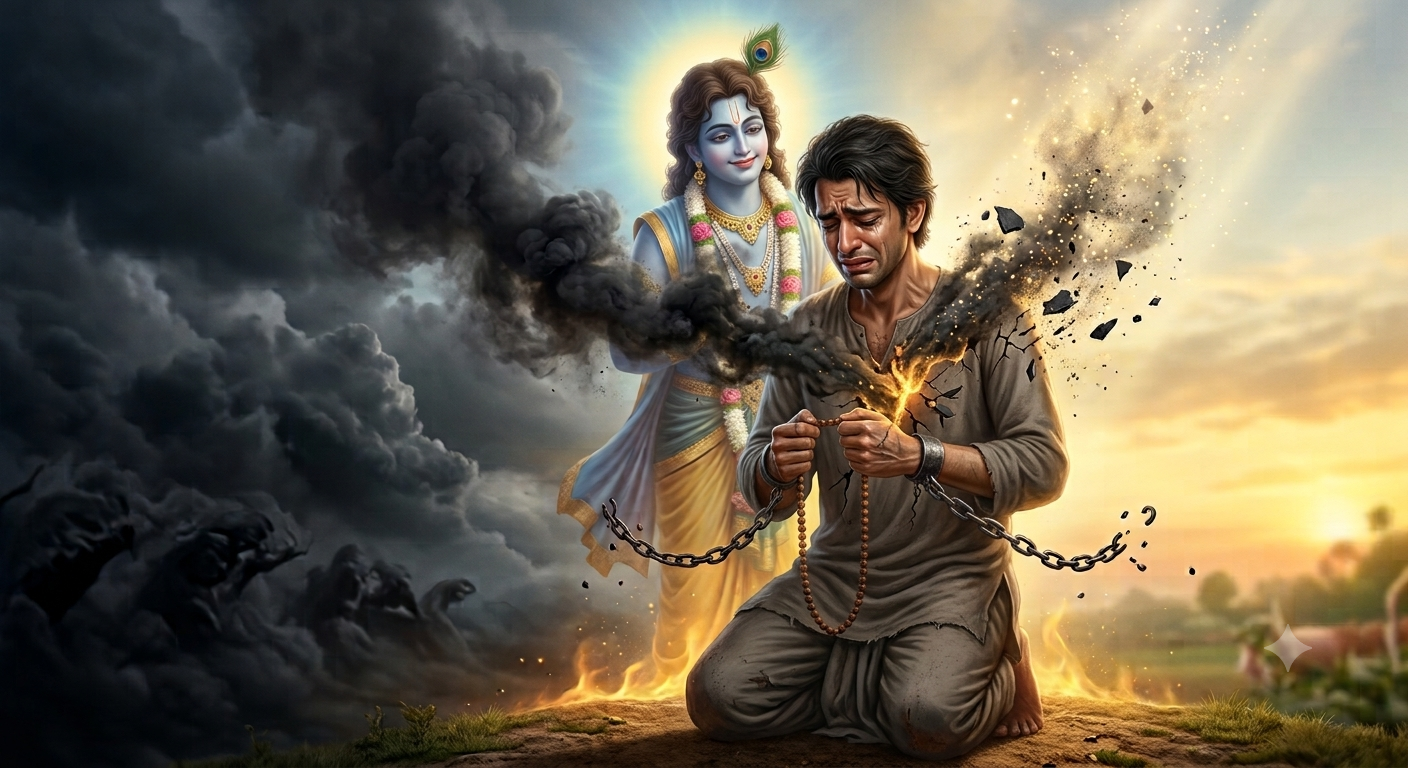
The process of purification is central to spiritual life. As conditioned souls, we carry many impurities in our consciousness, such as lust, anger, greed, pride and envy. Krishna consciousness offers the means to cleanse the heart and restore our original identity as loving servants of Krishna. However, this purification is not always comfortable. Through chanting, hearing and the association of devotees, Krishna gradually transforms our consciousness. Even difficult experiences can become opportunities for introspection, surrender and spiritual growth.
Kṛṣṇa consciousness is itself the purifying process, and by the direct method of devotional service it is simultaneously easy and sublime.
Bhagavad Gita 3.3, Purport
Purification
In its literary sense, purification means getting rid of contamination so that a substance can return to its original pure state.
To understand the process of purification applicable to us, we must first understand our original state and identify the contaminants that cover our consciousness.
Pure State, Contaminated State
As living spiritual souls, we are all originally Kṛṣṇa conscious entities, but due to our association with matter from time immemorial, our consciousness is now adulterated by the material atmosphere.
...
The basic principle of all such misgivings is the false consciousness that I am the lord of all I survey.
Chapter 6: The Hare Kṛṣṇa Mantra, Krsna Consciousness, the Topmost Yoga System, A.C. Bhaktivedanta Swami Prabhupada
Srila Prabhupada describes our pure and contaminated states in a remarkably simple way. In our original state of consciousness, we are Krishna conscious. In the contaminated state, we forget our spiritual identity and begin to consider ourselves the controllers and enjoyers of everything and everyone.
This misidentification arises from false ego. Because we identify ourselves as the enjoyers, we develop further material attachments and impurities.
These impurities are broadly classified as:
- Kama - lust
- Krodha - anger
- Lobha - greed
- Moha - illusion
- Mada - madness or pride
- Matsarya - envy
Therefore, purification means removing these impurities, commonly described as anarthas, while also addressing their root cause: our false identification.
Ego, in itself, is the principle through which we identify ourselves. Our true identity is that we are eternal spiritual souls, meant to love and serve Krishna. False ego makes us identify ourselves as independent enjoyers and controllers.
This enjoying propensity manifests in both gross and subtle forms. Gross enjoyment involves the gratification of the senses. Subtle enjoyment includes the desire for profit, adoration and distinction, known as labha, puja and pratishtha.
Thus, one of the major steps in purification is to transform our false identification into our true spiritual identity. Without this transformation, the purification process remains incomplete.
Pure Is Attractive, Purification May Be Painful

In almost every purification process, the final result is attractive, but the process itself may require considerable effort, time and energy.
Consider dental cleaning, polishing a diamond or purifying gold and silver through fire. The finished product may look beautiful, but the process of achieving that result is not necessarily comfortable.
Despite the effort involved, people willingly undergo such processes because they value the final result. Similarly, Krishna, the Supreme Personality of Godhead, carefully guides the purification of the hearts of His devotees.
Various revealed scriptures describe the Lord's concern for the purification of the heart and consciousness.
And he shall sit as a refiner and purifier of silver: and he shall purify the sons of Levi, and purge them as gold and silver, that they may offer unto the LORD an offering in righteousness.
Holy Bible, Malachi 3.3
Boy and His Puppy

Once, a boy saw six puppies playing beside a road. He went closer to play with them. Among the puppies, one was especially friendly and playful. The boy became attached to it and picked it up, intending to take it home.
On the way, he noticed dirt and filth on the puppy's fur. The first thing he did was put the puppy in a tub and give it a proper bath.
It may have been the puppy's first bathing experience. It did not like the water, the smell of the soap or the unfamiliar surroundings. It cried, jumped and tried to escape the boy's grip. However, the boy was determined to clean it thoroughly.
The puppy might have wondered why its siblings were apparently enjoying themselves on the roadside while it was undergoing this unpleasant experience. It might even have regretted allowing the boy to pick it up.
Why did the boy not let the puppy go, even though it was clearly uncomfortable?
The answer is love and affection.
Had the puppy escaped and returned to the roadside, it might have enjoyed its immediate freedom. However, it would also have continued to face dirt, lice and itchy skin.
Similarly, Krishna, out of His causeless mercy, provides the means for us to become purified. The process may not always be pleasant. However, if we remain sincere and continue taking shelter of Him, the result is spiritual advancement.
To remain in the process means to continue our devotional practices through difficulties rather than abandoning them and returning to our previous patterns of material consciousness.
Great devotees have demonstrated remarkable determination and faith while facing difficult circumstances. Their lives inspire us to remain steady in devotional service.
How Does Krishna Purify His Devotees?

To clean a dirty piece of cloth, we generally need three things:
- Washing powder
- Plenty of clean water
- A brush or scrubber
Similarly, Krishna, through the process of Krishna consciousness, provides three essential elements for cleansing our consciousness:
- Hari Naam - the washing powder
- Sravana, or hearing - the clean water
- Devotees - the brush or scrubber
Hari Naam
Hare Kṛṣṇa, Hare Kṛṣṇa, Kṛṣṇa Kṛṣṇa, Hare Hare is the transcendental process for reviving this original pure consciousness. By chanting this transcendental vibration, we can cleanse away all misgivings within our hearts.
Chapter 6: The Hare Kṛṣṇa Mantra, Krsna Consciousness, the Topmost Yoga System, A.C. Bhaktivedanta Swami Prabhupada
'After searching through all the Vedic literature, one cannot find a method of religion more sublime for this age than the chanting of Hare Krishna.'
Kali-santarana Upanishad
The chanting of the Hare Krishna Maha Mantra is not merely a religious activity. It is the direct process for reviving our original spiritual consciousness. By sincerely chanting the holy names, we invite Krishna into our lives and allow the heart to become cleansed of material contamination.
Sravanam
Chanting and hearing are inseparable parts of devotional service. Hearing about Krishna, His names, His qualities and His pastimes gradually purifies our desires and redirects our consciousness towards Him.
Prabhupāda: That is not possible. Suppression willing, that is not possible. He has to change the quality of willing; then he will be happy. And that is bhakti. Sarvopādhi-vinirmuktaṁ tat-paratvena nirmalam (CC Madhya 19.170). The process of willing should be purified. Then he will be happy. And the process of purifying the willing is bhakti, śravaṇaṁ kīrtanaṁ viṣṇoḥ (SB 7.5.23), chanting and hearing of the pastimes, all about the Lord. That will purify him. He is missing the point that he is individual, accepting that life is eternal, and still he wants, prefers this nirvāṇa. But he does not know what is nirvāṇa. Nirvāṇa means this kind of whimsical willing is troublesome. He has to stop this whimsical willing. He has to come to the standard willing. That is Kṛṣṇa consciousness.
Srila Prabhupada, Philosophy Discussion on Arthur Schopenhauer
So the most important item is śravaṇam, or hearing. If you do not do anything else, if you simply sincerely hear about God, then gradually you will be God conscious.
Srila Prabhupada, Initiation Lecture, Caracas, February 22, 1975
The most important thing for a devotee is getting a chance to hear about the pastimes and glories of the Lord.
Srimad Bhagavatam 4.30.33, Purport
Hearing about Krishna is therefore essential. We should regularly hear Srila Prabhupada's books, lectures and instructions, along with the teachings of our spiritual master and senior Vaishnavas.
Devotees
Soap and water are essential for cleaning a piece of cloth, but the brush also plays an important role. The more dirt the cloth has accumulated, the more effort may be required to clean it.
Similarly, the association of devotees plays an important role in our purification. Through their instructions, encouragement, correction and example, devotees help us recognise and overcome our shortcomings.
Just as a diamond is polished with the help of another diamond, the association of sincere devotees helps us refine our devotional character.
Such interactions may take different forms:
- Correction and chastisement from spiritual authorities, such as the spiritual master or responsible leaders.
- Honest feedback from peers.
- Clarification of misunderstandings and allegations.
- Learning to respond to envy, jealousy and disagreements within devotional communities.
A sincere devotee who receives genuine correction should try to understand it and rectify any mistake. However, situations involving false allegations, unfair treatment, envy or organisational politics can be particularly difficult to navigate.
There have been instances in which sincere devotees, despite their efforts to serve selflessly, have faced difficult experiences within devotee communities. Such experiences can shake the faith of newer devotees. Those whose spiritual practices are not yet steady may sometimes find it difficult to continue.
This is why mature, honest and compassionate leadership is essential.
Bhishmadeva: “Compassion must be a part of the leader’s mental make-up, but he must guard against displaying a too-forgiving nature, because then he will be considered weak by low men, and they will take advantage of him.”
H.H. Bhakti Tirtha Swami, Leadership for an Age of Higher Consciousness, Volume II: Ancient Wisdom for Modern Times
A leader should not confuse compassion with the absence of accountability. When someone commits an offence or causes harm, appropriate correction may be necessary. A leader must balance kindness with firmness and ensure that decisions are fair, responsible and aimed at genuine rectification.
During my engineering days, I heard an incident about a wealthy landlord who had five servants. One of them had served the family for generations and was extremely faithful and loyal. The others, however, had formed a group and were stealing money and belongings from the house.
The loyal servant repeatedly tried to warn the landlord, but the others would present explanations and convince him that nothing was wrong. Eventually, the loyal servant had no choice but to leave his employment.
Within a year, the landlord was at the police station filing an FIR against the servants for a major robbery. Had he taken the warnings seriously and investigated the matter in time, he might have avoided considerable loss and distress.
We may assume that such incidents should never occur in Krishna conscious communities. However, we must remember that we are living in Kali-yuga. People enter spiritual institutions with different levels of spiritual advancement and different motivations. Therefore, the presence of material conditioning cannot be ruled out.
New devotees may find this difficult to understand. They may wonder how material disqualifications can exist within a spiritual association. If they have been introduced only to an ideal picture of devotional life, the discovery of imperfections can seriously affect their faith.
It is therefore the responsibility of devotees and preachers to present an honest and balanced understanding. We should not hide the challenges that may arise in spiritual communities. Instead, we should help newcomers understand the importance of good association, spiritual discipline, discernment and accountability.
This will help them develop a mature foundation in Krishna consciousness. Their faith will then rest on Krishna, Srila Prabhupada and the teachings of scripture, rather than on the expectation that every individual in a spiritual institution will always behave perfectly.
We can learn from Srila Prabhupada, the founder-acharya of the Hare Krishna movement, who did not conceal the challenges that could arise within the institution he established. He gave clear instructions on how devotees should deal with envy and jealousy.
... One who is envious of the success of a Vaiṣṇava is certainly not a Vaiṣṇava himself but is an ordinary, mundane man. Envy and jealousy are manifested by mundane people, not by Vaiṣṇavas. ... A mundane person in the dress of a Vaiṣṇava should not be respected but rejected. This is enjoined in the śāstra (upekṣā). The word upekṣā means neglect. One should neglect an envious person. A preacher’s duty is to love the Supreme Personality of Godhead, make friendships with Vaiṣṇavas, show mercy to the innocent and reject or neglect those who are envious or jealous. There are many jealous people in the dress of Vaiṣṇavas in this Kṛṣṇa consciousness movement, and they should be completely neglected. There is no need to serve a jealous person who is in the dress of a Vaiṣṇava. When Narottama dāsa Ṭhākura says chāḍiyā vaiṣṇava sevā nistāra peyeche kebā, he is indicating an actual Vaiṣṇava, not an envious or jealous person in the dress of a Vaiṣṇava.
Sri Caitanya-caritamrita, Madhya 1.218, Purport
Envy and jealousy can lead to groupism, politics and disharmony within devotee communities. Srila Prabhupada's instructions help us recognise such tendencies and understand how to protect our devotional lives.
At the same time, we should be careful not to use these instructions as a reason to judge people casually. We must examine situations honestly, distinguish genuine correction from unfair treatment, and seek guidance from mature Vaishnavas.
Mood of Krishna
Sometimes a question arises: Why do people who appear envious or materialistic receive attention, recognition and material prosperity, while sincere devotees sometimes face criticism, accusations and difficulties?
To understand this, we must consider how Krishna reciprocates with the living entities.
ye yathā māṁ prapadyante tāṁs tathaiva bhajāmy aham.
As all surrender unto Me, I reward them accordingly.
Srimad Bhagavad Gita 4.11
Krishna reciprocates according to the consciousness and desires of each living entity. He does not forcibly take away our free will.
If someone approaches a temple primarily seeking recognition, position, name or fame, Krishna may allow that person to pursue those desires. If someone approaches with a genuine desire to serve Hari, Guru and Vaishnavas, that person may also receive opportunities to examine and purify the heart.
These opportunities may come through correction, criticism, misunderstandings or other challenging circumstances. However, we should not automatically assume that every painful experience is a sign of special mercy or that every person involved is acting as an instrument of Krishna. We must also act with intelligence, seek proper guidance and address wrongdoing responsibly.
Our responsibility is to use every circumstance as an opportunity for introspection, deeper surrender and stronger devotional practice.
ISKCON has witnessed remarkable examples of devotees who continued serving despite facing difficult circumstances. One such example often discussed in the history of the movement is that of HH Tamal Krishna Goswami Maharaj.
He rendered dedicated service to Srila Prabhupada and ISKCON through many challenging periods. His life inspires us to remain committed to devotional service rather than allowing criticism or a lack of recognition to become the centre of our consciousness.
We should not presume to compare our own circumstances with those of great personalities. However, we can learn from their determination and their commitment to service.
Our goal is not to please everyone, impress everyone or prove ourselves to everyone. Our goal is to serve Hari, Guru and Vaishnavas with sincerity.
Blessing in Disguise
Bali Maharaj was the ruler of the lower planetary systems and the Earth. He was preparing to perform a final yajna that would have further empowered him to conquer the higher planetary systems. In terms of material possessions and influence, he was at the height of his power.
Then Lord Vamanadeva appeared and asked him for three steps of land. Through this pastime, Bali Maharaj lost everything he had possessed.
From an ordinary material perspective, the situation appeared disastrous. He lost his kingdom, possessions and position. Those who had once feared him now celebrated his apparent defeat. Yet Bali Maharaj remained composed.
He did not become resentful towards the Lord. He understood that the Lord had given him something far greater than material possessions: the opportunity to surrender completely and attain his eternal position as the Lord's servant.
The pastime teaches us that Krishna's mercy cannot be measured by material prosperity, public recognition, position or influence. His mercy is ultimately directed towards our spiritual welfare.
Sometimes, a circumstance that appears to be a loss from the material perspective may become an opportunity for deeper spiritual understanding. We should therefore try to look beyond immediate circumstances and strengthen our faith in Krishna.
Our Attitude
One’s greatness has to be estimated by one’s ability to tolerate provoking situations.
Srila Prabhupada
Tolerance is an important quality in Krishna consciousness. HH Radhanath Swami Maharaj has explained that we should be especially careful about how we respond when we ourselves are offended.
If someone offends the Lord or His devotees, we should take appropriate steps to protect them. However, when an offence is directed towards us personally, we should examine our own response and try to remain humble and tolerant.
Great personalities in scripture have demonstrated this quality even when they were not at fault:
- Parikshit Maharaj was cursed to die by Shringi.
- Ambarish Maharaj was attacked by the anger of Durvasa Muni.
- Srivas Thakur was falsely accused by Gopala Chapala.
- Haridas Thakur was beaten by the soldiers of an envious Kazi in twenty-two marketplaces.
- Prahlad Maharaj faced repeated attempts on his life by his own father.
When we find ourselves in difficult situations involving conflict, criticism or unfair treatment, our first impulse may be to quit our service, leave the association of devotees or even abandon the institution.
Before making such decisions, we should pause, strengthen our sadhana and seek guidance from mature devotees. We should examine whether there is a genuine lesson to learn, whether we need to correct something in ourselves, or whether appropriate boundaries and responsible action are necessary.
We cannot imitate great personalities such as Kunti Maharani, who prayed for calamities because of her unwavering remembrance of Krishna. However, we can pray for the strength to remember Him and take shelter of Him during difficult circumstances.
We should not allow painful experiences to weaken our faith in Krishna or make us abandon the process of devotional service. At the same time, tolerating difficulties does not mean accepting misconduct or injustice as unavoidable. A sincere devotee should remain humble while also acting responsibly.
Surviving the Intense Process of Purification
Consider a piece of cloth being scrubbed very hard with little or no water. The fabric may become damaged or torn. Similarly, if we scrub a cloth without applying soap or detergent, the cleaning process becomes less effective.
This analogy also helps us understand the importance of sadhana during difficult phases of life.
When we face intense challenges, we must not neglect the essential practices that nourish our spiritual lives. If we experience pressure without taking sufficient shelter of Hari Naam and hearing, we may become discouraged and spiritually weakened.
This is why we should remain especially sincere and focused on our regular sadhana:
- Chanting the Hare Krishna Maha Mantra.
- Reading Srila Prabhupada's books.
- Hearing Srila Prabhupada's lectures and instructions.
- Hearing from our spiritual master and senior Vaishnavas.
- Maintaining the association of sincere devotees.
Another useful analogy is that of a washing machine. During the cleaning process, clothes move in different directions. They are sometimes pushed deep into the water and sometimes brought towards the surface. The direction of the movement may also change.
Our purification process may sometimes feel like being caught in such a whirlpool. We try to make adjustments, but circumstances keep changing. Plans fail, new difficulties arise and we struggle to understand what is happening.
We may wonder: "I am trying my best to adjust to the situation. Why do these difficulties continue?"
When we are caught in the middle of a difficult situation, it may be hard to understand its larger context. We may not immediately recognise what we need to learn or how the situation will affect our spiritual lives.
Rather than becoming overwhelmed, we should take shelter of the process given in Srimad Bhagavatam and explained by Srila Prabhupada.
naṣṭa-prāyeṣv abhadreṣu
nityaṁ bhāgavata-sevayā
bhagavaty uttama-śloke
bhaktir bhavati naiṣṭhikī
By regular attendance in classes on the Bhāgavatam and by rendering of service to the pure devotee, all that is troublesome to the heart is almost completely destroyed, and loving service unto the Personality of Godhead, who is praised with transcendental songs, is established as an irrevocable fact.
Srimad Bhagavatam 1.2.18
Here is the remedy for eliminating all inauspicious things within the heart which are considered to be obstacles in the path of self-realization. The remedy is the association of the Bhāgavatas. There are two types of Bhāgavatas, namely the book Bhāgavata and the devotee Bhāgavata. Both the Bhāgavatas are competent remedies, and both of them or either of them can be good enough to eliminate the obstacles. A devotee Bhāgavata is as good as the book Bhāgavata because the devotee Bhāgavata leads his life in terms of the book Bhāgavata and the book Bhāgavata is full of information about the Personality of Godhead and His pure devotees, who are also Bhāgavatas. Bhāgavata book and person are identical.
Srimad Bhagavatam 1.2.18, Purport
Therefore, we should focus on four essential practices:
- Intensify our sadhana. Remain steady in chanting, hearing and reading, especially during difficult periods.
- Take shelter of the book Bhagavata. Study Srimad Bhagavatam and other scriptures carefully.
- Take shelter of the devotee Bhagavata. Hear the teachings and instructions of pure devotees such as Srila Prabhupada and our spiritual master through their vani.
- Seek guidance from senior and sincere devotees. Practise guhyam ākhyāti pṛcchati (Nectar of Instruction, Verse 5) by confidentially sharing our concerns and seeking spiritual guidance.
Surviving in the Association of Vaishnavas
We should cultivate tolerance during difficult circumstances. However, this does not mean that we must maintain close personal association with everyone, irrespective of their conduct.
We can offer respect to everyone while choosing our close association carefully. If someone's behaviour repeatedly creates an unhealthy or spiritually damaging environment, we may need to maintain appropriate boundaries.
This is not the same as harbouring hatred or resentment. We should avoid developing grudges, remain free from the desire for revenge and seek to protect our devotional lives.
Srila Prabhupada and the acharyas have given clear instructions about how to understand different levels of devotees and how to choose our association.
A devotee should have intelligence to know who is deviating. Surrender by your intelligence but don't surrender your intelligence.
Srila Prabhupada, 1974 letter to Bali Mardan
mentally honor the devotee who chants the holy name of Lord Kṛṣṇa,
one should offer humble obeisances to the devotee who has undergone spiritual initiation [dīkṣā] and is engaged in worshiping the Deity,
associate with and faithfully serve that pure devotee who is advanced in undeviated devotional service and whose heart is completely devoid of the propensity to criticize others.
Nectar of Instruction, Verse 5
love the Supreme Personality of Godhead, make friendships with Vaiṣṇavas, show mercy to the innocent and reject or neglect those who are envious or jealous. There are many jealous people in the dress of Vaiṣṇavas in this Kṛṣṇa consciousness movement, and they should be completely neglected. There is no need to serve a jealous person who is in the dress of a Vaiṣṇava.
Sri Caitanya-caritamrita, Madhya 1.218, Purport
associate only with devotees who are sincerely aspiring.
H.H. Radhanath Swami Maharaj
The objective is not to become judgemental towards others. Rather, we should develop the intelligence to understand the nature of association and its influence on our devotional lives.
Understanding Vaishnava Aparadha
Sometimes, fear of committing Vaishnava aparadha can leave us confused. We may wonder whether we should speak up about misconduct, how to express disagreement or how to respond when we are part of a management team or service group.
In a class on Srimad Bhagavatam 7.10.5 on August 17, 2003, HH Radhanath Swami Maharaj was asked a question about this subject.
Question: When engaged in service with devotees for an event, the time may be short and the pressure very high. Considering the consequences of a mistake and the effect it may have on many devotees, sometimes one may flare up when something does not happen as instructed. In such cases, what is the practical advice on keeping one's cool?
Points from the answer by HH Radhanath Swami Maharaj:
- When we are trying to serve the Vaishnavas, and we become excited, sometimes overexcited, under the pressure of our service, that is not a serious offense.
- If we are intentionally trying to harm someone, if we are intentionally trying to ridicule or minimize a person's position in the eyes of others, that is an offense.
- But if we simply, "no-no you do like that, not like that", that is not offensive.
- However, if you have hurt somebody's heart by doing it, then you should ask for forgiveness.
- But the provoking situations are when we are offended, when we are insulted, or when lust, envy, anger, greed, pride, illusion comes upon us.
- Sometimes, in the service of others, we may act in an excited way, then we should be careful to do it in such a way that we have not hurt the heart of others. And if we do, we should ask for forgiveness.
- But that is not offensive.
- The offense is when you deliberately try to avenge someone for what they have done to you, or when we give in to our lower nature.
HH Radhanath Swami Maharaj, class on Srimad Bhagavatam 7.10.5, August 17, 2003
This guidance helps us distinguish between an emotionally charged response under pressure and a deliberate attempt to harm or humiliate someone.
When we realise that our words or actions have hurt another devotee, we should be willing to apologise and seek forgiveness. Similarly, when someone behaves improperly towards us, we should respond without revenge or hatred while taking appropriate steps to address the situation.
We should not use the concept of tolerance to justify wrongdoing. Nor should we use the concept of Vaishnava aparadha to silence sincere questions or prevent responsible correction.
Summary
The process of purification is an essential part of Krishna consciousness. Krishna reciprocates with the living entities according to their desires and consciousness. Through devotional service, He gives us the opportunity to cleanse our hearts and return to our original spiritual identity.
We should remember these principles:
- Krishna consciousness is the purifying process.
- Hari Naam, hearing and devotee association are essential for purification.
- Difficult circumstances can become opportunities for introspection and spiritual growth.
- We should learn from the examples of great devotees who remained steady despite challenges.
- Respect everyone, but choose close association carefully.
- Develop the intelligence to distinguish genuine correction from misconduct.
- Understand Vaishnava aparadha and seek forgiveness when we hurt another devotee.
- Remain steady in sadhana and seek guidance from sincere and mature Vaishnavas.
These principles are easy to explain but extremely difficult to practise.
In fact, I have written this article partly to motivate myself to tolerate provoking situations, remain steady in devotional service and avoid making impulsive decisions during difficult times.
I humbly request each one of you to pray for me and bless me, so that I may receive the strength to tolerate difficult circumstances, continue my devotional practices and sincerely progress through the process of purification.
Thank you for visiting.
If you have liked it, then please share it with your friends and loved ones. Please feel free to suggest how we can further improve our service.
For more Krishna Conscious Articles & Arts, please visit - Our Blog | Site Map
Hare Krishna!


It gives a valuable message to all practising devotees.
Very well written.
Haribol
Wonderful article Prabhuji. Such a thorough analysis on the subject is highly appreciated.
Amazing. Very matured article. A complete piece and a refresher. Thanks a lot.
Hare Krishna, Pamho
Excellent article Prji, very well researched.
I am from Rotterdam. For the past few weeks I am going through similar situations as you have mentioned. I was not able to share it with anyone or get some answers but after reading ur article a big burden is released from my heart. A lot of things have been answered through your article.
Pls keep writing and inspiring us. May Srila Prabhupad and Maharaj bless you and empower you to show the way to many many aspiring devotees.
ys
om namo bhagavate vasudevaya
Extremely super powerful article hitting the hammer on the spot.
A very important paragraph which i think – “There are incidents when sincere devotees who are selflessly trying to render service, get victimized by these activities. This shakes the faith of many devotees, and of them – those with weaker sadhana are at times compelled by situation to leave the movement, just like trees with weaker roots are uprooted in storms.”
Simple if our regular chanting, hearing is not strictly followed Maya can come anytime as a storm and uproot us. And we rascals will keep blaming everyone including our guru, but not ourselves.
Thankyou once again. Stay blessed and keep writing.