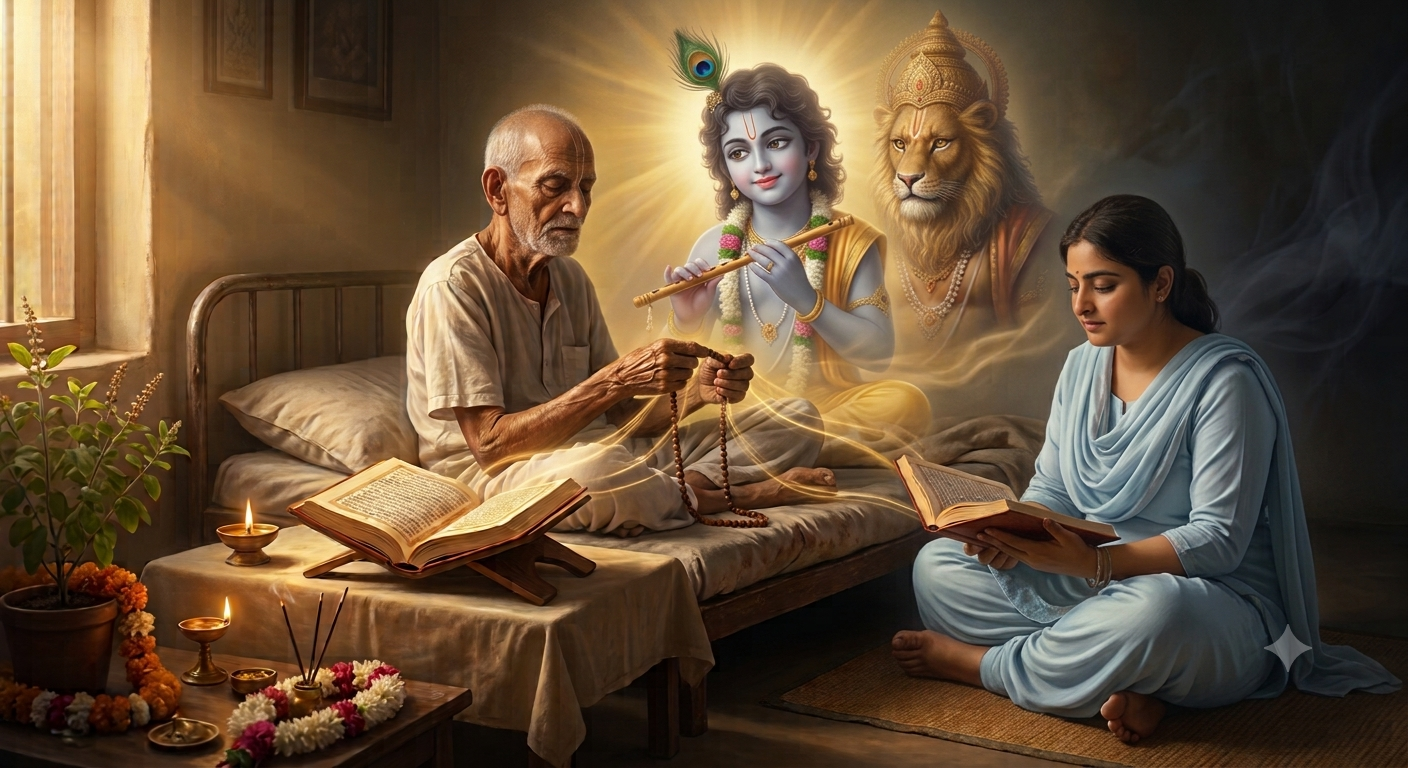
Some of the questions frequently searched on Google are: Can science prove God? Is there scientific evidence for the existence of Krishna? Does Krishna exist? Is Krishna God?
For our family, Krishna bestowed a very special benediction. Through the life of my uncle, we witnessed His causeless mercy in circumstances that strengthened our faith in Krishna, His devotees and the teachings of the scriptures.
We would like to share these events chronologically, as witnesses to that mercy, without exaggerating or mishandling the facts.
My Uncle
I remember one winter in the 1990s. My father was chasing me to make me study. To escape him, I quietly sneaked into my uncle's room. He was sitting erect, covered with a shawl. I slowly hid behind him. He wrapped his left arm around me, handed me his chanting beads with his right hand and, for the first time in this life, chanted the Hare Krishna Mahamantra into my ears:
Hare Krishna Hare Krishna, Krishna Krishna Hare Hare
Hare Rama Hare Rama, Rama Rama Hare Hare
My paternal uncle, Sri Amiya Kumar Mukherjee, was a lifelong brahmachari. We used to stay with him in Jamshedpur. Ever since I became conscious of my surroundings, I remember seeing him return from the office and chant the Hare Krishna Mahamantra. He would regularly read Srila Prabhupada's Bhagavad Gita, Sri Caitanya-caritamrita and Srimad Bhagavatam.
I especially loved the paintings of Krishna in Bhagavad Gita As It Is, particularly the one in which Mother Yasoda chases little Krishna with a stick. I could relate to the situation whenever mothers became strict with us, and I would sympathise with the adorable blue child.

The Vaishnava Monk
In those days, a Vaishnava monk from a nearby Radha-Krishna temple, which was not part of ISKCON, used to visit our residence regularly. I would watch my uncle having deep philosophical conversations with him.
The monk would not accept anything to eat or drink from our home, not even water. He was not addicted to anything, not even tea or coffee. We used to call him Maharaj. He was extremely simple and hardly ever sat on our chairs. He preferred a wooden stool to a comfortable chair. Maharaj used to call me Nitai and was very affectionate towards me. Whenever I bowed down to him, he would playfully rub my hair.
Through his association, my uncle gradually adopted a sattvik lifestyle, a life in the mode of goodness. He stopped eating non-vegetarian food and would not even kill a mosquito. He instructed me that Vishnu resides in every living being and that all living beings are His parts and parcels. He taught me how Vishnu is present in every atom and narrated the pastime of Lord Narasimha.
These experiences helped me understand the importance of association. In the association of saintly devotees, a person can gradually become free from material misconceptions and progress in Krishna consciousness.
Elevation is possible in Krishna Consciousness in the association of pure devotees who can deliver one from delusion.
- Srila Prabhupada
The New Acquaintance
Slowly, the days rolled into years. I was in high school when I noticed another saffron-clad person visiting our home. He was not a Vaishnava. I still remember that whenever he visited, he would sit with his leg on our chair, demand a cup of strong tea and smoke a bidi.
His conduct was very different from that of the saintly Maharaj. He did not appear to value the regulations and discipline that my uncle had previously followed. The influence of his association soon became visible.
My uncle gradually reduced his association with the Vaishnava monk. Instead, he began spending hours discussing philosophy with this new acquaintance. As time passed, I noticed that my uncle had given away Srila Prabhupada's Bhagavad Gita and purchased other publications recommended by his new associate.
He gradually abandoned the regulations he had once followed. He started eating fish again, believing that there was no need to be particular about food because dietary restrictions concerned only the body, whereas he was the soul.
Eventually, the two of them would sit together over tea, discussing philosophy and Indian politics for hours. My uncle also began donating rice bags and money to this person.
Gradually, I noticed another change. My uncle, who had once been affectionate towards Vaishnavas, became increasingly disrespectful towards them, including the saintly Maharaj who had earlier guided him.
When due to false pride, you disrespect exalted Vaishnavas, You become attracted to bad association. That bad association corrupts and destroys your devotion.
- His Holiness Radhanath Swami Maharaj
Diagnosis of the Illness
It was 2014. I was married to Rusha, and we had started practising Krishna consciousness through ISKCON. We were following the four regulative principles, which are essential for a disciplined spiritual life:
- No meat-eating
- No intoxication
- No gambling
- No illicit sex
My uncle once remarked, "It is good that you have quit smoking and drinking, but you shouldn't have left animal protein. There is no connection between our diet and spiritual growth."
Srila Prabhupada explains the connection between the purity of food, the purification of existence and spiritual advancement in his purport to Bhagavad Gita 3.11:
āhāra-śuddhau sattva-śuddhiḥ
sattva-śuddhau dhruvā smṛtiḥ
smṛti-lambhe sarva-granthīnāṁ vipramokṣaḥ.
By performance of yajña one’s eatables become sanctified, and by eating sanctified foodstuffs one’s very existence becomes purified; by the purification of existence finer tissues in the memory become sanctified, and when memory is sanctified one can think of the path of liberation, and all these combined together lead to Kṛṣṇa consciousness, the great necessity of present-day society.
- Purport - Bhagavad Gita 3.11
We used to have endless debates, but he remained firm in his views.
We often wondered how and why my uncle, who had studied so many scriptures, had become so different from the person we once knew. Whenever I tried to discuss this with him, the conversation would end in arguments. He would become offensive towards Vaishnavas and the acharyas. Eventually, we stopped engaging in these debates.
Instead, we tried to encourage my parents to take up Krishna consciousness. We quoted verses from Bhagavad Gita explaining that Krishna is the ultimate source and destination of everything, that bhakti-yoga is the supreme process of yoga, and that one should surrender unto Him because He personally protects His devotees.
My uncle would interrupt and say, "You are quoting the correct verses, but the inference isn't correct. We should surrender to the power who is speaking through Krishna."
That was when we began to understand the philosophical influence behind his changed outlook. He had become attracted to Mayavada philosophy.
Mayavada is not simply another way of expressing devotion to God. Vedic scriptures establish Krishna as the Supreme Personality of Godhead, an eternal person possessing His transcendental form, qualities, name and activities. The living being is His eternal servant, constitutionally distinct from Him. Mayavada philosophy, however, presents a fundamentally different conclusion. It accepts an ultimate reality called Brahman but considers it formless and impersonal, treating the personal form of the Supreme Lord as a temporary or lower manifestation or illusionary. This is why it is covered atheism. It appears to acknowledge the Absolute Truth while denying the eternal personal identity of the Supreme Lord.
Consider an analogy. Imagine someone saying, "I believe you have a father, but he has no face, no hands, no legs and no body." What meaningful understanding of the father remains if every personal feature and identity is denied? It is like presenting an identity card while deliberately removing the photograph. The document may still be called an identity card, but the identity of the person is being denied. Similarly, accepting the word Brahman while denying the eternal transcendental form, qualities and personality of the Supreme Lord is not genuine acceptance of the Absolute Truth. Krishna is not a temporary manifestation of some impersonal existence. He is the Supreme Personality of Godhead, eternally complete in His transcendental form.
Mayavada also promotes the conclusion that the individual living being is ultimately one with the Supreme Brahman. This erases the eternal distinction between the Supreme Lord and the living entity. The desire to become equal with the Supreme, rather than recognize one's eternal position as His servant, is a fundamental spiritual misconception. The living being is eternally dependent upon Krishna and can never become the Supreme Lord.
These are not merely differences in terminology or harmless philosophical variations. Sri Caitanya Mahaprabhu, who is Krishna Himself appearing in the form of His own devotee, directly condemned the Mayavadi interpretation:
prabhu kahe, — “māyāvādī kṛṣṇe aparādhī
‘brahma’, ‘ātmā’ ‘caitanya’ kahe niravadhi
Śrī Caitanya Mahāprabhu replied, “The Māyāvādī impersonalists are great offenders unto Lord Kṛṣṇa; therefore they simply utter the words ‘Brahman,’ ‘ātmā’ and ‘caitanya.’
CC Madhya 17.129
Mahaprabhu further gave a grave warning about hearing the impersonalist commentary on Vedanta:
jīvera nistāra lāgi’ sūtra kaila vyāsa
māyāvādi-bhāṣya śunile haya sarva-nāśa
“Śrīla Vyāsadeva presented the Vedānta philosophy for the deliverance of conditioned souls, but if one hears the commentary of Śaṅkarācārya, everything is spoiled.
CC Madhya 6.169
We must therefore understand the seriousness of this philosophy and protect ourselves from its influence. It does not lead the living entity towards loving service to the Supreme Lord. Instead, it obscures the Lord's eternal personality and the soul's eternal identity as His servant. Sri Caitanya Mahaprabhu Himself has warned us of its consequences. We should not treat such teachings as harmless alternatives to the eternal conclusions of the Vedic scriptures.
When we asked my uncle what he considered the essence of all the scriptures he had studied, he would say, "Manav Seva is Madhav Seva," and that we should serve Daridra Narayan.
We repeatedly tried to help him understand the shortcomings of Mayavada philosophy, but our attempts were unsuccessful. We felt that bringing Krishna back to the centre of our family was essential. So we proposed building a small altar for the Lord.
My uncle immediately opposed the idea. He said, "We are all Narayan, so why do we need another altar for Him? Save the money and donate it to the poor. Call Him from within. There is no need for external show."
His views were becoming increasingly difficult for my mother, who was inclined towards Krishna consciousness. Whenever she performed arati, listened to a lecture or read scriptures, my uncle would interrupt. Sometimes he would bring his collection of books to prove that she was following the wrong path.
He also tried to convince her that ISKCON would take all our money and that she should stop me because I might one day renounce everything and become a monk.
I knew my uncle was a good-hearted person. He had once been devoted to the Supreme Personality of Godhead, Krishna. It was painful to see someone who had introduced me to the Hare Krishna Mahamantra gradually turn away from the very teachings he had once cherished.
I was desperate to help him, but I was too young and inexperienced to explain the philosophy effectively. I could only pray to Krishna.
Srila Prabhupada explains the seriousness of this warning in his purport to Srimad Bhagavatam 7.15.6:
Māyāvāda philosophy is extremely dangerous, especially for a devotee. Śrī Caitanya Mahāprabhu has therefore strictly forbidden us to associate with Māyāvādī philosophers. Māyāvādi-bhāṣya śunile haya sarva-nāśa: if one associates with the Māyāvāda philosophy, his devotional life is doomed.
- Srila Prabhupada's purport to Srimad Bhagavatam 7.15.6
These are strong words, and we should understand their seriousness. Sri Caitanya Mahaprabhu did not consider the Mayavada interpretation of Vedanta to be a harmless alternative. It can undermine the very foundation of devotional service by obscuring the eternal distinction between the Supreme Lord and the individual living being.
For a devotee, therefore, philosophical discrimination is essential. We should not casually hear, accept or propagate teachings that contradict the conclusions of the Bhagavad Gita, Srimad Bhagavatam and the Vaishnava acharyas.
Protection of the Lord
It was November 2017, the holy month of Kartik. Rusha and I were in Sri Dham Mayapur, attending the annual yatra led by His Holiness Radhanath Swami Maharaj.
We received a call from my parents informing us that my uncle was in a very serious condition. He was completely bedridden. The doctors had given up hope, and everyone feared that he might leave his body soon.
Hearing the news, I was shaken. One thought kept troubling me: my uncle was not prepared for death. The consciousness one has at the time of leaving the body determines one's next destination. Considering the philosophical direction he had taken and the way he had gradually abandoned his spiritual practices, I was deeply concerned about his spiritual welfare.
Whatever state of being one remembers when he quits his body, O son of Kuntī, that state he will attain without fail.
- Bhagavad Gita 8.6
I discussed the situation with Rusha. We did not know what to do. We went to Lord Narasimha, offered lamps and prayed intensely. Knowing that we were not pure devotees, we also requested senior devotees to pray on our behalf.
We mentally offered our prayers to our Guru Maharaj, His Holiness Radhanath Swami Maharaj, requesting him to pray for my uncle's protection.
The next morning, we were unsure whether to continue with the yatra or arrange train tickets to return home. I remember that it was early morning, and we were on Pada Yatra to Mahaprabhu's birthplace. The devotees were chanting the holy name, smiling and enjoying the journey. Rusha and I, however, were deeply anxious.
Soon my phone rang. It was a call from home. We expected to hear bad news, but to our utter surprise, my parents informed us that my uncle had improved. He was now able to sit up and speak.
garjantam garjayantam nija-bhuja-patalam sphotayantam hatantam
dipyantam tapayantam divi bhuvi ditijam kshepayantam kshipantam
krandantam roshayantam dishi dishi satatam samharantam bharantam
vikshantam purnayantam kara-nikara-shatair divya-simham namami
Lord Narasimha roars loudly and causes others to roar. With His multitudes of arms He tears the demons asunder and kills them in this way. He is always seeking out and tormenting the demoniac descendants of Diti, both on this earth planet and in the higher planets, and He throws them down and scatters them. He cries with great anger as He destroys the demons in all directions, yet with His unlimited hands He sustains, protects, and nourishes the cosmic manifestation. I offer my respectful obeisances to the Lord, who has assumed the form of a transcendental lion.
- Narasimha Kavacham
Within a week, my uncle had returned to his normal routine and was walking around again. This episode strengthened our faith in Krishna, the statements of the scriptures, the path of Krishna consciousness and the guidance of the acharyas through ISKCON.
It also brought us much closer to Lord Narasimha. My mother became more convinced that she had not chosen the wrong path by practising Krishna consciousness.
During this period, my mother shared something significant. As long as my uncle was weak, he remained humble. But as soon as he regained his health, he returned to his previous outlook.
This made me reflect on our own lives. When we are healthy and comfortable, we often behave as if we will live forever. We forget the ultimate goal of human life and become absorbed in temporary material pursuits.
Countless people die every day, yet those who remain alive continue to believe that death is far away. This reminds me of the famous question asked by Yudhisthira in the Yaksha Prashna.
Day after day, hour after hour, countless people die, yet the living believes they will live forever
- Yudhisthira to Yaksha
Again, in 2018, my uncle suffered a similar health crisis. Once more, the doctors gave up hope. By this time, my father, who had been an atheist, suddenly requested me to arrange a puja for Lord Narasimha for my uncle.
I saw a ray of hope in my father as well. I again requested devotees to pray for my uncle. I personally prayed to the Lord, asking that my entire family might become devotees. This time, I also encouraged my father to chant the holy names of the Lord, and he began chanting.
Once again, my uncle recovered within a few days. However, after his recovery, both my father and uncle gradually returned to their previous way of life. My father stopped chanting.
Seeing that time was passing, my mother, Rusha and I tried even harder to convince my uncle to return to Krishna consciousness. We tried every possible means, but he remained convinced of Mayavada philosophy. He also spent time watching television programmes featuring self-proclaimed spiritual personalities and people claiming divine status for themselves or their gurus.
The Last Chapter
By 2019, my uncle had become extremely frail. In the middle of the year, he was admitted to the hospital because of a serious urinary problem. The doctors treated him with the available options and eventually discharged him without being able to cure his condition.
Towards the end of 2019, he was admitted again with breathing difficulties. The doctors diagnosed him with cancer and discharged him within a week.
My uncle was no longer the person we remembered. He was completely bedridden and extremely weak. He needed assistance even to turn to one side. The situation was so serious that everyone understood that his time might be near.
Both my parents were tirelessly serving him. Rusha also went to my parents' home to help care for him, while I had to stay back in Kolkata to attend to my office responsibilities.
As before, my father requested me to arrange a puja for Lord Narasimha. Although my uncle was always in my prayers, this time I found it difficult to pray for his recovery. I felt as though I was approaching the Lord only when I needed something.
It seemed as if our family had been making a business arrangement with Krishna: pray when there is trouble, receive relief and then forget Him. There was no genuine gratitude.
Srila Prabhupada explains this mentality very clearly:
... So those who are going to religious life, making God as their servant, they will be failure. You must approach God as master. You should become servant. The so-called religionist, they accept God as their order-supplier servant: "I must pray to God." Whenever there is some inconvenience, "I must pray," or "I must... " Not "must." "At that time I shall pray, and then I shall finish that prayer, and God must supply. If God does not supply, then there is no God." This is the general attitude.
- Srila Prabhupada's Lecture on SB 1.16.19 - Los Angeles, July 9, 1974
Yet I knew that I had no one else to take shelter of except Krishna. I also knew that this was perhaps the most critical phase of my uncle's life.
So I prayed with all sincerity. But this time, I did not pray for his physical recovery. I prayed that he might receive the gift of devotion. I prayed that Krishna might bless him with Krishna consciousness and that he might become a devotee.
I requested every devotee I knew to pray for my uncle's bhakti. My only desire was that he might remember Krishna at the time of leaving his body.
The Downpour of Mercy
He quickly becomes righteous and attains lasting peace. O son of Kunti, declare it boldly that My devotee never perishes.
- Bhagavad Gita 9.31
Fearing that my uncle might leave his body at any moment, Rusha and my mother used to sing kirtan near his ears. Their intention was simple: perhaps, through the sound of the holy name, he would remember the Lord, even if only once.
Gradually, my uncle began regaining his external consciousness. He could speak, hear and understand. Rusha, who was already taking care of him, recognised this as an opportunity to speak with him briefly about spiritual subjects.
One day, she took Srila Prabhupada's Bhagavad Gita As It Is and randomly selected verses, asking my uncle to explain their meanings.
Initially, he was reluctant to speak about Krishna or the Gita. He would sometimes blame Krishna for the pain and suffering he was experiencing. He also disliked hearing the recording of Srila Prabhupada chanting the Mahamantra that we played in his room.
But my mother and Rusha did not give up. They continued finding opportunities to read Bhagavad Gita in his presence.
One day, my uncle called Rusha and asked her to read the Gita. When she asked which chapter he wanted to hear, he replied, "Chapter 12," the chapter on devotional service, or bhakti.
What a remarkable change! Someone who had gradually moved away from devotional teachings was now asking to hear the chapter that glorifies bhakti.
Rusha read the verses along with Srila Prabhupada's purports. After hearing each purport, my uncle would exclaim, "Correct! It is correct!" He would even ask her to repeat certain lines.
These were the very teachings he had once rejected and the very book he had earlier given away. Now, he was listening to them with appreciation.
This continued for almost two weeks.
One morning, he asked my mother to bring him his old chanting beads. He wanted to chant! He also asked her to increase the volume of Srila Prabhupada's recording.
When asked why he wanted to chant Krishna's name when Krishna was supposedly giving him so much pain, my uncle replied:
"Krishna is not making me suffer. I am suffering due to my own Karma. Krishna is mercifully curing me of all the Karma so that I may return to my eternal home, Back to Him."
Hare Krishna!
Gradually, my uncle became strong enough to stand. Taking small steps, he began walking again.
Seeing his improvement, my parents asked Rusha to return to Kolkata.
The Climax
On 20 December 2019, my parents suddenly called us and asked us to return home as soon as possible because my uncle's health was deteriorating.
We were preparing to board the train early in the morning on 21 December when my parents called and informed me that my uncle had left his body.
I had no complaints. All that I had sincerely asked Krishna for was the gift of devotion for my uncle. Krishna had mercifully given us the opportunity to witness his return to chanting, his desire to hear Srila Prabhupada and his appreciation of Bhagavad Gita. I silently prayed for my uncle.
Just then, a thought gripped me.
Death is the end of the body, but for the soul, it is the beginning of another journey.
Today's culture is deeply influenced by modern materialistic thinking. Hardly anyone is interested in understanding the soul and its journey after death. Rituals are often performed merely as social obligations, without understanding their spiritual purpose.
People can become so occupied with their material lives that they look for shortcuts even in matters concerning the departed soul. In some communities, there is a custom of serving non-vegetarian food after the thirteenth day. We were concerned about following the scriptural and Vaishnava principles of offering sanctified food to the Lord and honouring prasadam, rather than arranging a feast involving animal slaughter.
Sraddha ceremonies are meant to benefit the departed soul. They should not become an occasion to indulge in activities that create further suffering and sinful reactions.
I immediately called my parents and informed them that I wanted to take responsibility for the rituals and follow the guidance of scriptures and senior devotees. Thankfully, they agreed.
However, I was unsure how to proceed. I was also worried about whether our relatives would agree with the decisions we wanted to make.
Surrender Unto Me
There was no other option but to surrender unto Krishna. I kept praying, asking Him to help me perform my duties towards my uncle in the best possible way.
I took my mobile phone and began reading about the responsibilities expected of a son. I came across a powerful explanation by Srila Prabhupada about the meaning of the word putra:
Putra means Pun-namno narakad yasmat trayate iti putra. Pu-tra. Pu means pun-namno narakat. There is a hell which is called put. So from that hellish condition, one who delivers, trayate iti tra, therefore he is called putra. This is... Every Sanskrit word has got meaning, root meaning. Putra. Putra-piṇḍa-prayojanam. Putra is required. Why? After death, if by chance the father does not get ordinary life or goes to the hellish condition of life, the son will deliver. Therefore sraddha ceremony. There is sraddha... What is that sraddha ceremony? Sraddha ceremony means to offer foodstuff to Viṣṇu, and with the prasadam, to the forefathers or father it is offered so that by eating prasadam, if he is in ghost life or in hellish life, he'll be delivered. This is called sraddha.
- Srila Prabhupada Lecture - Vrndavana, August 5, 1975
On ISKCON Desire Tree, I found an article explaining the journey of the soul as described in Garuda Purana. This helped me understand the significance of the rituals performed after someone's departure.
When we reached home, everyone was waiting for us. My mother told us that my uncle's chanting beads were beside him when he left his body. We could not know with certainty what his consciousness was at that exact moment, but knowing that he had returned to chanting and had wanted to hear the holy name was a great source of solace for us.
We went to the crematorium, and I performed the final rites. The ritual of placing a flame near my uncle's mouth marked the final separation from his physical body.
As taught and guided by senior devotees, I loudly chanted the Hare Krishna Mahamantra near the cremation area throughout the time his body was being cremated. I wished that I had a devotee association who could accompany me in chanting and singing kirtan.
Krishna helped me understand that this was the time to perform whatever service I could for the departed soul.
On our way back home, I prayed to Krishna to arrange a qualified priest. I did not want someone simply reciting mantras without understanding their significance. By His causeless mercy, Krishna arranged for a Vaishnava priest, something we had not expected. We were extremely grateful.
He opened the panjika and informed us that my uncle had left his body without any dosha. Hare Krishna! Rusha and I understood the regulations that needed to be followed. We also contacted our siksha gurus and other senior devotees to seek their guidance.
Everything was progressing well, but we still felt that something was missing. We realised that Krishna was not sufficiently at the centre of the occasion.
Suddenly, we remembered the one spiritual family Srila Prabhupada had created for all of us: ISKCON.
We immediately contacted the Jamshedpur ISKCON temple and requested the devotees to perform a small kirtan at our home. When we shared the mercy of Lord Narasimha in my uncle's life, they suggested performing arati, reciting the 108 names of Lord Narasimha and offering Tulasi to the Lord.
Since it was around the time of Gita Jayanti, we also expressed our desire to distribute Bhagavad Gita on behalf of my uncle.
We invited our neighbours and relatives to our home for the evening.
The devotees arrived and performed kirtan, Sandhya Arati and Tulasi Arati. They recited the 108 names of Lord Narasimha and led congregational chanting with everyone who had attended. The entire atmosphere became spiritually uplifting and ecstatic.

Seeing Krishna's merciful arrangements, we dared to hope for something else that initially seemed difficult: serving Krishna prasadam to all the guests attending the sraddha ceremony.
Krishna arranged for a vegetarian cook, and we prepared a menu without onion or garlic. The only remaining task was to offer the food to the Lord.
The next day, the sraddha ceremony was performed with Narayan Shila. Lord Vishnu was worshipped and offered food. The ceremony concluded with the chanting of the Hare Krishna Mahamantra.
We also distributed Srila Prabhupada's Bhagavad Gita As It Is to our relatives, neighbours and everyone who attended the ceremony, on behalf of my uncle.
Krishna guided us through the day with His mercy.
However, the final day was a little challenging. In our community, it was customary for people to serve non-vegetarian food on that day. From the beginning, some of my relatives had discussed bringing fish and meat. Their argument to my father was that my uncle used to love fish, and serving it would make him happy.
My mother, Rusha and I did not want animal slaughter to be associated with the ceremony. My father was in an awkward position because he did not want to offend our relatives.
Once again, we had no one other than Govinda to take shelter of. We prayed to Him, the Supreme Controller.
To our surprise, the next morning, our relatives themselves called my father and said:
"You are performing the rituals in a pure Vaishnava way. We do not want to hamper it. We can have a non-vegetarian diet at our home. There is no need to bring any flesh into this house."
We were internally relieved and could not thank Krishna enough for turning the situation around.
At every stage of the ceremonies, Krishna had made arrangements for us. He is the Supreme Controller, and not even a blade of grass moves without His sanction.
arjuna uvāca
kṛṣṇa kṛṣṇa mahā-bāho
bhaktānām abhayaṅkara
tvam eko dahyamānānām
apavargo 'si saṁsṛteḥ
"Arjuna said: O my Lord Śrī Kṛṣṇa, You are the almighty Personality of Godhead. There is no limit to Your different energies. Therefore only You are competent to instill fearlessness in the hearts of Your devotee. Everyone in the flames of material miseries can find the path of liberation in You only."
- Srimad Bhagavatam 1.7.22
Conclusion
We do not know how many shortcomings there may have been in the way we performed our duties. But one thing we are certain of: we placed our uncle under the shelter of Krishna and did whatever we could to serve him according to our understanding and the guidance of devotees.
From this experience, we learned many important lessons:
- Krishna is the ocean of mercy - Karunasindhu. His mercy is beyond our comprehension.
- Krishna is the Supreme Personality of Godhead. He alone is the ultimate shelter and can protect us from every calamity.
- Krishna takes care of His devotees. Even in the most difficult circumstances, He makes arrangements for their service. We should depend upon Him rather than place our ultimate faith in material arrangements.
- Krishna does not abandon His devotees. Even when a person becomes distracted or deviates from devotional practice, the Lord's mercy remains available to those who turn towards Him.
- Association shapes our consciousness. We must consciously seek the association of devotees and remain careful about philosophies and influences that weaken our devotion.
- The prayers of devotees are valuable. We should seek the association, guidance and blessings of Vaishnavas in every phase of our lives.
- Mayavada philosophy is a serious threat to devotional understanding. We must study the conclusions of the Vaishnava acharyas carefully and avoid accepting impersonalist interpretations that contradict the eternal individuality of the soul and the supreme personal identity of Krishna.
- Krishna consciousness is a time-tested spiritual science. It must be received through a bona fide sampradaya, in the disciplic succession.
- We must endeavour sincerely and surrender the results to Krishna. He is the supreme controller and can arrange what is beyond our ability.
- A Vaishnava is a genuine well-wisher. A devotee understands the soul, its relationship with Krishna and the ultimate welfare of every living being.
- The greatest asset we can accumulate is the mercy of Krishna and His devotees.
- We must cultivate unflinching faith in Krishna.
Srila Prabhupada repeatedly reminded us that a devotee who remains surrendered to Krishna need not be afraid, even in the face of calamities:
If you remain a pure devotee, always surrendered to Krsna, you should know it very well that Krsna will give you protection in any calamity. Don’t be worried. Simply we must have the faith. That is surrender. Surrender means avasya raksibe krsna, visvasa palana [Saranagati].
- Srila Prabhupada’s lecture on Srimad-Bhagavatam 7.9.37 - March 15, 1976, Mayapur
As described in the following verse, there is no loss on the path of Krishna consciousness. Even a little advancement can protect one from the greatest fear.
nehābhikrama-nāśo ’sti
pratyavāyo na vidyate
sv-alpam apy asya dharmasya
trāyate mahato bhayāt
In this endeavor there is no loss or diminution, and a little advancement on this path can protect one from the most dangerous type of fear.
- Bhagavad Gita 2.40
We simply need to surrender unto Krishna by following His instructions. He promises to deliver us from all sinful reactions.
sarva-dharmān parityajya
mām ekaṁ śaraṇaṁ vraja
ahaṁ tvāṁ sarva-pāpebhyo
mokṣayiṣyāmi mā śucaḥ
Abandon all varieties of religion and just surrender unto Me. I shall deliver you from all sinful reactions. Do not fear.
- Bhagavad Gita 18.66
The art of dying as a human being is to remember Krishna at the time of death. The consciousness in which one leaves the body determines one's next destination. We should therefore use this human life to cultivate Krishna consciousness and prepare for that final moment.
yaṁ yaṁ vāpi smaran bhāvaṁ
tyajaty ante kalevaram
taṁ tam evaiti kaunteya
sadā tad-bhāva-bhāvitaḥ
Whatever state of being one remembers when he quits his body, O son of Kuntī, that state he will attain without fail.
- Bhagavad Gita 8.6
Our Gratitude
Before ending this article, I would like to offer my heartfelt gratitude to everyone who supported us during this difficult period.
I am grateful to my office management for granting me leave and to my office teammates for supporting me during my absence; to our neighbours and relatives for their support; to my brother, Anupam, and his good wife, Tandrima, who tirelessly supported us despite their demanding professional lives; and to my aunts for their guidance.
My heartfelt gratitude goes to my wife, Rusha, for being my strength and for her selfless service; to my parents, for demonstrating how to care for someone selflessly and for patiently tolerating my demands as we tried to surrender to Krishna without question; and to all the devotees who sincerely prayed for my uncle.
I am especially grateful to HG Vallabha Chaitanya Prabhu, HG Sri Govind Ghosh Prabhu, HG Chaitanya Madhav Prabhu and HG Kanai Nathshala Prabhu, our siksha gurus, for guiding us through every phase of our lives.
My gratitude also goes to HG Tushtha Gopal Prabhu and his team of devotees from Jamshedpur ISKCON for their invaluable support, and to our beloved Guru Maharaj, HH Radhanath Swami Maharaj, for his mercy and shelter.
Above all, I offer my respectful obeisances to Srila Prabhupada for descending to this world and creating a genuine spiritual family for us in the form of ISKCON. And finally, I offer my heartfelt gratitude to the all-merciful Sri Krishna for orchestrating everything and remaining our ultimate shelter.
Hare Krishna!
Thank you for visiting.
If you have liked it, then please share it with your friends and loved ones. Please feel free to suggest how we can further improve our service.
For more Krishna Conscious Articles & Arts, please visit - Our Blog | Site Map
Hare Krishna!


Very touching story.
May we develop faith in the Lord so that we get more of His mercy.
Thank you for your kind words, mataji. Yes, let us pray that may we all develop unflinching faith in Him
Hare Krishna,
Jaideep P and Matajis ki jai by your intense devotional service you saved a soul trapped in mayavad philosophy leading to hell.
Glorious seva. Your service attitude, patience, determination and faith in Lord and devotional service helped him.
Thanks for nicely describing the incident with quotes from sastra. i am surprised to see how you get so many quotes from various scriptures.
Srila Prabhupada, parampara and Lord will be happy with your sevas. May Lord bless you to preach more and more and bring more souls to the path of bhakti.
Thanks. Hare Krishna. Ys
Hare Krishna Prabhu.
Dandavat Pranam.
Thankyou so much prabhu for your kind words of appreciation. We thank you for all your support and guidance throughout, especially during those days.
Through you we offer our gratitude and obeisances to HG Vallabh Chaitanya Prabhu, HG Sri Govind Ghosh Prabhu, HG Chaitanya Madhav Prabhu and all ISKCON temple devotees.
YAS
Superb. Very inspiring. All glories to the devotees.
Thankyou so much for your kind words.
Extreamly inspiring incident and very much motivating. Everyone should read this and circulate this as much as possible.
Thankyou so much for your kind words.
I am genuinely thankful to the holder of this web page who has shared this wonderful paragraph.
Thankyou so much for your kind words.
Very inspiring and heart touching! Grateful for letting us know!