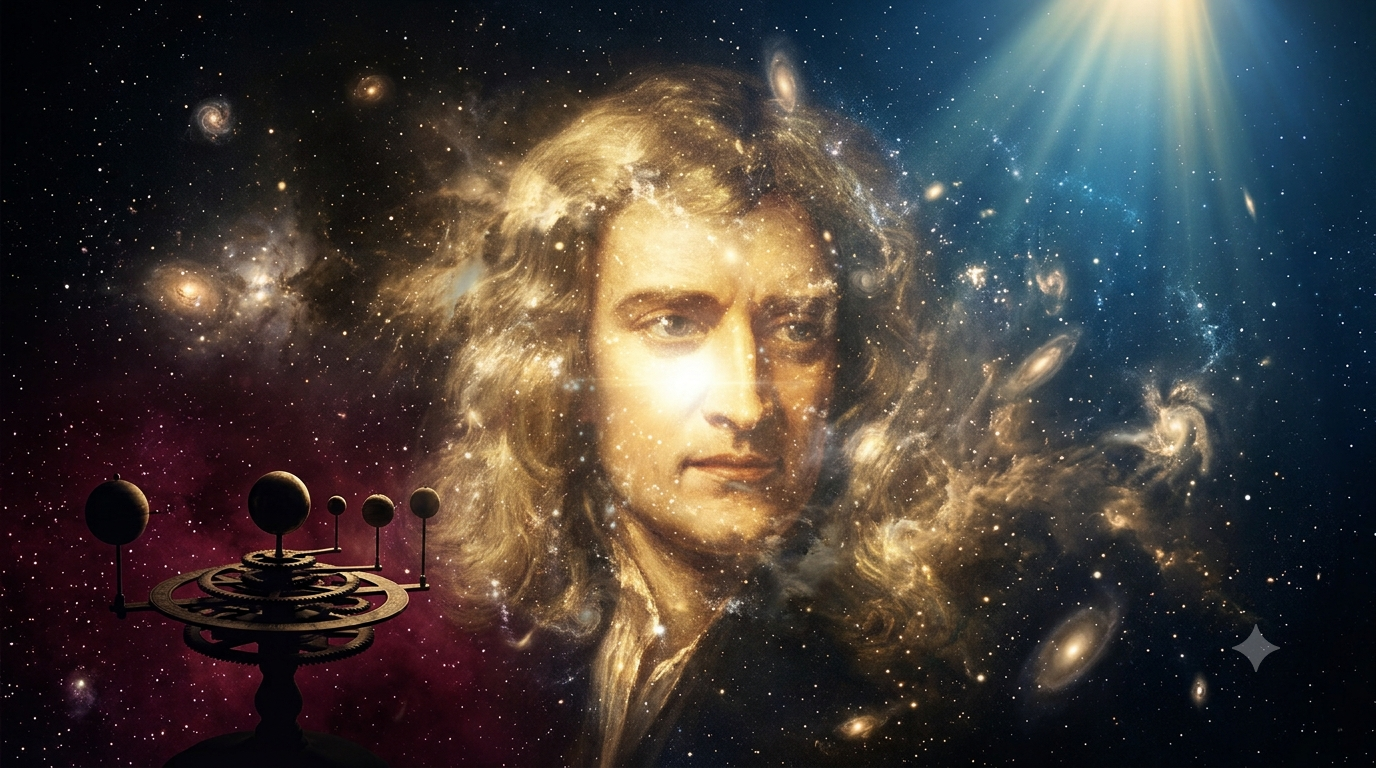
Who created the universe? The question of God and the origin of the universe has occupied the minds of thoughtful people for centuries. When we look at the sun, moon, stars and the vast order of the cosmos, we can ask a fundamental question: can such an intricate universe exist without an intelligent source? The question of God and the origin of the universe goes beyond scientific explanations of cosmic expansion and leads us to consider the ultimate source of all existence.
Some explanations describe how the universe changes and develops. But do they answer the deeper question of why the universe exists in the first place? A popular story attributed to Sir Isaac Newton offers an interesting way to reflect on this question.
Newton's Story: God and the Origin of the Universe
Sir Isaac Newton is said to have commissioned a skilled artisan to make a small model of the solar system. The model stood on a large table in Newton's home. The artisan had carefully represented the planets, their relative sizes and distances. He had also designed it so that the planets moved around the model when someone turned a crank.
One day, an atheist friend of Newton visited him. He noticed the model and examined it with great admiration.
"My, what an exquisite thing this is!" he exclaimed. "Who made it?"
Newton supposedly replied, "Nobody."
Surprised, the visitor asked again, "Evidently you did not understand my question. I asked who made this."
Newton repeated that nobody had made it and that it had simply assumed its present form.
The visitor protested that such a complex model could not have come into existence without a maker. Newton then used the model to make his point:
"This thing is but a puny imitation of a much grander system whose laws you know, and I am not able to convince you that this mere toy is without a designer or maker; yet you profess to believe that the great original from which the design is taken has come into being without either designer or maker! Now tell me by what sort of reasoning do you reach such an incongruous conclusion?"
The story makes a simple point: when we see an intelligently arranged object, we naturally look for its maker. It invites us to consider why we should dismiss the question of an intelligent source when we observe the far greater complexity and order of the universe.
Big Bang Theory: Does It Explain the Origin of the Universe?
The popular explanation of the Big Bang describes the universe as having originated from an extremely hot and dense state, often portrayed as an infinitesimally small point containing all matter and energy. When the expansion of the universe is traced backwards using classical equations, it leads to the concept of a singularity, where density and temperature become infinite. The universe is then said to have expanded and gradually developed into the cosmos we observe today.
However, describing the development of the universe is not the same as explaining the ultimate cause of existence. Even if a model theoretically try to answer how the observable universe expanded, some deeper questions remain:
- What caused the initial hot and dense state from which the universe is said to have developed?
- What caused the singularity, and what, if anything, existed before it?
- If space itself has been expanding, what accounts for the existence of space?
- Does it make sense to speak of something outside the universe, and what would that mean?
- Why does the universe exist at all rather than nothing?
- Why do the laws of nature exist, and what is their ultimate source?
- Why does the universe possess such an orderly and mathematically describable structure?
- What is the ultimate source of all matter, energy, space and the laws that govern the cosmos?
These are not questions that can be settled simply by describing cosmic expansion. A scientific model may investigate physical processes, but the question of the ultimate source of existence also involves philosophy and theology.
Therefore, accepting a description of the universe's physical development does not require us to reject God. Nor does the existence of a scientific theory establish that the universe has no Creator.
God and the Origin of the Universe: The Vedic Understanding
The Vedic scriptures offer a clear answer to the question of the ultimate source. They do not present the universe as an independent reality without a Supreme cause. They describe the Supreme Lord as the source of both material and spiritual existence.
In the Bhagavad-gita, Lord Krishna declares that He is the source of everything. Everything emanates from Him. The wise understand this and engage in His devotional service. Bhagavad-gita 10.8 - Read the verse on Vedabase
This is not merely a claim about how planets or stars came into existence. It addresses the deeper question of the source of all existence. According to the Vedic understanding, the universe depends upon the Supreme Lord. He is not simply another object within the universe. He is its ultimate source and controller.
Thus, the question is not merely whether we can describe the physical processes of the cosmos. We must also ask whether those processes themselves have an ultimate source.
Krishna: The Supreme Source of Creation
When we observe the universe, we encounter remarkable order, structure and interdependence. The movement of celestial bodies, the conditions that support life and the complex arrangements found throughout nature invite us to reflect on the source behind this order.
The Newton story encourages us to examine our assumptions. If we recognise the need for a maker behind a small mechanical model, it is reasonable to ask why the vastly greater universe should be treated as having no ultimate source.
We should not confuse a description of how something works with an explanation of why it exists. Understanding the movements of the planets does not answer every question about the source of the planetary system. Similarly, describing physical processes does not by itself settle the question of the Supreme Creator.
Conclusion
The question of God and the origin of the universe deserves serious thought. Scientific models may describe aspects of the physical universe, but they do not remove the deeper question of its ultimate source.
The Vedic scriptures identify that Supreme source as Lord Krishna. The Bhagavad-gita does not present Him as one possible explanation among many. It establishes Him as the source of everything.
We therefore need not stop at observing the universe or studying its physical laws. We can also enquire into the Supreme Person behind its existence and order. Such enquiry leads beyond the visible universe towards its ultimate source, Lord Sri Krishna.
Thank you for visiting.
If you have liked it, then please share it with your friends and loved ones. Please feel free to suggest how we can further improve our service.
For more Krishna Conscious Articles & Arts, please visit - Our Blog | Site Map
Hare Krishna!


