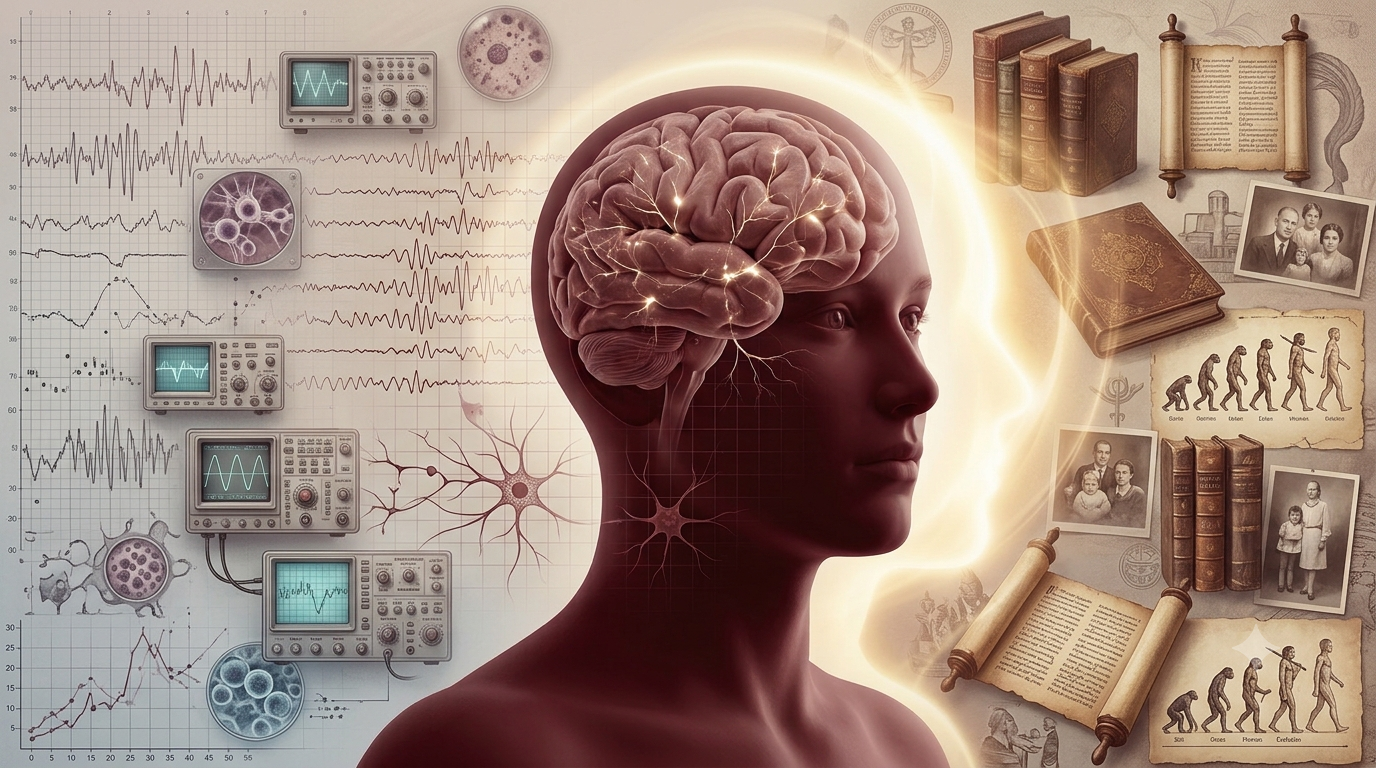
Who are we according to science? This question has occupied philosophers, scientists and spiritual seekers for centuries. Modern science has made remarkable discoveries about the brain, thoughts and human perception. Yet, fundamental questions about consciousness and personal identity remain. Let us explore these scientific observations and examine what they reveal about who we really are.
The Vedanta-sutra (1.1.1) begins with the aphorism athato brahma jijnasa: "Now one should inquire about Brahman, the Absolute Truth."
The first aphorism in the Vedanta-sutra is athato brahma jijnasa. In the human form of life one should put many questions to himself and to his intelligence. In the various forms of life lower than human life the intelligence does not go beyond the range of life's primary necessities--namely eating, sleeping, mating and defending. Dogs, cats and tigers are always busy trying to find something to eat or a place to sleep, trying to defend and have sexual intercourse successfully. In the human form of life, however, one should be intelligent enough to ask what he is, why he has come into the world, what his duty is, who is the supreme controller, what is the difference between dull matter and the living entity, etc. There are so many questions, and the person who is actually intelligent should simply inquire about the supreme source of everything: athato brahma jijnasa.
Srimad-Bhagavatam 4.25.26, Purport - Read on Vedabase
We have heard the scriptural or Vedic explanation of our identity. But what does modern science tell us? To explore who we are according to science, let us take a journey through important developments in philosophy, neuroscience and the study of consciousness. We will examine how these observations challenge a simplistic identification of the self with the body or brain.
1. Who Are We According to Science? Rene Descartes and the Thinking Self
In the development of modern philosophy, Rene Descartes made an important contribution to the question of personal identity.

Descartes wanted to find a firm and certain starting point for knowledge. He therefore adopted a method of systematic doubt. He questioned everything that could possibly be doubted, including information received through the senses and even mathematical reasoning.
He considered the possibility that an evil genius might deceive him, making what appeared to be true actually false.

However, he discovered something that he could not doubt. Even if everything else were an illusion, the very act of doubting required a thinker. If he was thinking, he had to exist.
He expressed this famous conclusion as Cogito ergo sum, meaning "I think, therefore I am."
Descartes established the existence of the thinking self as a certainty that survived his method of doubt. This raised an important question: Is the self simply the thoughts that arise within us, or is there a thinker who experiences those thoughts?
The question emerging from Descartes' philosophy: Who is the thinker?
2. The Year 1929: Electroencephalography (EEG) and the Brain
The development of electroencephalography (EEG) was an important breakthrough in the study of the human brain. German psychiatrist Hans Berger recorded the first human EEG in 1924 and published his findings in 1929.


An EEG records electrical activity produced by the brain. Scientists use it to study brain activity during different conditions, including wakefulness, sleep and certain neurological disorders.
As neuroscience developed, researchers discovered that different patterns of brain activity accompany different mental states. This established an important relationship between brain activity and our thoughts, perceptions and experiences.
However, an EEG does not directly record thoughts. It records electrical patterns associated with brain activity. The relationship between the physical activity of the brain and the subjective experience of thinking remains a much deeper question.
Are We the Brain or the Conscious Self?
If thoughts are associated with brain activity, does that mean that we are simply the brain? Or is the brain an instrument through which the conscious self experiences and interacts with the material world? This is another important aspect of the question of who we are according to science.
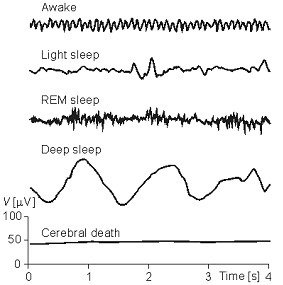
There is another important distinction. A person in a coma may remain alive with varying degrees of brain function. Brain death, however, is a separate medical condition involving the irreversible loss of all brain function. A ventilator may temporarily maintain oxygen circulation and a heartbeat, but this does not mean that a brain-dead person remains alive.
Therefore, the medical distinction between consciousness, brain activity and bodily functions makes the question of personal identity more complex. We cannot simply equate every function of the living person with one measurable brain signal.
The question emerging from neuroscience: Are we merely the physical brain and its electrical activity?
3. The Year 1980: Dr. John Lorber and the Mystery of Hydrocephalus
As research continued, scientists encountered cases that challenged simple assumptions about the relationship between brain size and intelligence. These cases add another dimension to the question of who we are according to science.
Until then, many people assumed that the amount of brain tissue would directly determine a person's intellectual capacity. British neurologist Dr. John Lorber studied numerous cases of hydrocephalus, a condition in which excess cerebrospinal fluid enlarges the fluid-filled spaces in the brain and can compress the surrounding brain tissue.

In a 1980 article in the journal Science, science writer Roger Lewin reported Lorber's account of a remarkable student at Sheffield University.
There's a young student at this university [Sheffield University] who has an IQ of 126, has gained a first-class honors degree in mathematics, and is socially completely normal. And yet the boy has virtually no brain…When we did a brain scan on him, we saw that instead of the normal 4.5-centimeter thickness of brain tissue between the ventricles and the cortical surface, there was just a thin layer of mantle measuring a millimeter or so. His cranium is filled mainly with cerebrospinal fluid.
Professor John Lorber, quoted by Roger Lewin, "Is Your Brain Really Necessary?", Science, 210 (4475), 12 December 1980, pp. 1232-1234. View publication record
This case is remarkable. The student's brain structure was severely affected by hydrocephalus, yet he achieved a high IQ, earned a first-class honours degree in mathematics and functioned socially.
However, the student was not literally without a brain. He retained brain tissue, including important deeper structures. The case demonstrates that the relationship between brain structure and intellectual ability is more complex than a simple measurement of brain size would suggest.
What Does the Case Tell Us About Intelligence?
Other cases of severe hydrocephalus have also demonstrated the brain's remarkable capacity to adapt and compensate. Researchers continue to study how the brain maintains functions despite substantial structural differences.
Bruce Lipton, in the epilogue of The Biology of Belief, makes the following observation:
I submit in the epilogue of The Biology of Belief that human intelligence can only be fully understood when we include spirit ("energy") or what quantum physics savvy psychologists call the "superconscious" mind.
Bruce H. Lipton, The Biology of Belief.
This is Lipton's philosophical interpretation, rather than a conclusion established by Lorber's clinical observations. Nevertheless, the cases raise an important question about the nature of intelligence and the relationship between the brain and the conscious individual.
The question emerging from these cases: Can the physical size and structure of the brain alone explain the full nature of human intelligence?
4. The Year 1991: Pam Reynolds and the Near-Death Experience
Another remarkable case entered discussions about consciousness and personal identity through the reported near-death experience of Pam Reynolds Lowery. Her account is often discussed when exploring who we are according to science and whether consciousness can be fully explained through bodily processes.
Pam Reynolds (1956-2010), an American singer-songwriter from Atlanta, underwent a highly unusual operation in 1991 at the Barrow Neurological Institute in Phoenix, Arizona. She had a large aneurysm near the brain stem. Neurosurgeon Robert F. Spetzler decided that a procedure known as hypothermic cardiac arrest was necessary.
The Medical Procedure
During the operation, Reynolds' body temperature was lowered to approximately 10 degrees Celsius. Her heartbeat and breathing were stopped, and blood was drained from her head. Her eyes were closed with tape, and specially designed earphones containing speakers were placed in her ears.
The speakers produced loud clicking sounds. Medical staff used these sounds to monitor auditory brain-stem responses. The surgical team also monitored her brain activity using EEG equipment.
The procedure was successful, and Reynolds recovered. The operation lasted approximately seven hours.
Her Reported Near-Death and Out-of-Body Experience
Reynolds later reported that during the operation she experienced something unusual. She described hearing a sound like a natural musical note that seemed to pull her out of her body.
She said that she appeared to float above the operating room and observe the doctors performing the operation. She also described seeing surgical instruments and hearing conversations among the medical staff.
She reported that her awareness seemed unusually clear and that her visual experience was more focused than ordinary vision.


Her account became one of the most widely discussed cases in near-death experience research. Cardiologist Michael Sabom examined the case and compared aspects of her account with information about the operation.
There are, however, important questions about the precise timing of her reported perceptions and the extent to which the medical monitoring establishes what was happening in her brain at each moment. The case remains debated, and it should not be presented as conclusive proof that consciousness functions independently of the brain.
Nevertheless, Reynolds' account raises a profound question: how should we understand reports of conscious awareness during an operation involving such extraordinary medical conditions?
Her experience adds another dimension to the mystery of consciousness. It invites us to investigate whether the conscious self can be fully explained by the functioning of the physical body alone.
The question emerging from this case: Is our conscious identity completely confined to the physical body?
5. Enduring Mystery No. 1: The Binding Problem
As neuroscience advanced, researchers identified different functional areas of the human brain. Different regions process different kinds of information. Some are involved in vision, others in hearing, touch, movement and other functions.
This raises a fascinating question known as the Binding Problem. It is an enduring question in neuroscience and the study of consciousness, rather than a mystery that first appeared in a particular year.

How Does the Brain Combine Different Sensory Information?
Consider what happens when we see a person wearing a red shirt and singing a song. The brain processes different features of this experience, including colour, shape, movement and sound.
How do these separately processed features come together into one unified experience? How do we experience the red shirt, the person's movement and the sound of the voice as belonging to the same person and the same event?
This is the central question of the neural binding problem. Researchers have proposed different mechanisms involving communication and coordination between brain regions. However, the relationship between neural processing and the unified subjective experience of the individual remains an important area of investigation.
It is important to distinguish two questions here. Neuroscience investigates how the brain coordinates information. The deeper philosophical question asks how these processes give rise to a unified conscious experience that is experienced by an individual.
When we ask who we are according to science, this distinction becomes important. Explaining how information is processed is not necessarily the same as explaining who experiences the resulting perception.
The question emerging from the binding problem: Who is the conscious subject experiencing the unified world presented through the senses?
6. Enduring Mystery No. 2: The Inverted Image Problem
Another fascinating feature of human vision concerns the image formed on the retina of the eye. This is another longstanding question that helps us examine the relationship between physical processes and conscious perception.
As shown in the illustration below, the lens of the eye forms an inverted image on the retina. Yet we experience the world in its normal upright orientation.

How Do We Experience the World as Upright?
How do we experience the world as upright?
It is important to understand that the brain does not need to contain a tiny picture that it physically turns upside down. The brain processes patterns of neural signals, and our visual experience emerges through this complex processing.
However, explaining the neural processing is not the same as answering every question about subjective experience. How does the individual experience the world through these signals? What is the conscious subject to whom the visual world appears?
This question takes us beyond the simple idea that seeing is merely a matter of receiving an image through the eyes. It also invites us to examine who we are according to science beyond the physical process of vision.
The question emerging from visual perception: Who is the conscious observer experiencing the world through the eyes?
7. The Homunculus: Who Is the Observer Within?
The questions raised by perception and the binding problem bring us to another philosophical idea: the homunculus, a Latin word meaning "little human".
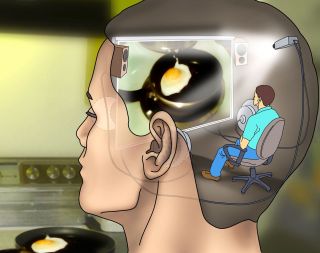
In discussions about consciousness, the homunculus is sometimes used as an illustration of an imagined observer within the brain who receives and interprets information from the senses.
This is not a scientific discovery of a little person inside the brain. In fact, simply proposing such an observer does not solve the problem, because we would then have to ask who observes the information received by that little person.
Nevertheless, the analogy points towards an important question. When the brain processes information from the eyes, ears and other senses, who is the conscious individual experiencing that information?
Science can investigate the neural processes involved in perception. But identifying those processes does not, by itself, settle the philosophical question of the identity of the experiencer.
Let modern discussions use the illustration of a "ghost in the brain" or a homunculus. The Vedic scriptures provide a definite understanding of the conscious individual. They describe that individual as the eternal spirit soul, distinct from the material body.
8. Who Are We Beyond the Body and Brain? The Vedic Understanding
After considering these philosophical questions and scientific observations, we can return to the fundamental question: Who are we? The Vedic scriptures give a clear answer to who we are according to science's unanswered questions about consciousness and personal identity.
The Vedic scriptures give a clear answer. We are not the temporary material body. We are eternal spirit souls who inhabit and use the material body.
The Soul and the Temporary Material Body
The soul is the conscious living entity. The body is the material vehicle through which the soul acts in the material world. The mind, intelligence and senses are also part of the material covering through which the soul experiences material existence.
This understanding does not depend on claiming that every mystery in neuroscience has already been solved or that every unusual medical case proves the existence of the soul. The Vedic conclusion comes from revealed spiritual knowledge. Scientific observations can nevertheless encourage us to examine the limits of a purely bodily understanding of identity.
The distinction between matter and the living entity is central to Vedic knowledge. The Bhagavad-gita explains that the body is temporary, while the soul is eternal. The living being does not cease to exist when the material body changes or is destroyed.
Therefore, our real identity is not determined by the appearance, age, condition or physical capacity of the body. We are eternal spirit souls.
For the soul there is never birth nor death. Nor, having once been, does he ever cease to be. He is unborn, eternal, ever-existing and primeval. He is not slain when the body is slain.
Bhagavad-gita 2.20 - Read on Vedabase
Atma, Soul and Rooh
We find similar terminology across different spiritual traditions. The Bible speaks of the soul, and the Quran uses the word Rooh. The Vedic scriptures describe the conscious living entity as the atma, or spirit soul.
These terms arise within different scriptural contexts, but they direct our attention towards the spiritual dimension of human identity.
9. Science and the Search for God
Scientific investigation does not have to lead us away from spiritual inquiry. The study of nature can inspire questions about the order, intelligence and ultimate source of creation. This is another important aspect of the broader question of who we are according to science and our understanding of the universe.
Scientific Discovery and Spiritual Inquiry
Several well-known scientists have expressed thoughts about God, religion and the natural world. The following quotations illustrate how some influential thinkers reflected on these questions.
The more I study nature, the more I stand amazed at the work of the Creator. Science brings men nearer to God.
Attributed to Louis Pasteur, the founder of microbiology and immunology.
It is evident that an acquaintance with natural laws means no less than an acquaintance with the mind of God therein expressed.
Attributed to James Joule, propounder of the first law of thermodynamics.
I want to know how God created this world. I am not interested in this or that phenomenon, in the spectrum of this or that element. I want to know his thoughts; the rest are details.
Albert Einstein, as reported in "A Talk with Einstein", The Listener, 1955.
God [is] the author of the universe, and the free establisher of the laws of motion.
Attributed to Robert Boyle, physicist and chemist.
The more I study science, the more I believe in God.
Attributed to Albert Einstein.
I believe that the more thoroughly science is studied, the further does it take us from anything comparable to atheism. If you study science deep enough and long enough, it will force you to believe in God.
Attributed to Lord William Kelvin.
God created everything by number, weight and measure.
In the absence of any other proof, the thumb alone would convince me of God's existence.
I have a fundamental belief in the Bible as the Word of God, written by those who were inspired. I study the Bible daily.
Attributed to Sir Isaac Newton, widely regarded as one of the greatest scientists in history.
Both religion and science require a belief in God. For believers, God is in the beginning, and for physicists He is at the end of all considerations… To the former He is the foundation, to the latter, the crown of the edifice of every generalized world view.
There can never be any real opposition between religion and science; for the one is the complement of the other. Every serious and reflective person realizes, I think, that the religious element in his nature must be recognized and cultivated if all the powers of the human soul are to act together in perfect balance and harmony. And indeed it was not by accident that the greatest thinkers of all ages were deeply religious souls.
Max Planck, Nobel Prize-winning physicist and a pioneer of quantum theory.
These statements remind us that scientific investigation and spiritual reflection need not be treated as enemies.
What Scientific Knowledge Can and Cannot Establish
The study of nature can reveal extraordinary patterns and laws. Yet, discovering how something works does not necessarily answer why it exists or what its ultimate source is. These are important questions that deserve serious consideration.
Scientific knowledge is valuable, but it should not be treated as though it has settled every question about existence, consciousness or the ultimate source of life. The limits of a particular scientific explanation should not be mistaken for proof that no spiritual reality exists.
Conclusion: We Are Eternal Spirit Souls
Our journey through philosophy, neuroscience and the study of consciousness has raised several important questions. Descartes asked us to consider the thinking self. EEG research revealed measurable electrical activity in the brain. Lorber's cases challenged simple assumptions about brain structure and intellectual ability. Pam Reynolds' reported experience raised questions about consciousness during an extraordinary medical procedure. The binding problem and the study of visual perception continue to challenge our understanding of subjective experience.
So, who are we according to science? The scientific observations discussed here reveal important relationships between the brain, body and mental activity. They also leave deeper questions about the conscious experiencer and the nature of personal identity open to philosophical and spiritual inquiry.
The Vedic scriptures answer this question directly. We are not the temporary material body. We are eternal spirit souls, distinct from matter and ultimately connected with the Supreme Lord.
True human intelligence therefore means more than understanding the physical body or developing scientific knowledge. It means inquiring into our spiritual identity, understanding our relationship with God and discovering the purpose of human life.
As Srila Prabhupada explains through the aphorism athato brahma jijnasa, the human form of life is meant for serious inquiry into the Absolute Truth. Let us use our intelligence to pursue that highest knowledge and understand who we really are.
Thank you for visiting.
If you have liked it, then please share it with your friends and loved ones. Please feel free to suggest how we can further improve our service.
For more Krishna Conscious Articles & Arts, please visit - Our Blog | Site Map
Hare Krishna!


