The year 2020 began with a crisis that brought the entire world to a standstill. The COVID-19 pandemic claimed lives, overwhelmed healthcare systems and forced millions of people into lockdown. Thousands of families lost their loved ones, while countless brave and generous individuals came forward to protect others and serve those in need.
Our heartfelt gratitude goes to the police personnel, medical professionals and essential service workers who risked their own safety to protect society. Many organisations also stepped forward to distribute food and provide relief to those struggling during this difficult period.
ISKCON India, for example, had distributed more than 12 million prasadam meals to people in need by April 17, 2020. This was one of many examples of people coming together to serve humanity during the crisis.
Read: ISKCON India distributes over 12 million prasadam meals during COVID-19
What Is a Pandemic?
One of the widely searched questions during the COVID-19 outbreak was: What is a pandemic?
A pandemic is an epidemic that spreads across a large geographical area, affecting a substantial number of people. COVID-19 became a global pandemic because the disease spread across countries and continents, affecting millions of lives.
However, COVID-19 was not the first pandemic in human history. Humanity has faced devastating outbreaks before. An article published by Visual Capitalist in March 2020 presented a historical overview of major pandemics, including the Black Death, which is estimated to have killed around 200 million people.

Read: History of Pandemics - The World's Deadliest
These figures remind us how vulnerable human civilisation can be in the face of disease. But there is another question worth asking.
What if there were a catastrophe in which billions of lives were lost every year? Would we recognise it as a crisis? Would we call it a pandemic?
Pandemic of Another World!
Consider the scale of animal slaughter carried out by human beings every year.
According to the historical estimates published by Our World in Data, the number of land animals slaughtered for meat worldwide in 2018 was approximately:
- 68.79 billion chickens
- 1.48 billion pigs
- 656.31 million turkeys
- 573.81 million sheep
- 479.14 million goats
- 302.15 million cattle
Together, these figures amount to approximately 72.28 billion animals in a single year.
That is an extraordinary number of lives taken for human consumption. To understand the scale, consider the approximate rate:
- One year: 72.28 billion animals
- One day: 198 million animals
- One hour: 8.25 million animals
- One second: 2,292 animals
These figures are based on estimates for the six categories of land animals listed above. They do not include fish or eggs, and therefore do not represent the full scale of animal use for food.
Source: Our World in Data - Meat and Dairy Production
Think about it. While we are deeply concerned about the loss of human life during a pandemic, billions of animals are being bred, confined and slaughtered every year to satisfy human demand.
They too experience fear and suffering. They too struggle to live. Yet their suffering is often treated as an ordinary part of our food system.
Even during the COVID-19 lockdown, when the world was reflecting on life, death and vulnerability, many people continued to seek out meat as before. The crisis had made us conscious of our own helplessness, but had it made us more sensitive to the helplessness of other living beings?
Human intelligence and strength should make us more responsible, not give us unlimited freedom to exploit those who cannot defend themselves.
Breath of Fresh Air
Industrialisation and modernisation have brought many conveniences to human life. Yet they have also come with serious environmental costs. Pollution, deforestation, excessive resource consumption and the destruction of natural habitats have placed enormous pressure on the planet.
We often take pride in scientific and technological progress, but progress should not be measured only by our ability to control nature. It should also be measured by our ability to live responsibly within it.
During the COVID-19 lockdowns of 2020, reduced traffic and industrial activity led to temporary improvements in air quality in several places. Images and reports of clearer skies and reduced pollution attracted widespread attention.

These changes offered us an important lesson. Human activity has a measurable impact on the natural environment. When certain activities are reduced, some forms of pollution can decline as well.
Of course, the lockdown was not a permanent solution to environmental problems. Nor did nature become free from all the damage caused by human activity. But the experience gave us an opportunity to reflect.
Once restrictions were lifted, economic and social activities resumed. The question was whether we would return to our old habits without learning anything from the crisis.
We were already witnessing irregular weather patterns, rising temperatures and destructive storms in different parts of the world. These challenges would affect not only our generation but also the generations that follow us.
If our love for our children and grandchildren is genuine, our responsibility must extend beyond providing them with comforts, gadgets, entertainment and material facilities. We must also consider the kind of world we are leaving behind for them.
Our food choices are one part of this responsibility. The production of animal-based foods, particularly meat from ruminant animals such as cattle and sheep, can have a substantial environmental footprint. It contributes to greenhouse gas emissions and can also require significant land and other resources.
Greenhouse Gas Emissions from Food
In simple terms, greenhouse gases are gases in the Earth's atmosphere that trap heat. They allow sunlight to enter the atmosphere while absorbing and re-emitting some of the heat that the Earth radiates back. This natural process keeps our planet warm enough to support life. However, an increase in greenhouse gas concentrations intensifies the warming effect and contributes to climate change.
Rising global temperatures can contribute to several serious consequences, including melting glaciers and ice sheets, rising sea levels and changes in weather patterns. The effects are complex and vary across regions, but the risks are real.
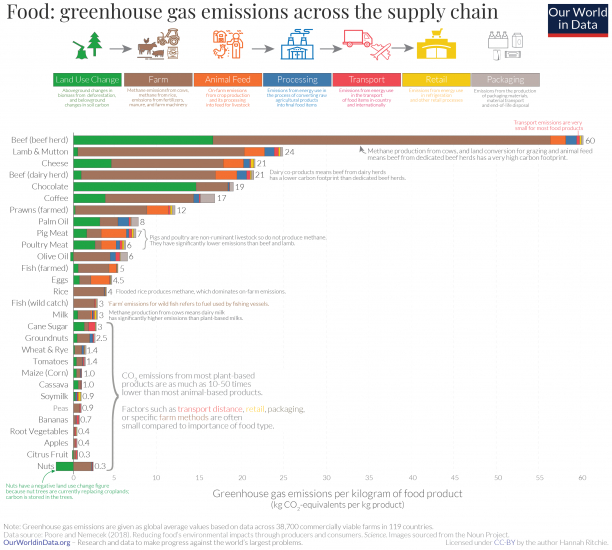
The data published by Our World in Data, drawing on research by Joseph Poore and Thomas Nemecek, highlights an important relationship between food production and environmental impact.
Every food we consume has an environmental footprint. However, that footprint varies considerably depending on the food and the way it is produced.
Our World in Data explains that plant-based foods generally have a lower carbon footprint than meat, particularly beef and lamb. This conclusion remains broadly consistent whether food is compared by weight, calories or protein content.
Consider the greenhouse gas emissions associated with producing 100 grams of protein:
- Peas: approximately 0.4 kg of CO2-equivalent emissions
- Beef: approximately 25 kg of CO2-equivalent emissions on average
That means producing the same amount of protein from beef can generate many times more greenhouse gas emissions than producing it from peas.
These are average estimates, and the actual environmental footprint can vary depending on farming practices and production methods. Nevertheless, the broader finding is clear: choosing more plant-based foods can reduce the environmental impact of our diet.
Source: Our World in Data - Environmental Impacts of Food Production
Conclusion
We live in a world where the suffering of animals is often hidden behind the convenience of a packaged product or a prepared meal. The animal is rarely seen, its life is rarely considered, and its suffering is easily forgotten.
Yet the absence of visible suffering does not mean that suffering does not exist.
We may be concerned about the future of humanity, the environment and the health of our children. But can we genuinely claim to be compassionate if our concern stops at our own species?
We do not need to wait for another global crisis to reconsider our choices. We can begin with the decisions we make every day.
Study. There are numerous credible sources available that explain the environmental consequences of different food production systems. Learn about the impact of our food choices and make informed decisions.
Reflect. Consider whether our desire for taste and temporary satisfaction justifies the suffering inflicted on other living beings.
Choose compassion. There are innumerable vegetarian dishes and plant-based sources of nutrition available. A thoughtful vegetarian diet can provide a wide variety of nutrients while reducing dependence on animal slaughter.
Let us also remember that a truly responsible lifestyle is not limited to food. It includes reducing waste, conserving resources, respecting other living beings and using our intelligence for the welfare of all.
If we genuinely love our children and grandchildren, let us leave them a world in which compassion and responsibility are not forgotten values.
May we become a healthy part of nature, rather than a source of pain and suffering for the living beings with whom we share this world.
Thank you for visiting.
If you have liked it, then please share it with your friends and loved ones. Please feel free to suggest how we can further improve our service.
For more Krishna Conscious Articles & Arts, please visit - Our Blog | Site Map
Hare Krishna!


Hare Krishna !!!
So true….we humans are the virus causing imbalance in the entire ecological sphere…when will we learn….
Nice article…!!!
We are the creators of this present crisis.
This is Gods way to put a brake on our selfish activities and its high time we realise this and change.
Extreamly powerful message packed with facts … must for everyone to read and understand and follow it
Bold article … portrayed naked truth as it is …